The first time you're handed your baby and someone says "right, he needs changing", it can feel like being asked to defuse something.
They're so small. They wriggle. The poo is a colour you didn't know existed. And everyone else in the room seems to know exactly what they're doing.
Here's the truth most experienced parents will tell you: nobody is good at this on day one. Confidence comes from doing it, badly at first and then a bit better, dozens of times a day. Within a couple of weeks, most dads can change a nappy half-asleep at 3am without a second thought.
This is a new dad's guide to nappy changes and the rest of everyday baby care: getting set up, changing a nappy step by step, preventing nappy rash, bathing, dressing, cord care, feeding support, settling and knowing when to call for help. None of it is complicated. And every one of these small jobs is also a chance to get to know your baby, so it's worth doing them yourself rather than handing them over.
Getting ready for your first nappy change
The single biggest difference between a calm nappy change and a chaotic one is preparation. Get everything within reach before you take the old nappy off.
What do you need for nappy changing? Not much:
- Nappies in the right size. Disposable nappies are quickest to learn with. Reusable cloth nappies work just as well and need a liner and a waterproof cover. Pick whatever suits your family; there's no wrong answer. If you're unsure what's worth buying, our guide to newborn nappy essentials keeps it simple.
- Something to clean with. Cotton wool and a bowl of warm water is what many midwives suggest in the first weeks. Fragrance-free, alcohol-free baby wipes are fine too. Our comparison of water wipes vs baby wipes explains the difference.
- A changing mat or towel. The floor is the safest place to change a baby, because they can't fall off it.
- Nappy bags or a lidded bin for the dirty nappy and used wipes.
- A clean set of clothes. Leaks happen, especially in the early weeks.
- Barrier cream, if needed. Useful if the skin looks red, not essential at every change.
Setting up a nappy changing station
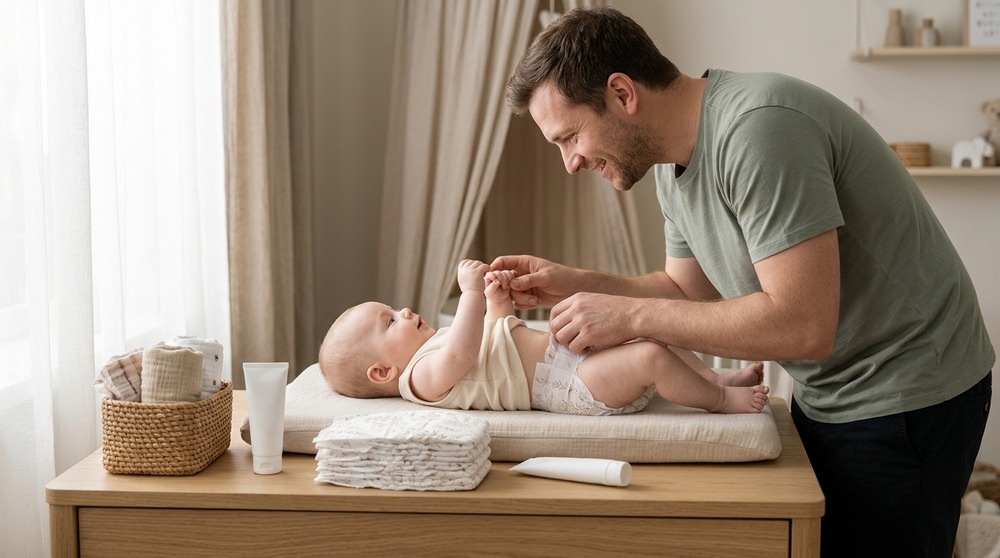
Pick one spot at home, a changing table, a chest of drawers with a mat or simply a corner of the floor, and keep a basket of supplies there: a stack of nappies, wipes or cotton wool, bags, a spare vest and sleepsuit, and cream. A second mini-kit downstairs saves a lot of stair climbing. Some parents keep everything together in a ready-made changing essentials bundle, but a basket works just as well.
Safety first: Never leave your baby alone on a changing table, bed or sofa, not even for a second to grab a wipe. Babies can roll without warning, even very young ones. If you're using a raised surface, keep one hand on your baby. If you have to step away, take your baby with you or put them on the floor.
Step-by-step guide: how to change a nappy
Here's how to change a nappy, using a disposable nappy as the example. The same basic steps apply to how to change a newborn nappy, just with a bit more care around the cord stump (more on that below).
- Wash and dry your hands.
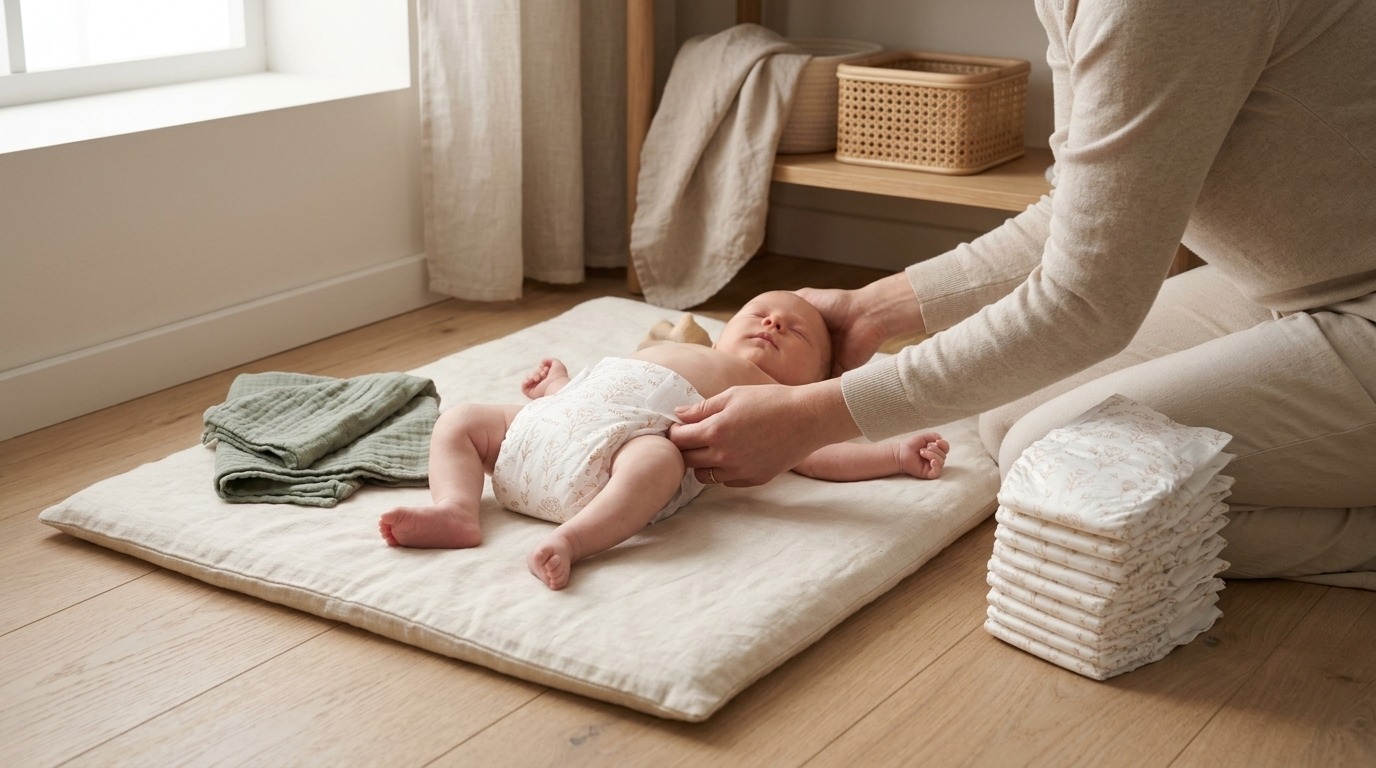
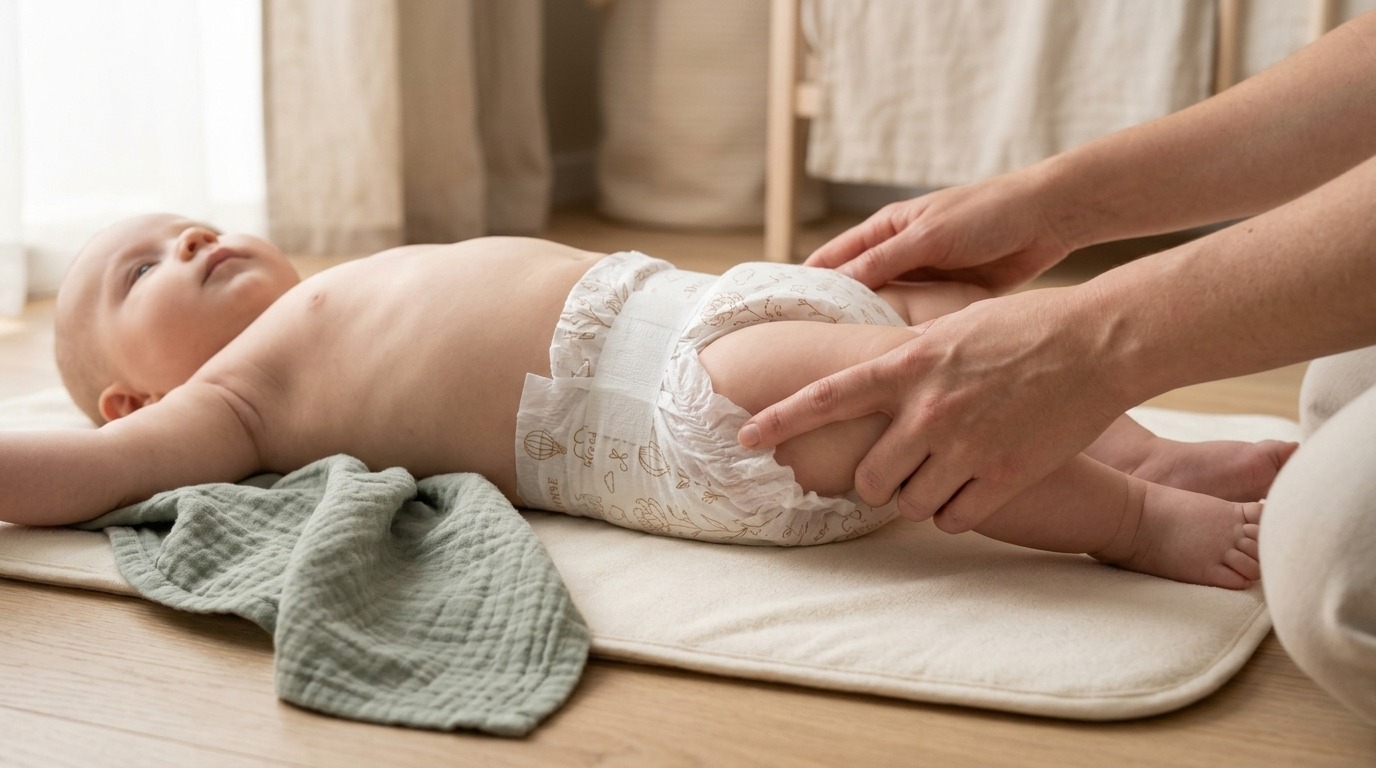
- Lay your baby on their back on a clean mat or towel, with everything you need within reach.
- Open the dirty nappy. If there's poo, use the clean front part of the nappy to wipe most of it away in one downward sweep, then fold the nappy under your baby's bottom.
- Clean gently from front to back, using damp cotton wool or a wipe. This is especially important for girls, to keep bacteria away from the vagina and urethra.
- Check the skin folds at the tops of the legs and around the bottom. Wipe gently; don't rub or scrub.
- Let the skin dry, or pat it dry with a soft cloth. A minute or two without a nappy is good for the skin if the room is warm.
- Apply a thin layer of barrier cream if the skin looks red or sore.
- Slide a clean nappy underneath. Lift your baby's bottom gently by holding the ankles or by rolling them slightly to one side. Never pull the legs up high. The back of the nappy (the side with the tabs) goes under your baby, roughly level with the belly button.
- Bring the front up between the legs and fasten the tabs. It should be snug, not tight. You should be able to slip two fingers between the nappy and your baby's tummy.
- Pull out the leg cuffs. The frilly edges around the legs should sit outwards, not tucked in. Tucked cuffs are the classic cause of leaks.
- Bag and bin the dirty nappy. Tip any solid poo into the toilet first if you can.
- Wash your hands again.
Changing a baby boy's nappy
Boys have perfect aim when the cold air hits. Lay a clean wipe or the front of the fresh nappy loosely over the penis while you clean. Wipe around the penis and testicles gently, but don't pull back the foreskin. In babies it doesn't retract, and forcing it can cause damage. When you fasten the new nappy, point the penis downwards to help prevent leaks out of the top.
Changing a baby girl's nappy
Always wipe from front to back, using a fresh wipe or piece of cotton wool for each stroke. Gently clean the outer folds, but there's no need to clean inside the labia. In the first few days you might see a little white discharge or even a small amount of blood-tinged discharge. This is usually caused by mum's hormones and settles on its own, but mention it to your midwife if you're unsure.
Cleaning after a poo
Use the old nappy to remove the worst, then work from the cleanest areas towards the messiest. Check every crease: thigh folds and the back are favourite hiding places. Newborn poo is sticky and dark at first (meconium), then turns yellow and seedy if breastfed or paler and firmer if formula-fed. Warm water loosens the sticky stuff better than dry wiping.
Changing a wriggly or unsettled baby
Newborns tend to protest because they're cold, not because they hate you. Keep the room warm and cover your baby's tummy with a muslin. Older babies roll and kick. Give them something to hold, sing or pull faces, and work quickly. Once your baby can stand, nappy pants can make changes easier, as you can change them standing up.
Checking the nappy fits
A well-fitting nappy is snug at the waist and legs without leaving deep red marks. If you're seeing regular leaks, red marks, or the tabs barely reach the middle, it's probably time for the next size. Go by the weight guide on the pack rather than your baby's age. If leaks keep coming from the legs or back, our guide to nappy leaking at the legs or back runs through the usual fixes.
How often should you change your baby's nappy?
Often, especially at first. NHS guidance suggests expecting around 10 to 12 changes a day in the early weeks, dropping to roughly 6 to 8 a day as your baby gets older. Treat those numbers as a rough picture, not a rule. Every baby is different.
In practice, nappy changing tips for dads come down to a few habits:
- Check regularly. Have a quick feel or look every couple of hours while your baby is awake.
- Change wet nappies promptly and dirty nappies as soon as you reasonably can. Poo against the skin is the main trigger for soreness.
- Use feeds as a reminder. Many babies poo during or just after a feed, so changing after feeding often makes sense. If your baby falls asleep at the breast or bottle, you might change before the feed or halfway through instead.
- Put a fresh nappy on at bedtime. It'll be on for longer stretches overnight.
- At night, change when needed, not on a timer. A poo needs changing. A slightly wet nappy on a sleeping baby usually doesn't, especially once they're a bit older.
Newborns need more changes because they feed little and often, and their bladders are tiny. Wet and dirty nappies are also one of the easiest ways to see that your baby is feeding well (see When should a new dad ask for help? below). For a fuller breakdown by age, read how often you should change a baby's nappy. And if you want to know what you're in for, here's how many nappies a baby uses in the first year.
Understanding nappy rash and how to prevent it
Nappy rash is very common, and most babies get it at some point. It usually shows up as red, sore-looking or blotchy skin on the bottom and genitals. On darker skin it can look darker, grey or purplish rather than red. Your baby may be uncomfortable or cry more at changes.
The usual causes are simple: skin left in contact with wee or poo for too long, rubbing from the nappy, not drying properly, or irritation from soap, bubble bath or fragranced, alcohol-based wipes.
Prevention is mostly about the basics you're already doing:
- Change wet and dirty nappies promptly.
- Clean gently with water or fragrance-free wipes, and pat dry rather than rubbing.
- Give your baby some nappy-free time on a towel when it's warm enough.
- Apply a thin layer of barrier cream if the skin starts to look pink. A thin layer is enough; you don't need to plaster it on. Some parents prefer a protective spray such as our diaper change spray, which works on the same principle of keeping moisture off the skin.
- Skip talcum powder, perfumed products and anything with alcohol.
Most mild nappy rash clears within a few days with this kind of care. Speak to your health visitor, pharmacist or GP if the rash isn't improving after a few days, is bright red with spots spreading into the skin folds, has blisters, open sores or pus, seems very painful, or if your baby has a fever or seems unwell. Our in-depth guide to nappy rash causes, treatment and prevention goes into more detail.
Everyday baby care every new dad should know
Nappies are just one part of it. Here's the rest of newborn baby care for dads, in plain terms.
Cleaning your baby's face and hands
Milk and dribble collect around the mouth, under the chin and in neck folds, and newborns' hands are always curled and fluffy. A quick daily wipe with cotton wool and warm water is all most babies need. For the eyes, use a fresh piece of cotton wool for each eye and wipe from the inner corner outwards. Only clean the outside of the ears, never inside. This daily routine has a name: top and tailing a newborn, and it's a great job to own.
Bathing your baby safely
You don't need to bath a newborn every day. Two or three times a week is plenty, with a top-and-tail or cloth wash in between. Many parents wait until the cord stump has dropped off before the first full bath.
Before you start:
- Warm the room and lay out a towel, a clean nappy and clothes.
- Run the water first, cold then hot, and mix it well. Check it with your wrist or elbow: it should feel warm, not hot. Around 37°C is about right. A bath thermometer helps.
- Keep it shallow: a few centimetres is enough.
During the bath, support your baby's head and neck with one hand and arm, and wash with the other. Keep your baby's face clear of the water at all times. Then lift them out onto the towel and pat dry, paying attention to the neck, armpits, groin and other skin folds.
Never leave your baby alone in or near water, not even for a moment to answer the door or grab a towel. Babies can drown in a few centimetres of water, silently and quickly. If you have to leave, take them with you.
In the first month, plain water is best. After that, a little mild baby cleanser can be used if you want. Our guide to baby bath products explains what's worth having and what isn't, and how often to bathe a baby covers frequency by age.
Caring for your baby's skin
Newborn skin is thin and still developing. It often peels or looks dry in the first weeks, which is normal. Keep products to a minimum and choose ones that are fragrance-free and made for babies. If skin looks dry after the first month, a plain moisturiser or gentle baby body lotion after the bath can help.
For more, see our baby skincare routine by age, or read about dry skin in babies and signs of sensitive skin. If a rash or patch doesn't settle, get it checked rather than trying lots of products.
Dressing and undressing your baby
Newborns seem to have more joints than you'd expect, and none of them help. A few tips:
- Pick easy clothes. Envelope necks, poppers down the front and sleepsuits that open all the way make life much easier.
- Bring the sleeve to the arm, not the arm to the sleeve. Gather the sleeve up, reach through it, gently hold your baby's hand and slide the fabric over.
- Stretch necklines wide and go over the face first, then the back of the head.
- Never pull arms or legs firmly. Move limbs gently within their natural range.
- Dress for the room, not the season. Babies can overheat. A rough guide is one more layer than you're wearing. Feel the back of the neck or tummy: warm is fine, hot or sweaty means remove a layer. Hats are for outdoors, not indoors or for sleep.
Umbilical cord stump care
The cord stump usually dries and drops off within a week or two. Until then:
- Keep it clean and dry. If it gets dirty, clean around it with plain water and pat dry.
- Fold the top of the nappy down below the stump so it can air.
- Don't pull it off, even if it's hanging by a thread, and don't apply powders or creams unless a healthcare professional tells you to.
- Follow any specific advice from your midwife.
Contact your midwife, health visitor or GP if you see redness spreading onto the tummy, swelling, pus, a foul-smelling discharge, bleeding that doesn't stop, or if your baby has a fever.
Feeding, burping and settling your baby
Whether your baby is breastfed, formula-fed or both, there's plenty a dad can do around feeds.
If your partner is breastfeeding, your job is support, not supervision. Bring the baby to her, fetch water and snacks, sort the pillows, take over the burping and changing afterwards, and handle the settling so she can rest. Practical help like this makes a real difference to how long and how comfortably breastfeeding goes.
If you're giving a bottle, make up formula exactly as the instructions on the pack say, using freshly boiled water that has cooled for no more than 30 minutes, so it's still at least 70°C. Test the temperature on your inner wrist before feeding. Hold your baby fairly upright, with their head supported, and tip the bottle just enough to keep milk in the teat. Let your baby take breaks. Never prop a bottle and leave your baby to feed alone.
Burping. Try holding your baby upright against your shoulder, or sitting on your lap leaning slightly forward with your hand supporting their chin and chest. Gently rub or pat their back. Not every baby needs to burp after every feed, so if nothing comes up after a few minutes and they seem comfortable, that's fine. Keep a muslin handy.
Reading cues. Early hunger signs include stirring, turning the head and opening the mouth (rooting), and sucking on hands. Crying is a late sign. Tiredness often shows as staring into space, yawning, jerky movements, rubbing eyes or fussing.
Settling. Holding your baby close, gentle rocking, walking, shushing, talking or singing softly all help. Skin-to-skin on your chest is very calming for many babies. Some days nothing works, and that's normal too.
Never shake a baby. Shaking can cause serious brain injury. If the crying is getting to you, put your baby down safely on their back in their cot, leave the room for a few minutes, take some deep breaths and come back when you're calmer. It's always OK to ask someone else to take over.
Building a daily baby care routine as a dad
Newborns don't follow timetables, so don't try to force one. What helps is a loose rhythm that you and your partner share. Here's what an everyday baby care routine might look like:
- Morning: nappy change, fresh vest and clothes, a quick face and hand wipe.
- Around feeds: bring the baby, sort the bottle or fetch water, burp, change the nappy afterwards.
- Through the day: check the nappy every couple of hours; wind down after feeds with a cuddle or some quiet time.
- Awake time: talking, singing, faces, a bit of tummy time when your baby is ready. Even a few minutes counts.
- Bath time: two or three evenings a week, often a nice job for dad.
- Bedtime: fresh nappy, sleepsuit, dim lights, feed and settle. Always put your baby down on their back in their own cot or Moses basket.
- Night: agree who does what. For example, one of you feeds and the other changes and resettles, or you take turns by night.
As your baby grows, feeds space out and sleep gets a little more predictable. The routine will change with it, and that's how it's supposed to work.
Common nappy-changing mistakes new dads should avoid
Everyone makes these. Here's how to fix them:
- Starting before you're ready. Get the nappy, wipes and cream out first. Opening a fresh nappy one-handed while holding two legs in the air is a skill you don't need.
- Leaving the baby on the changing table. Even "just for a second". Take your baby with you, or change on the floor.
- Fastening the nappy too tightly. Aim for two fingers' room at the waist. Too tight rubs and leaves red marks.
- Forgetting the leg cuffs. Run a finger around each leg to pull the frills out. This fixes a surprising number of leaks.
- Wiping back to front. Always front to back, especially for girls.
- Scrubbing. Gentle wiping and patting dry. Babies' skin doesn't need elbow grease.
- Using too much product. A thin layer of barrier cream, only when needed. More isn't better.
- Ignoring a rash that isn't getting better. If it hasn't improved within a few days, get advice.
- Assuming every cry means hunger. It might be a wet nappy, wind, being too hot or cold, tiredness, or just wanting to be held. Run through the list.
- Trying to be perfect. You'll put a nappy on back to front. You'll get weed on. It doesn't matter. Your baby won't remember, and you'll get faster.
How everyday baby care helps dads bond with their baby
Nappy changes aren't glamorous, but they add up to hours of close, face-to-face time. That's what bonding is made of.
- Skin-to-skin. Holding your baby against your bare chest is calming for both of you, and it isn't just for mums.
- Talk and sing during changes. Narrate what you're doing, pull faces, copy their noises. Babies love voices, and yours will become familiar quickly.
- Eye contact. Newborns see best at around 20 to 30 cm, roughly the distance from a changing mat to your face.
- Respond to cues. Picking your baby up when they cry, noticing when they've had enough, and learning their signals is called responsive parenting. It won't spoil them. It teaches them they're safe.
- Share the big jobs. Bath time, bedtime and night feeds aren't "helping out". They're parenting.
And if you don't feel an overwhelming rush of love straight away, you're not doing anything wrong. For lots of parents, the bond builds gradually, through ordinary days and repetition. The more you do, the more natural it feels.
When should a new dad ask for help?
Asking for help is what responsible parents do. Your midwife, health visitor, GP or pharmacist would much rather hear about something small than miss something important. Get in touch if you notice:
- nappy rash that's severe, spreading or not improving after a few days
- unusual skin changes, blisters or signs of infection
- worries about feeding, or your baby seems less interested in feeds
- fewer wet nappies than expected. After the first few days, NHS guidance says a baby who is feeding well usually has at least six heavy, wet nappies a day
- dark urine, a dry mouth or a sunken soft spot on the head, which can be signs of dehydration
- problems with the umbilical cord: spreading redness, pus, a bad smell or bleeding
- your baby seems floppy, very sleepy, unusually irritable or just "not right"
- any uncertainty about how to do something safely
Fever in young babies is urgent. If your baby is under 3 months old and has a temperature of 38°C (100.4°F) or higher, get medical help straight away: call your GP or NHS 111 (or your local equivalent). If your baby is struggling to breathe, is floppy or unresponsive, has a rash that doesn't fade when you press a glass against it, or you're very worried, call 999 or your local emergency number.
You know your baby better than anyone. If something feels wrong, trust that and get it checked.
Essential nappy-changing and baby care checklist for new dads
You don't need every gadget in the baby shop. These are the basics that actually get used.
Nappy-changing essentials
- Nappies in the correct size: taped nappies for newborns, nappy pants later if you prefer
- Cotton wool and warm water, or fragrance-free baby wipes
- A changing mat or towel
- Nappy bags or a lidded bin
- A spare vest and sleepsuit
- A suitable barrier cream
Everyday care essentials
- Soft baby towels and washcloths
- A gentle baby cleanser, if needed after the first month
- Comfortable clothes with poppers or envelope necks
- A good stack of muslin cloths
- A baby thermometer
- A safe sleeping space: a cot or Moses basket with a firm, flat mattress and nothing else in it
For the bigger picture, our newborn essentials checklist for the first month covers sleep, feeding, clothing and travel too.
This article is for general information only and doesn't replace advice from your midwife, health visitor, GP or other qualified healthcare professional. If you're worried about your baby's health, contact a professional or, in an emergency, call 999 or your local emergency number.
Frequently asked questions
Get everything ready first, lay your baby on a mat on the floor, open the nappy and wipe front to back with warm water and cotton wool. Pat dry, slide a fresh nappy underneath, fold it below the cord stump, fasten it snugly and pull out the leg cuffs. Then wash your hands.
As often as the baby needs it, the same as anyone else. In the early weeks that's around 10 to 12 times a day, dropping to roughly 6 to 8 as your baby gets older. Change dirty nappies as soon as you can.
Both work. Many parents change after a feed, because babies often poo then. If your baby gets very sleepy on the breast or bottle, changing before or halfway through can wake them enough to finish.
Cover the penis loosely with a wipe or the clean nappy while you work, move quickly, and point the penis downwards before you fasten the fresh nappy.
Wipe from front to back, using a fresh wipe or piece of cotton wool each time. Clean the outer folds gently, but there's no need to clean inside.
Yes, if they're fragrance-free and alcohol-free. Many parents use cotton wool and warm water in the first weeks, especially for the face, and switch to wipes later or for outings.
Change wet and dirty nappies promptly, clean gently, dry the skin well, give nappy-free time, and use a thin barrier cream if the skin looks red. Avoid fragranced products and talcum powder.
Two or three times a week is enough. Clean the face, hands, neck and nappy area daily in between.
Stay calm, talk or sing, keep your baby warm with a muslin over the tummy, and work quickly. If your baby seems in pain at every change, look for nappy rash and ask your health visitor.
By doing it. Take on whole jobs, such as every evening bath or every night-time change, rather than waiting to be asked. Ask the midwife to show you in the first days, and don't worry about getting it perfect.