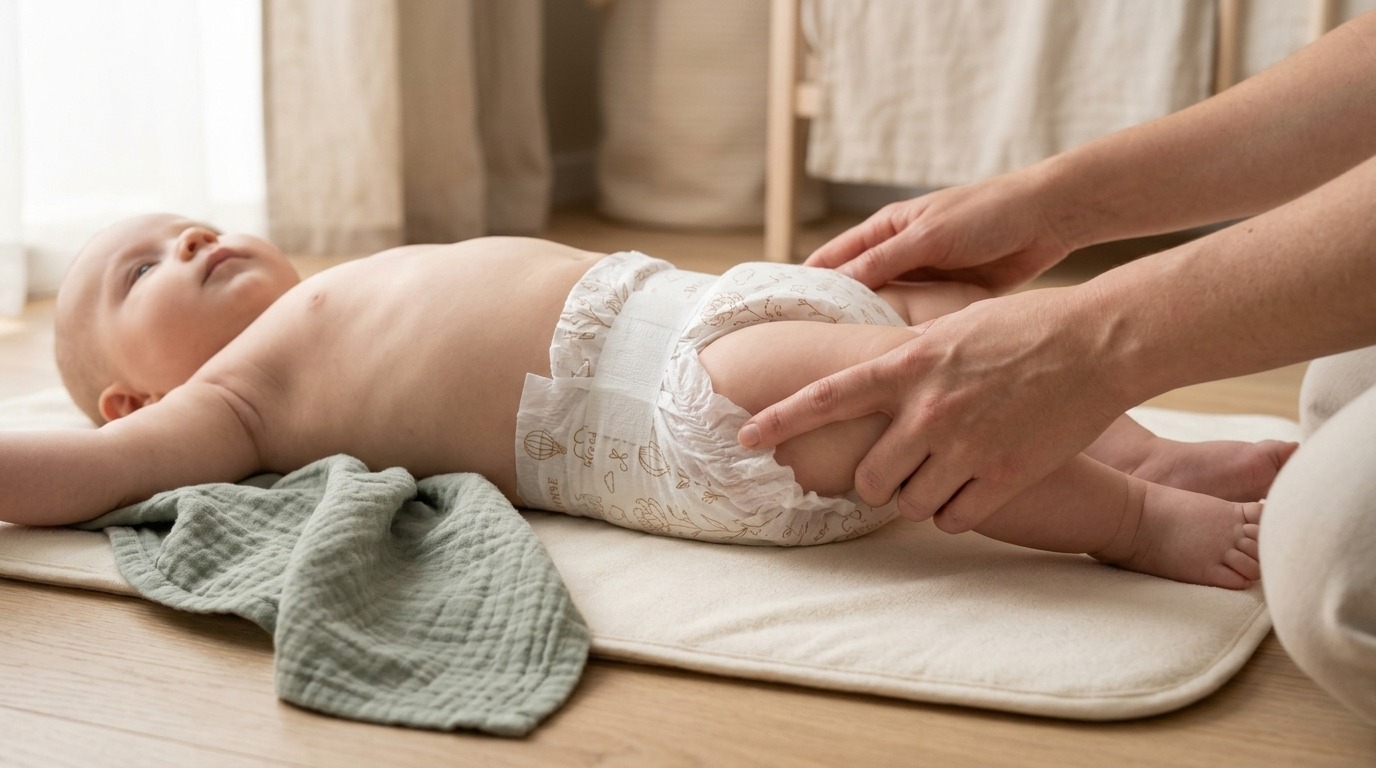
You changed the nappy twenty minutes ago.
It looked fine. Now there's a damp patch spreading down one leg of the sleepsuit, or a wet stripe up your baby's back, and you're reaching for the spare clothes again.
If this keeps happening, you're in good company. Nappies leak for all sorts of reasons, and most of them have nothing to do with doing anything wrong.
Here's the short answer. A nappy leaking at the legs or back usually comes down to one of four things: the size isn't right for your baby's shape, the leg cuffs or waistband aren't sitting where they should, the nappy is full, or the nappy's absorbency doesn't match how much your baby wees. The quickest way to a fix is to notice where the leak starts, then check fit, absorbency and the timing of the last change. Changing brand can wait until you've tried that.
This article gives general information. It doesn't replace advice from your midwife, health visitor, pharmacist or GP.
Why is your baby's nappy leaking?
Where the wet patch appears is a useful clue. It isn't proof of a single cause, though, and two problems often overlap. A slightly loose nappy that's also very full will leak sooner than either problem alone.
Use the table below as a starting point for troubleshooting. It's not a way to diagnose anything about your baby's health.
| Where the leak happens | Possible cause | First thing to check |
|---|---|---|
| Around the legs | Leg cuffs tucked in, gaps at the thighs, nappy too big or off-centre | Run a finger round each leg opening and pull the cuffs outwards |
| At the back or up the back | Back of the nappy sitting too low, not enough coverage, runny poo | Where the back waistband sits before you fasten the tabs |
| Around the waistband | Waist too loose, nappy fastened unevenly, a full nappy pushing upwards | Whether the tabs are level and the waist sits snugly |
| After long sleeps | Nappy saturated, absorbency too low for a long stretch | How long since the last change and how heavy the nappy feels |
| Soon after a fresh nappy | Fit or positioning problem rather than fullness | Cuffs, centring and size, straight after fastening |
Nappy leaking at the legs: causes and fixes
Leg leaks are the most common complaint, and the fixes are usually quick.
The leg cuffs are tucked in
Most disposable nappies have elasticated leg cuffs, often with a soft ruffle, designed to sit around the top of your baby's thighs and act as a barrier. If a cuff gets folded inwards while you fasten the nappy, wee can run straight past it.
After fastening, run a finger around each leg opening and gently pull the cuff out so it lies against the skin. Moise's own fitting instructions, for example, say to smooth the leg cuffs outwards once the tabs are done. Cuff design varies between brands, so follow the instructions on your pack.
The nappy is too big
A nappy that's too large leaves gaps, and gaps are where leaks start. Signs include loose leg openings you can easily fit several fingers into, the absorbent pad bunching between the legs, or a waistband that won't sit securely however you fasten it.
Use the manufacturer's size guide as a starting point, then judge the fit on your baby. Weight is only part of the picture. Two babies at the same weight can have quite different thighs and tummies.
The nappy is too small
A nappy that's too small may not cover your baby's bottom properly and can dig in around the thighs. It also holds less, so it may fill faster than your baby needs.
It may be worth trying the next size if you notice several of these together:
- gaps that keep appearing even when the cuffs are positioned correctly
- the nappy no longer covers the whole bottom
- the nappy is heavily soaked well before the usual change
- tabs that only just reach, or red marks that linger after the nappy comes off
One leak on its own doesn't mean your baby has outgrown a size. Check the fit first.
The nappy is not centred properly
If the nappy goes on slightly crooked, one leg opening ends up looser than the other. You'll often see leaks on one side only.
Lay the nappy so the absorbent middle sits centrally under your baby's bottom, with roughly equal amounts of nappy on each side. Bring the front up evenly, then fasten both tabs at the same height, following your nappy's instructions.
Your baby's body shape affects the fit
Some babies have chunky thighs and a slim waist. Others are long and lean. A nappy that fits one baby beautifully can gap on another baby of a similar weight.
If you've checked the size, cuffs and centring and still see leg leaks, a different cut or style may simply suit your baby better. That's about shape, not quality.
Nappy leaking at the back or up the back
Back leaks tend to show up during sleep, after a big poo, or when a baby spends a lot of time lying down or leaning back in a seat.
The back waistband is too low
The back of the nappy needs to sit high enough to cover the whole bottom. If you slide the nappy under your baby and it ends up low, there's less material between the bottom and the waistband, and wee or poo can escape upwards.
Before fastening, check where the back edge sits. Moise's instructions, for instance, describe sliding the nappy under until the waistband sits at navel height. Other brands may describe it differently, so go by your own pack.
The nappy is too small or lacks coverage
A nappy that barely covers the bottom has little margin when your baby moves, bends or sleeps curled up. If the back edge sits low even when you position it carefully, look at the size guide and the overall fit before deciding to size up.
The nappy is saturated
Every nappy has a limit. Once it's heavily soaked, extra wee has nowhere to go and tends to escape at the waist or back, especially if your baby is lying down.
Think about how long it's been since the last change, how much your baby tends to wee, and how absorbent that nappy is. There's no single number of hours that's right for every baby and every nappy. Your baby's age, skin and comfort matter more than a fixed rule.
Poo is escaping up the back
Loose or runny poo, which is common in young breastfed babies, can travel up the back very quickly. A "poonami" is far more likely when the back is sitting low, the tabs are loose or the nappy is already full.
Check the back coverage, the fastening and the size. Clean poo away as soon as you notice it, because contact with poo is one of the causes of nappy rash listed by the NHS.
Runny poo isn't the same as diarrhoea in every baby, but some symptoms need a health professional. Get medical advice if your baby has diarrhoea that doesn't settle, blood in their poo, or signs of dehydration such as fewer wet nappies. The NHS advice on diarrhoea and vomiting lists fewer wet nappies in a child under 5 as a reason to get help.
How to check whether your baby's nappy fits correctly
A ten-second check at each change catches most fit problems before they become leaks. Run through this list once the nappy is on:
- The nappy is centred and covers your baby's whole bottom.
- The waistband sits comfortably where the manufacturer's instructions say it should.
- Both fastening tabs are secure and at the same height.
- The leg cuffs sit the way the manufacturer intends, usually pulled outwards rather than tucked in.
- There are no obvious gaps around the thighs.
- Nothing is digging in, and there are no marks that stay after the nappy comes off.
- Your baby can kick, bend and move comfortably.
- The size matches both the size guide and how the nappy actually looks on your baby.
A common reaction to leaks is to fasten the nappy tighter. It rarely helps and can make your baby uncomfortable. The NHS advises against putting nappies on too tightly because it can irritate the skin. Its Start for Life guidance suggests a snug fit round the waist and legs, with room to run two fingers between the nappy and your baby's tummy.
Should you size up or size down to stop leaks?
Sometimes a different size is the answer, and sometimes a better fit in the current size does the job. Look at the signs together rather than reacting to one.
| Sign | What it may mean | What to try |
|---|---|---|
| Gaps around the legs | Nappy may be too big, or cuffs tucked in | Pull the cuffs out and re-centre; if gaps remain, check the size guide for a smaller size |
| Tabs hard to fasten | Nappy may be too small | Check the weight range and coverage; try the next size if the tabs barely meet |
| Leaks continue despite correctly positioned cuffs | Size, cut or absorbency may not suit your baby | Review size first, then consider a different style or a more absorbent nappy |
| Waistband sits too low or doesn't cover the bottom | Positioning, or nappy too small | Reposition the back higher; size up if coverage is still short |
| Nappy often saturated before the usual change | Absorbency too low for your baby, or a size too small | Change a little sooner, or try the next size or a more absorbent option |
| Discomfort or lasting red marks | Nappy too small or fastened too tightly | Loosen the tabs slightly; if marks persist, try the next size |
Weight ranges on a pack are a starting point. Fit, your baby's shape, absorbency and the manufacturer's instructions all count too. Ranges also overlap between sizes, so a baby at the top of one range may fit either size depending on their build.
How to prevent overnight nappy leaks
Night-time is when many parents notice leaks most. Your baby goes longer between changes and lies still for long stretches, often on their back, which puts the back of the nappy under more pressure.
Start bedtime with a fresh nappy
A clean nappy at bedtime gives your baby a dry start for the longest stretch of the day. The NHS includes this in its newborn guidance, noting that a bedtime nappy will be worn for longer.
A fresh bedtime nappy doesn't replace later changes. Change it during the night if there's poo in it, if it's leaking, if your baby seems uncomfortable, or if their skin is sore. Our guide to changing a nappy at night without waking your baby covers how to do that calmly.
Consider an overnight nappy
Some nappies are designed with extra absorbency for longer stretches. They can help babies who regularly soak through at night. Plenty of babies do fine in their normal nappy, though, and an overnight nappy won't guarantee a dry night.
Check the fit before sleep
Give the bedtime nappy a little more attention than a daytime change. Check that the back sits high enough, the tabs are level and the leg cuffs are out. These small details matter more over ten hours than over two.
Avoid over-tightening the nappy
Fastening the nappy tighter for the night isn't a reliable fix. It can leave marks and make your baby uncomfortable, and a nappy that's too tight can still leak if it's full. Aim for snug, not tight.
Check the timing of changes
If the nappy is heavily soaked by the time you change it, it may need changing a little sooner, perhaps at a night feed. Base this on your baby's age, skin and feeding pattern rather than a rigid schedule. Newborns usually need more night changes than older babies.
Never cut back on feeds or drinks to reduce night-time wee. Babies need their milk, and fewer wet nappies can be a sign a baby isn't getting enough. If you're unsure what's normal for a young baby, our guide to how many wet nappies a newborn should have each day explains more.
Disposable nappies, reusable nappies and different nappy styles
The principles are the same across nappy types. Fit, absorbency and timing matter. What you check differs a little depending on what you use.
Disposable nappies
With disposables, the usual suspects are size, leg cuffs, the position of the back and fastening. If those are right and leaks continue, absorbency is the next thing to look at. Some brands offer different absorbency levels or overnight versions.
Reusable cloth nappies
Reusable systems vary a lot, so follow the manufacturer's fitting and care instructions for yours. Things that commonly affect leaks include:
- how snugly the nappy fits around the legs and waist
- how many absorbent inserts or boosters you use, and where they sit
- whether any insert or fabric is poking out beyond the waterproof layer, which can wick moisture onto clothes
- the condition of the leg elastics, which can slacken over time
- whether the waterproof outer layer is intact
The NHS also suggests using dry nappy liners and changing them often if you use cloth nappies, which helps keep skin drier.
Nappy pants
Pull-up nappy pants suit some older babies and toddlers who wriggle or stand during changes. They still need the same checks: the waistband pulled fully up at the front and back, and the leg cuffs not folded in. Neither style is automatically better at preventing leaks. Our comparison of nappy pants and taped nappies explains the differences.
What if the nappy is leaking despite the correct fit?
If you've checked the size, cuffs and coverage and the leaks keep coming, work through these one at a time:
- Are you changing the nappy before it gets heavily saturated?
- Does the nappy's absorbency suit how much your baby wees?
- Are the leg cuffs and waistband in the right place at every change, including rushed ones?
- Has your baby moved towards the top of the current size range?
- Would a different cut or style suit your baby's shape better?
- For reusables, are the inserts, elastics and waterproof layer still doing their job?
Change one thing at a time and give it a few days. If you swap brand, size and bedtime routine all at once, you won't know which change helped.
Leaks don't automatically mean a product is faulty, and they certainly don't mean you're getting it wrong. Expensive nappies aren't the default fix either. Most of the time, small adjustments sort it out.
Can nappy leaks cause nappy rash?
Leaks themselves don't cause rash, but what often sits behind them can. The NHS lists long contact with pee or poo, not changing the nappy often enough and the nappy rubbing against the skin among the causes of nappy rash. A nappy that's full, loose or leaking can involve all three.
To look after your baby's skin:
- Change dirty nappies promptly, and wet ones before they're saturated.
- Clean the area gently, with water or fragrance-free and alcohol-free baby wipes.
- Pat the skin dry rather than rubbing.
- Avoid unnecessary fragranced products, soaps and bubble bath on the nappy area.
- Use a suitable barrier cream when your baby's skin needs it. A pharmacist can recommend one.
- Give some nappy-free time when it's warm and safe to do so.
See a health visitor or GP if the rash doesn't go away, gets worse or spreads, if your baby has a high temperature, or if they seem very uncomfortable. Persistent skin problems can have causes beyond a poorly fitting nappy, such as an infection, so let a professional take a look rather than guessing. Our full guide to nappy rash causes, treatment and prevention goes into more detail, and you'll find step-by-step tips on cleaning your baby's nappy area.
Find the cause before changing everything
Nappy leaks are frustrating, but they're usually fixable with small changes. Start here:
- Notice where the leak happens: legs, back, waist or overnight.
- Check the fit, size, leg cuffs and back coverage.
- Ask whether the nappy is simply getting too full before it's changed.
- Look at overnight absorbency if leaks mainly happen during sleep.
- Clean the skin gently and deal with any irritation early.
- Get professional advice if your baby has a rash that won't settle or seems unwell.
Occasional leaks happen to every family, even with a well-fitting nappy. You don't need to overhaul your whole routine or buy a cupboard full of new products. Change one thing, see what helps, and go from there.
Frequently asked questions
Usually because of a gap at the thigh. The leg cuffs may be tucked in, the nappy may be too big or off-centre, or it may not suit your baby's shape. Pull the cuffs out and re-centre the nappy before changing size.
Most often the back of the nappy is sitting too low, the nappy is full, or there's runny poo. Position the back higher before fastening and check the size gives enough coverage.
Not straight away. Check cuffs, centring and back coverage first. Size up if the tabs barely meet, the bottom isn't covered or the nappy fills quickly, and your baby is near the top of the weight range.
Yes. A nappy that's too big leaves gaps at the legs and waist, and wee escapes through them. A bigger nappy isn't automatically a better barrier.
On most disposables, outwards against the skin, not folded in. Run a finger round each leg after fastening to pull them out, and follow the instructions for your brand.
Because the nappy is worn longer and your baby lies still for long stretches. A full nappy plus the pressure of lying down makes back and waist leaks more likely. A fresh bedtime nappy, a careful fit and, if needed, more absorbency can help.
It can help if your baby regularly soaks through at night. It's not necessary for every baby, and no nappy guarantees a leak-free night. Get the fit right first.
Make sure the back of the nappy covers the whole bottom, fasten the tabs evenly and check the size. Change the nappy as soon as you notice poo. Runny poo can still escape occasionally, especially with young babies.
Not necessarily. Leaks depend on size, fit and absorbency more than on whether a nappy has tabs or pulls up. Some babies fit one style better than the other.
Yes. Common causes include a loose fit at the thigh, slack leg elastics, too little absorbency, or an insert peeking out beyond the waterproof layer. Follow your system's fitting guide.
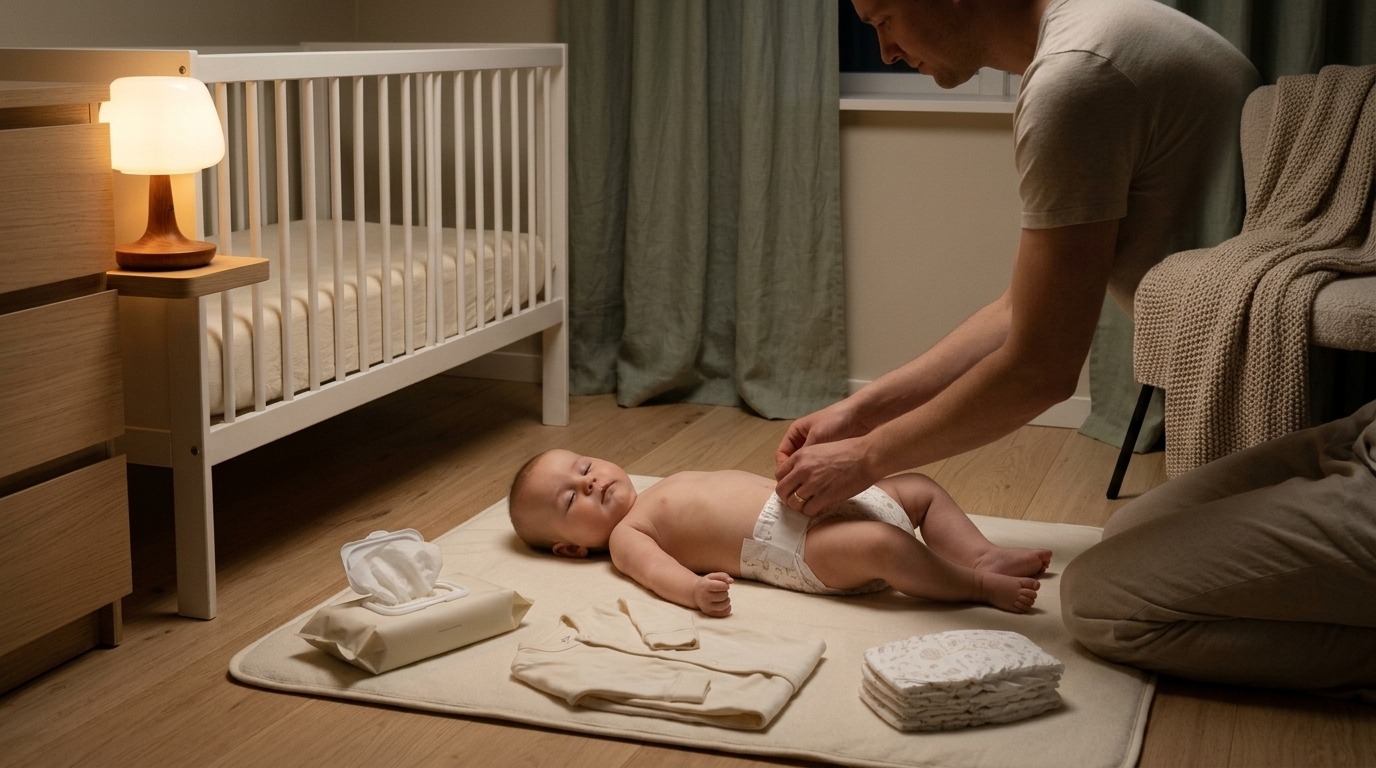
If the nappy has leaked onto their clothes or bedding, change the nappy and anything damp. Keep the light low and the change quiet. Then lie your baby back down on their back in their own cot or Moses basket.
Leaks alone rarely need a doctor. See a health visitor or GP if a nappy rash doesn't go away, gets worse or spreads, or if your baby has a high temperature or seems very uncomfortable. Seek advice promptly for blood in poo, diarrhoea that won't settle, or signs of dehydration such as fewer wet nappies.