Stand in the baby aisle for five minutes and you'll spot two very different pitches: one pack proudly listing "just 2 ingredients," the other promising pH-balanced protection with added moisturisers. Both are aimed at the same worried instinct, keeping your baby's skin comfortable, and both can't be right that the other is doing it wrong.
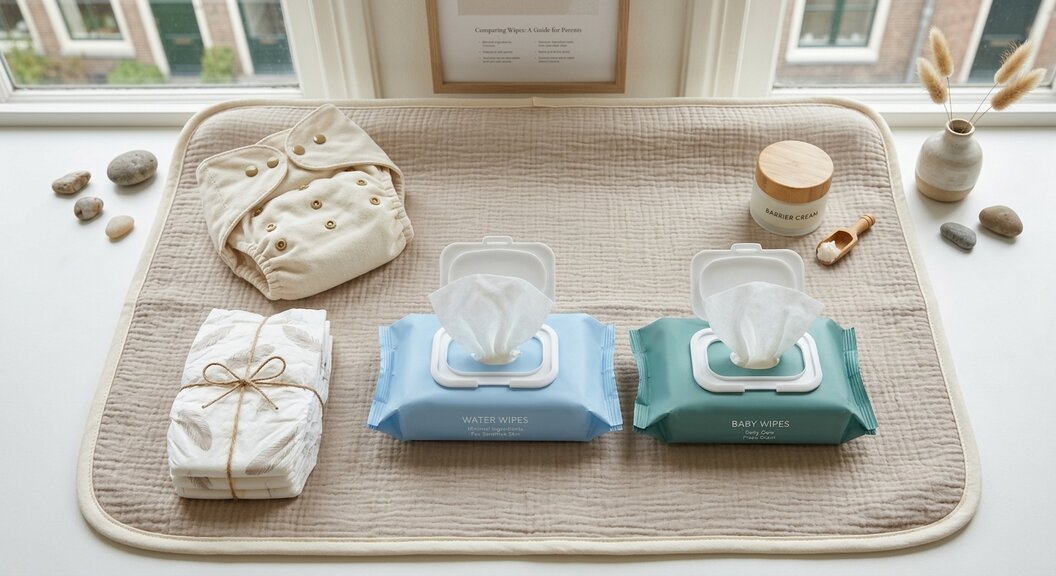
Here's the direct answer: water wipes are a category of wipes formulated mostly from water plus a small number of additional ingredients, while regular baby wipes typically add cleansing agents, moisturisers and preservatives on top of that water base. Formulations vary by brand within both categories, and neither is automatically the better or safer choice for every baby.
One thing worth clearing up before anything else: "water wipes" and "WaterWipes" are not the same thing. WaterWipes is a specific commercial brand, made in Ireland, that happens to be the best-known example of the water-wipe category in the UK. But it isn't the definition of the category, and it isn't the only product that fits it. Treating a brand name as a generic term is part of why this comparison gets confusing, so we'll keep the two separate throughout this guide.
What Are Water Wipes, Exactly?
"Water wipes," lower case, describes a type of baby wipe built around a very high proportion of water, typically upwards of 99%, with only one or two additional ingredients, usually a small amount of fruit extract used as a mild conditioning agent.
The appeal is simplicity. Fewer ingredients generally means fewer potential irritants, which is why these products are marketed heavily at parents of newborns or babies with reactive skin.
But "mostly water" doesn't mean "only water," and it's worth being precise here. Even minimal-ingredient wipes usually need something to keep the product stable and free from microbial growth while it sits, moist, in a resealable pack for weeks. On WaterWipes' own UK ingredient listings, for example, the fruit extract used is noted as containing a trace of benzalkonium chloride, a preservative, carried in via that extract rather than added as a separate ingredient. It's a small amount, and the brand is upfront about it on pack, but it does mean the product isn't literally water and nothing else, despite how the marketing sometimes reads at a glance.
WaterWipes is the market leader in this space in the UK, but it isn't the only water-based option. Several supermarket own-brand ranges and other manufacturers, including Pampers' own water-based wipe lines, sit in the same broad category with similarly minimal formulations. If a "water wipe" product matters to you specifically for its ingredient simplicity, the practical step is the same regardless of brand: check the ingredient list on the pack you're buying, since formulations can and do differ between products, and can change over time even within the same product line.
What's in a Regular Baby Wipe?
"Regular baby wipe" isn't a single fixed formula either, it's a broad category that generally includes water plus a handful of functional ingredient types, added for reasons that make sense once you know what they're doing:
Water. Still the primary ingredient in the vast majority of wipes, water-wipe or not.
Cleansing agents. Mild surfactants help lift oil-based residue, particularly from stool, more effectively than water alone can manage.
Humectants and moisturising ingredients. Ingredients such as glycerin help the wipe feel less drying on the skin and can leave a slight moisturising effect after use.
Preservatives. Because these products are water-based and sit in a pack for weeks or months, a preservative system is generally needed to prevent bacterial or fungal growth. Common examples include sodium benzoate and disodium EDTA, which appear on many mainstream UK baby wipe ingredient lists.
Fragrance. Some regular wipes include a light fragrance; many, including several major "sensitive" ranges, are formulated fragrance-free.
Other functional ingredients. Depending on the product, you might see ingredients intended to stabilise pH, improve texture, or help the wipe hold its shape when wet.
The key point is that "regular baby wipe" covers a wide range of actual formulations, from fairly minimal, fragrance-free sensitive ranges to more heavily formulated everyday wipes. Two products both labelled "baby wipes" can have quite different ingredient lists.
Ingredient Comparison Table
| Feature | Typical Water-Wipe Formula | Typical Regular Baby-Wipe Formula |
|---|---|---|
| Water | Very high proportion (often 99%+) | Usually a high proportion, though generally lower than water-wipe products |
| Cleansing agents | Minimal or none in most products | More commonly included |
| Humectants/moisturisers | Usually limited or absent | More commonly included |
| Preservatives | May still be present, sometimes via an extract rather than added directly | Commonly used, often listed explicitly (e.g. sodium benzoate) |
| Fragrance | Typically fragrance-free | Varies — some fragranced, many "sensitive" ranges fragrance-free |
| Other ingredients | Usually few | May include several functional ingredients for texture, pH or stability |
| Exact formulation | Varies by brand and product line | Varies by brand and product line |
This table describes typical patterns, not a universal rule that every product follows. A "water-based" or "aqua" wipe can still contain a preservative, and a "sensitive" regular wipe can be formulated with very few ingredients beyond water. Always check the actual pack, since manufacturers do update formulations.
Are Water Wipes Better for Sensitive Skin or Nappy Rash?
There's a reasonable logic here: fewer ingredients generally means fewer opportunities for a reaction, so parents of babies with easily irritated skin or a history of eczema often gravitate toward simpler formulations. That reasoning holds up in principle, and it's part of why fragrance-free, minimal-ingredient products are commonly recommended for newborns and reactive skin generally.
Where it gets murkier is the specific evidence used to market individual products. Several of the studies cited by wipe manufacturers to support claims like "clinically proven" or "reduces nappy rash" are funded, wholly or partly, by the manufacturer whose product is being tested. That doesn't make the findings false, but it does mean they should be read as manufacturer-supported research rather than fully independent evidence, and reported that way rather than presented as settled medical fact.
Independent research in this specific area is genuinely limited. A widely cited academic review looking at newborn skin cleansing found a shortage of good-quality, independently controlled studies comparing wipes to water, and noted that some trials didn't include enough healthy, full-term infants to draw strong general conclusions. In plain terms: there isn't a large, independent body of evidence proving any single wipe formulation is best for skin health.
What can be said with more confidence:
- Nappy rash has multiple possible causes, including prolonged contact with urine or stool, friction, moisture, diarrhoea, and individual skin sensitivity
- Reducing potential irritants, fragrance, certain preservatives, added actives, is a sensible general approach for a baby who reacts easily, regardless of which specific product category that comes from
- No wipe, water-based or otherwise, can guarantee a baby won't develop nappy rash, since so much of it comes down to changing frequency, skin type and other factors unrelated to the wipe itself
Which Cleans Better? Wet Wipes vs Water Wipes for Different Types of Mess
This is where ingredient simplicity and actual cleaning performance start to pull apart, and it's a distinction most comparison articles skip entirely.
Light, wee-only changes. A highly water-based wipe is generally more than sufficient here. There's little mess to lift, and the priority is gentle cleansing rather than heavy-duty cleaning power.
A fully soiled nappy. This is where cleansing agents in regular wipes can make a practical difference. Formulated cleansers are designed to help lift oil-based residue more efficiently, which can mean fewer wipes needed per change. Water-based wipes still work, but you may find yourself using more of them to get the same result, particularly with a looser or larger stool.
Sticky or dried-on stool. Wipe moisture level and texture matter as much as ingredients here. A thicker, more saturated wipe, of either type, tends to lift dried mess more effectively than a thinner, less moist one, regardless of its formulation philosophy.
Newborn meconium. The first few days' stools are notably sticky and tar-like. Many parents find a well-saturated wipe, or cotton wool with water, works better in the very first days than a drier or thinner wipe of either category, simply because of how meconium behaves on skin.
The wider point: cleaning performance depends on more than the ingredient list. Wipe material, thickness, moisture level, size and how many you're prepared to use per change all affect how well a wipe actually does its job. A wipe with fewer ingredients isn't automatically a worse cleaner, and a wipe with more ingredients isn't automatically more effective, the physical characteristics of the wipe matter just as much.
Water Wipes vs Baby Wipes by Age and Stage
Newborns. Skin is thinner and more permeable in the first weeks, which is why many parents lean toward simple, fragrance-free formulations, whether that's a water-based wipe or a minimal "newborn" or "sensitive" regular wipe. Some parents choose cotton wool and water for this stage specifically, particularly for the first couple of weeks.
Weaning and solids stage. Once your baby starts solid food, stool consistency and smell both change, generally becoming firmer and more variable. This is often when parents reconsider wipe choice, sometimes moving toward a slightly more robust regular wipe simply because there's more to clean.
Toddlers and potty training. Mess becomes more varied and unpredictable, and convenience often becomes a bigger factor than ingredient minimalism, particularly for wipes kept in a changing bag, car, or used away from home. Nursery and childcare settings may also have their own policies on what products they'll use, which is worth checking if this affects your choice.
There's no rule requiring a particular wipe type at any specific stage. The right choice tends to shift naturally with what you're actually cleaning up and where you're doing it.
Cost Comparison: Are Water Wipes Worth the Extra Money?
Price is one of the clearest, most consistent differences between the two categories, and it's worth looking at concretely rather than just noting that one "costs more."
At the time of writing, WaterWipes typically retails in the UK at around £3–£3.25 for a 60-wipe pack, working out to roughly 5p per wipe. Mainstream regular baby wipes, such as Pampers Sensitive, are commonly available in bulk packs (12 x 52 wipes, for example) for figures that work out closer to 1.5–2.5p per wipe, depending on pack size, retailer and any promotions running at the time.
That's a real difference, water wipes can cost two to three times more per wipe than budget-friendly regular ranges. Prices vary by retailer, promotion and pack size, so it's worth checking current pricing before assuming either figure holds exactly, but the general pattern (water wipes sitting at a premium) is consistent across UK retailers.
A simple way to work out your own cost:
Cost per wipe = pack price ÷ number of wipes in the pack
Approximate monthly cost = cost per wipe × wipes used per day × 30
For a newborn using, say, 8–10 wipes a day, that difference between 2p and 5p a wipe adds up to a genuinely noticeable gap over a month, but whether that gap matters depends entirely on your household budget and how much weight you put on ingredient minimalism specifically. There's no universally "right" answer here; it's a trade-off each family weighs differently.
Convenience and Practical Trade-offs
Shelf life once opened. Minimal-ingredient wipes, with fewer or no traditional preservatives, are often intended to be used within a shorter window after opening, some water-wipe packs specify use within two to four weeks, compared with some regular wipe ranges. Always follow the specific product's storage guidance on the pack.
Drying out. Wipes with a higher water content and simpler preservation systems can be more prone to drying out if the pack isn't resealed properly after each use. Regular resealing genuinely matters more with these products.
Thickness and tear resistance. This varies by specific product line rather than by category, some water wipes are marketed as "textured" and thicker for tougher messes, while some regular wipes are notably thin. Check the specific product rather than assuming based on category alone.
On-the-go use. Both types work fine for travel, though a wipe that dries out faster once opened is a slightly bigger inconvenience if you're carrying a part-used pack around for extended periods.
Nursery and daycare. Some settings have their own policies on what wipes and skincare products they'll use on your baby, sometimes for allergy or consistency reasons. It's worth checking with your specific nursery if this is relevant to you.
Environmental Considerations
Sustainability claims are common on both sides of this comparison, and they're worth examining a little more carefully than the marketing usually invites.
Plastic content and biodegradability. A number of wipe products, including several water-wipe ranges, are now made from plant-derived fibres rather than plastic, with biodegradability claims attached. Biodegradable generally means the material will break down under particular environmental conditions, but the specific conditions and timeframes vary by product, and claims should be read on the specific pack rather than assumed to be identical across the category.
Flushability. This is an important distinction to get right: biodegradable does not mean flushable. UK water companies are consistent on this point, baby wipes, including ones marketed as biodegradable or eco-friendly, should go in general waste, not down the toilet, because they don't break down quickly enough in the sewage system and are a leading contributor to blockages and "fatbergs." Always check the specific disposal guidance on the pack, and when in doubt, bin rather than flush.
Packaging and manufacturing. Both wipe categories involve water use, manufacturing processes and plastic packaging (even where the wipe material itself is plastic-free), so neither is automatically the lower-impact choice overall. If environmental impact genuinely matters to your decision, it's worth looking at the whole picture — material, packaging, and disposal guidance — rather than a single headline claim.
Water Wipes, Baby Wipes, or Cotton Wool and Water, How Do They Compare?
Cotton wool and cooled boiled water remains a common choice for the first couple of weeks, particularly for parents who prefer to keep things as simple as possible while their baby is newest and smallest.
| Option | Ingredients | Convenience | Suitable situations | Potential considerations |
|---|---|---|---|---|
| Water wipes | Usually mostly water plus limited additional ingredients | High | Home and travel, all ages | Higher cost per wipe; may dry out faster once opened |
| Regular baby wipes | Water plus various functional ingredients (cleansers, moisturisers, preservatives) | Very high | Everyday use, all ages, especially messier changes | Formulation varies significantly; some contain fragrance |
| Cotton wool and water | Water plus cotton wool | Lower | Home use, particularly newborn stage | More preparation each time; ongoing cotton wool cost and waste |
None of these is universally superior. Cotton wool and water offers about as simple an ingredient list as possible, but it's less practical for travel and requires warm water on hand. Both wipe categories trade some of that simplicity for convenience, just to different degrees.
How to Choose the Right Wipe for Your Baby
A practical way to think through the decision:
If your baby has easily irritated skin, consider a simpler, fragrance-free formulation, whether that's a water-based wipe or a minimal regular "sensitive" range, and monitor how their skin responds over a week or two before switching again.
If convenience is your priority, look at moisture level, resealable packaging, and thickness rather than the ingredient philosophy alone.
If budget matters, compare cost per wipe rather than pack price, since pack sizes vary considerably between brands.
If your baby is a newborn, many parents start with the simplest option they're comfortable with, whether that's cotton wool and water or a minimal wipe, and reassess as their baby grows.
If your baby is weaning or eating solids, you may find a slightly more robust wipe, with cleansing agents, more practical for the mess involved.
If you travel frequently, prioritise resealable packaging and a wipe that resists drying out.
If environmental impact is a priority, look beyond the headline claim on the front of the pack to the actual material, packaging and disposal instructions.
The honest bottom line: the best choice is the formulation and format that suits your particular baby's skin, your cleaning needs, your budget and your routine, not a fixed ranking that applies to every family.
Common Myths About Water Wipes
Myth: "Water wipes are always better." Better for what, and for whom, matters here. They may suit reactive skin well, but they aren't automatically superior for cleaning performance, cost, or environmental impact.
Myth: "Regular wipes cause nappy rash." Nappy rash has multiple possible causes, and plenty of babies use regular wipes without any issue. A specific ingredient reaction is possible but isn't the default outcome.
Myth: "Water wipes are 100% water." Most water-wipe products contain a small amount of additional ingredients, commonly a fruit extract, and often a trace preservative carried within that extract. Check the specific pack's ingredient list.
Myth: "Preservatives are never found in water wipes." As above, even minimal-ingredient wipes generally need some form of stabilisation to remain safe to use over the product's shelf life.
Myth: "Biodegradable wipes can be flushed." These are separate claims. A wipe can be genuinely biodegradable in general waste conditions while still being unsuitable for flushing, since sewage systems don't provide the same breakdown conditions. Bin wipes rather than flushing them, regardless of biodegradability claims.
Myth: "Fragrance-free means irritation-free." Fragrance is one common irritant, but not the only one. A baby can still react to a preservative, a cleansing agent, or another ingredient in a fragrance-free product.
When Should You See a GP or Health Visitor About Skin Reactions?
Most skin reactions to wipes, of either type, are mild and settle once you switch to a different, simpler formulation. It's worth getting professional advice if:
- The irritation is persistent or getting worse despite changing products
- The skin looks very inflamed, or you notice blistering, open sores, or significant swelling
- There's pus or discharge from the affected area
- Your baby seems generally unwell alongside the skin reaction
- The rash is spreading beyond the nappy area or looks unusual
- You're simply unsure what's causing it and want it checked
Your health visitor or GP can properly assess a reaction rather than you needing to guess based on which product you were using at the time.
Key Takeaways
- Water wipes are a product category, not a specific brand, WaterWipes is one well-known example, not a synonym for the whole category.
- Most water-wipe products contain a small amount of ingredient beyond water, sometimes including a trace preservative.
- Regular baby wipes can include cleansing agents, moisturisers, preservatives and sometimes fragrance, though formulations vary considerably between products.
- Simple, fragrance-free formulations may suit babies with reactive skin, but no wipe guarantees nappy rash won't happen.
- Cleaning performance depends on a wipe's thickness, moisture and material as much as its ingredient list.
- Water wipes typically cost two to three times more per wipe than budget regular ranges in the UK.
- Biodegradable does not mean flushable, bin wipes of any type rather than flushing them.
- The right choice comes down to your baby's skin, your budget, and your practical routine, not a fixed ranking.
Conclusion
There's no single wipe that's right for every baby. The meaningful differences between water wipes and regular baby wipes sit in the details, ingredients, fragrance, preservatives, cleansing power, thickness, price and environmental claims, rather than in one category being straightforwardly "better" than the other.
If you're exploring wipes for your own changing routine, Moise's baby wipes are one option worth looking at alongside others, check the current ingredient list and see whether the formulation fits what you're looking for, whether that's simplicity, everyday cleaning power, or something in between.