One week your baby lies happily on the changing mat. The next, they flip over mid-change and crawl off with one tab still undone. It is around this point that many parents start comparing nappy pants vs nappies and wondering whether it is time for a change.
The short answer: taped nappies fasten around the waist with adhesive tabs, whilst nappy pants are pulled on like underwear. Taped nappies are convenient when a baby is changed lying down. Nappy pants can make changes easier for some active babies. The best choice depends on fit, development and convenience, not on age alone.
This guide explains how the two styles differ, what each does well, and how to tell whether switching would actually help your family.
What Is the Difference Between Nappy Pants and Traditional Nappies?
The difference between nappies and nappy pants is how they go on, how the fit is adjusted, and how they come off. Both are disposable products designed to absorb urine and contain poo. Neither style is automatically more absorbent than the other, because performance varies between brands and models.
What Are Taped Nappies?
Taped nappies are the traditional open design. You lay the nappy flat under your baby, bring the front panel up between the legs, and fasten it at the waist with an adhesive tab on each side.
Because the tabs can be placed tighter or looser, you can adjust the waist to suit your baby's shape. You can also reopen a tab to reposition the nappy if it sits unevenly.
This design suits lying-down changes, which is why taped nappies are so widely used for newborns and younger babies. The nappy opens fully, so you can slide it under a baby who cannot yet stand or help.
What Are Nappy Pants?
Nappy pants, sometimes called pull-up nappies, are shaped like underwear. They have a stretchy, elasticated waistband instead of tabs. You guide your baby's feet through the leg holes and pull the pants up over the hips.
The waistband provides the fit, so there is nothing to fasten. That can help when a baby is standing, cruising along the sofa, or simply refuses to lie still.
Many nappy pants have side seams that tear open, so a dirty nappy does not have to be pulled down the legs. Designs differ, though. Always check the instructions on the pack for how to put on, remove and dispose of that particular product.
In brief: a taped nappy is fastened around your baby with tabs. A nappy pant is pulled up like underwear. Both do the same job, and both work well when the size and fit are right.
Nappy Pants vs Taped Nappies: A Quick Comparison
The table below sums up the practical differences between pull-up nappies and taped nappies.
| Feature | Taped Nappies | Nappy Pants |
|---|---|---|
| How they are put on | Fastened with adhesive tabs | Pulled on like underwear |
| Changing position | Often convenient when the baby is lying down | Can be convenient when the baby is standing or moving |
| Fit adjustment | Tabs allow the fastening to be adjusted | Elasticated waistband provides the fit |
| Newborn use | Often convenient for newborns, depending on product range | Availability and suitability depend on the product |
| Active babies | May take more effort when a baby wriggles | May be easier for some wriggly babies |
| Removing a dirty nappy | Open the tabs and remove carefully | Usually tear the sides or follow product instructions |
| Checking the fit | Adjust tabs and inspect the waist and leg openings | Check the waistband, leg openings, and overall fit |
| Potty-training stage | Can still be useful during changes | May feel more like underwear and be easier to pull up and down |
| Best choice | Depends on the baby's fit and changing routine | Depends on the baby's fit and changing routine |
This comparison is a guide to how each style behaves in daily use. It is not proof that one is better. Both can work well when they are correctly sized and fitted.
Pros and Cons of Taped Nappies
Taped nappies are the style most parents start with, and many families never feel the need to change.
Advantages of Taped Nappies
- Easy lying-down changes. The nappy opens flat, so you can slide it under a baby lying on their back.
- Adjustable fastening. You decide where the tabs sit, which helps when your baby is between sizes or has a slimmer or rounder tummy.
- Simple to check and reposition. If the fit looks uneven, you can lift a tab and fasten it again.
- Well suited to many newborns and younger babies. Small sizes are widely available in taped designs.
- Plenty of choice. Depending on the brand, taped nappies come in a wide range of sizes and absorbency options.
Possible Disadvantages of Taped Nappies
- Wriggly changes can be harder. Once a baby rolls or twists, lining up both tabs takes more patience.
- Awkward on a standing baby. Fastening tabs evenly is tricky when your little one wants to be upright.
- Fit depends on fastening. Tabs fastened unevenly, too loosely or too tightly can leave gaps, cause tightness or lead to leaks.
These are practical considerations, not drawbacks for every family. Plenty of toddlers stay in taped nappies comfortably until they are out of nappies altogether.
Pros and Cons of Nappy Pants
Nappy pants were designed with movement in mind, which explains both their strengths and their limits.
Advantages of Nappy Pants
- Pull-on design. There are no tabs to line up, which may make changes easier for active babies.
- Handy for standing changes. Some babies are calmer when they can stay upright and hold on to something steady.
- Up and down in one movement. This can suit some potty-training routines, because a child can practise pulling them down and up.
- Familiar shape for toddlers. The underwear-like design can feel like a step towards "big kid" pants.
Possible Disadvantages of Nappy Pants
- Less convenient for a full lying-down change. Threading both legs through takes longer if your baby needs to stay on their back.
- Dirty changes need care. You usually tear the sides and lift the nappy away, then clean thoroughly.
- The fit is fixed. With no tabs to adjust, a particular cut may not suit every baby's body shape.
- Price can differ. Nappy pants may cost more per nappy than some taped alternatives, depending on the brand, pack size and retailer.
Pack sizes often differ between the two styles, so pack prices can mislead. Compare the cost per nappy instead.
When Should You Switch to Nappy Pants?
There is no single recommended age at which every baby should switch to nappy pants. Babies reach milestones at different times, and families change nappies in different ways. The useful question is not "how old is my baby?" but "are changes still working?"
Nappy pants might be worth trying if:
- your baby rolls or wriggles constantly during changes
- your baby crawls, pulls up, stands or walks
- your baby protests about lying down for a nappy change
- you find a pull-on design easier for your routine
- your child is beginning potty training and can practise pulling clothing up and down
These are practical signs, not requirements. If taped nappies still fit well and changes are calm, there is no reason to move on. The NHS also suggests a simple trick for older babies who try to wriggle away: offer a toy or use a mobile as a distraction.
Should You Use Nappy Pants for a Newborn?
Taped nappies for newborns are usually the more convenient option, because changes happen whilst your baby is lying down. A nappy that opens flat is simply easier to position under a very small baby.
That does not make nappy pants unsafe for young babies. Suitability depends on the specific product, its size range and how it fits. Many nappy pant ranges start at larger sizes, so check the weight guidance on the pack.
In the first weeks, also look at how any nappy sits around the umbilical cord area, and follow the manufacturer's guidance. Your midwife or health visitor can advise if you are unsure. Our newborn essentials checklist for the first month covers what else to have ready.
Are Nappy Pants Better for Crawling or Walking Babies?
Nappy pants for crawling babies can make changes quicker, because nothing needs to be fastened whilst your baby is on the move. Some parents change a wet nappy with their child standing and holding on to a steady surface.
Taped nappies can still be among the best nappies for active babies if they fit securely and you can change them safely. Many mobile babies are happy to lie down for thirty seconds with a toy in hand. If that describes yours, you may not need to switch at all.
Are Nappy Pants Better for Potty Training?
Nappy pants for potty training can help a toddler practise pulling clothing up and down. They do not make a child ready, and they are not a training method in themselves.
Readiness varies widely. One NHS children's health service notes that children usually show signs of being ready between 18 months and 3 years. Signs to look for include:
- showing interest in the potty or toilet
- telling you, in words or gestures, that they need to go
- noticing when their nappy is wet or dirty
- staying dry for an hour or two at a time
- following simple instructions
No single sign is a strict requirement. For a fuller picture, read our guide to the signs your little one is ready for potty training.
How to Choose the Right Option for Your Baby
If you are unsure when to use nappy pants and when to stay with tapes, work through these seven questions.
- Your baby's movement. Does your baby stay fairly still, or wriggle and roll throughout every change?
- Ease of changing. Is it easier to change your baby lying down, or standing with appropriate support?
- Fit and body shape. Does the nappy sit comfortably around the waist and legs, without gaps or digging in?
- Leak protection. Does it contain urine and poo reliably when it is the right size and properly fitted?
- Skin comfort. Is there any rubbing, lasting redness or sign of discomfort?
- Your daily routine. Which design is easier at home, when travelling, or in a cramped public changing room?
- Cost and waste. What is the cost per nappy, and what do the product's environmental claims actually say?
If you are still undecided, buy one small pack before committing to a larger order. A few days of real changes will tell you more than any comparison chart.
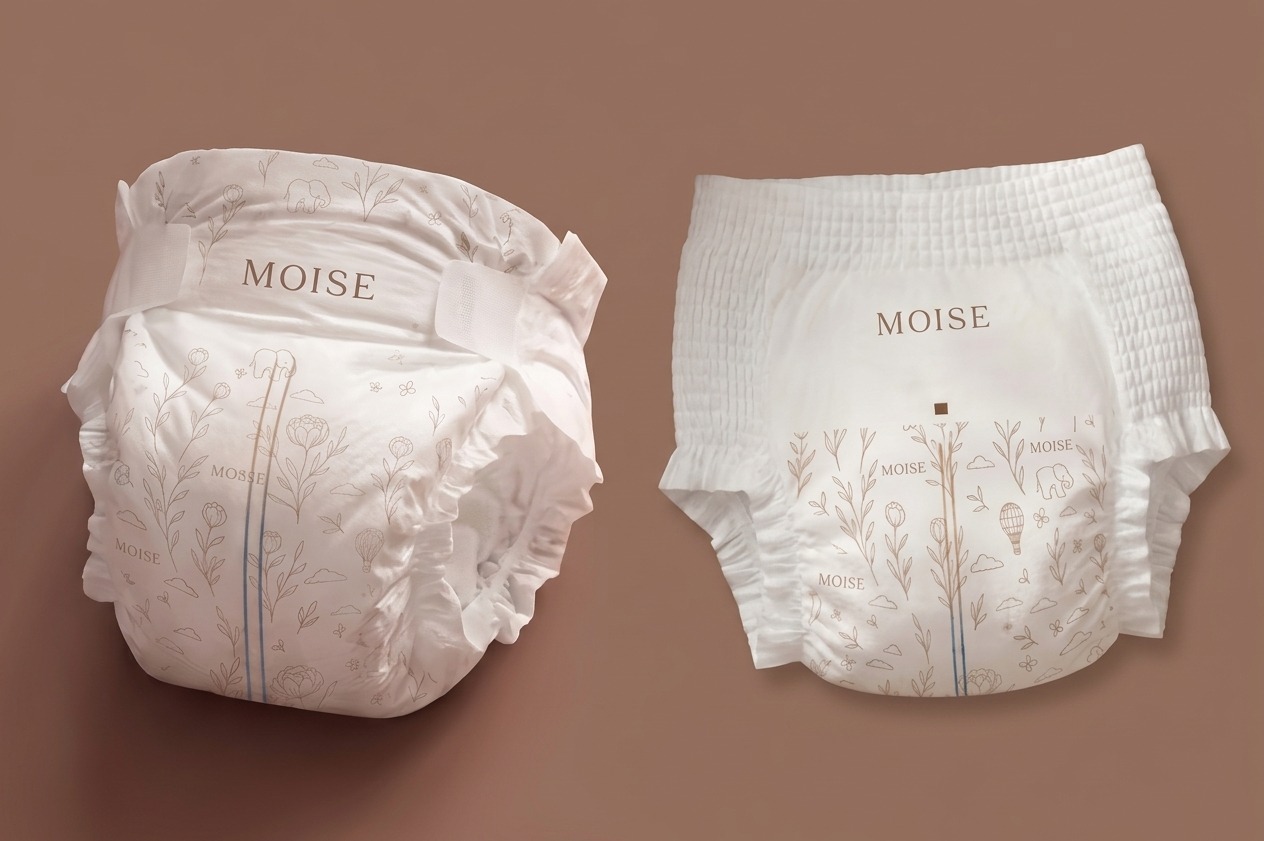
You can see how the two designs differ by looking at Moise taped nappies alongside our pull-on nappy pants.
How to Get the Best Fit With Nappy Pants and Taped Nappies
Correct sizing and fit matter more than which style you choose. Most questions about nappy leaks and fit come down to the same few checks.
- Start with the weight range. Use the manufacturer's guidance as a starting point, then judge the fit on your own baby.
- Check the waistband. It should sit comfortably and not dig into the skin.
- Check the legs. Leg openings should fit snugly, without deep marks or visible gaps.
- For taped nappies: fasten both tabs evenly, then run a finger around each leg to pull the cuffs outwards.
- For nappy pants: pull the waistband fully up at the front and back, and make sure the leg cuffs are not folded inwards.
- Review if leaks continue. Try a different size or another cut if leaks persist despite careful fitting.
- Follow the pack instructions for changing and disposal.
Not every leak means your baby needs a bigger size. Fit, absorbency, how often the nappy is changed and the product's design can all play a part.
Skin matters too. The NHS advises making sure nappies fit properly and are not put on too tightly, as part of preventing and easing nappy rash. For everyday care between changes, see our baby skincare routine by age.
How to Change Nappy Pants
Putting nappy pants on is straightforward, but removal works differently from a taped nappy.
- Gather a clean nappy, wipes or cotton wool and water, and a nappy bag.
- For a wet nappy, pull the pants down or tear the side seams, whichever the pack advises.
- For a dirty nappy, tear both sides and lift the nappy away from front to back.
- Clean the whole nappy area gently and let the skin dry.
- Guide each foot through a leg hole and pull the pants up to the waist.
- Run a finger around the waistband and leg cuffs to check nothing is folded in.
Common Mistakes to Avoid
Most nappy frustrations come from a few easily fixed habits.
- Switching styles because of age alone. A birthday is not a reason to change something that works.
- Assuming nappy pants prevent all leaks. No nappy can promise that.
- Choosing a size by age. Use the manufacturer's weight guidance and the actual fit instead.
- Leaving leg cuffs folded in. Tucked-in cuffs are an easy thing to miss in a hurried change.
- Fastening taped nappies too loosely or too tightly. Aim for snug but comfortable.
- Leaving a baby unattended on a raised surface. The NHS says to keep an eye on your baby at all times on a changing table and not to rely on the straps. A mat on the floor is the safest place.
- Expecting nappy pants to do the potty training. They support the routine, but they cannot replace readiness.
- Persevering with a poor fit. If a product keeps causing discomfort, try another size, cut or style.
Can You Use Both Nappy Pants and Taped Nappies?
Yes. You do not have to make a permanent either-or choice, and many families keep both in the changing bag.
- Taped nappies for calmer changes at home.
- Nappy pants when your baby is especially active, or when you are out and about.
- Different options for daytime and overnight, provided each one offers suitable fit and absorbency.
- A return to taped nappies if they are easier for a particular stage, such as during illness.
Choose each product on fit, absorbency, comfort and the manufacturer's intended use. Do not assume that one style is automatically better overnight.
Final Thoughts: Nappy Pants or Taped Nappies?
When it comes to nappy pants vs nappies, the two styles share one purpose and differ mainly in how they go on and come off. The right option is the one that fits comfortably, contains wee and poo reliably, and keeps changes manageable.
- Taped nappies: often practical for newborns and lying-down changes.
- Nappy pants: may be convenient for wriggly, crawling, standing and walking babies.
- Both: can remain useful at different stages, including during potty training.
There is no deadline and no wrong answer here. Try both styles if you are curious, watch how your baby moves and how the nappy fits, and choose what works best for the two of you.
Disclaimer: This article offers general, practical information and is not a substitute for medical advice. If you have concerns about your baby's skin or health, speak to your health visitor or GP.