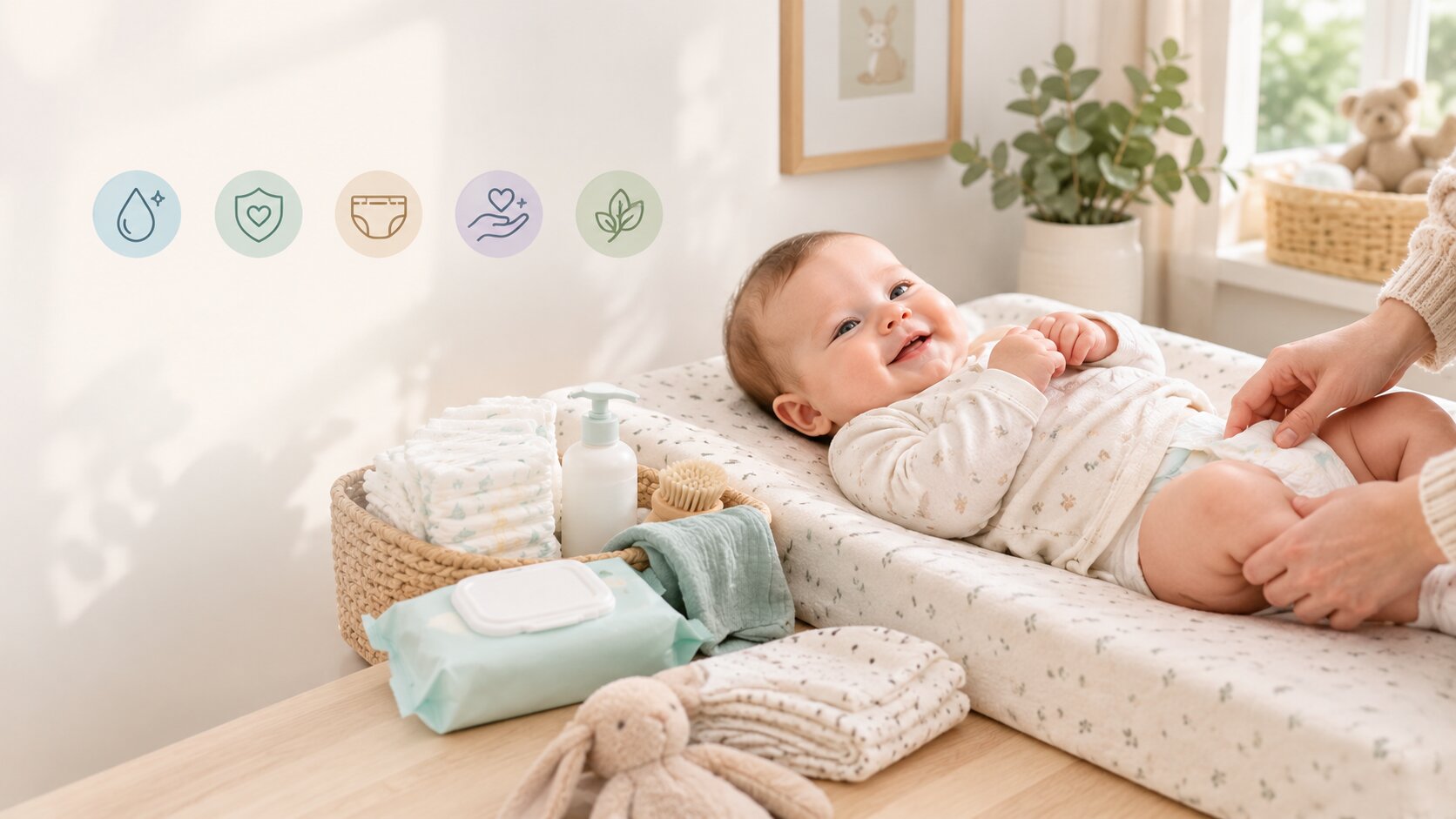
A sore, red bottom after a messy nappy is one of those things almost every parent deals with at some point. It's rarely serious, but it can still be upsetting to see your baby uncomfortable, especially if it's happening for the first time and you're not sure whether what you're looking at is "normal" nappy rash or something that needs a closer look.
This guide walks through what nappy rash actually is, why it happens, what you can do about it at home, and the situations where it's worth getting a health visitor, pharmacist or GP involved.
Quick Answer
The best way to treat nappy rash is to change wet and dirty nappies promptly, clean the skin gently with water or fragrance-free wipes, pat it dry, and apply a thin layer of barrier cream. Leaving nappies off for short periods also helps. If the rash doesn't improve within a few days, gets worse, or your baby seems unwell, speak to a pharmacist, health visitor or GP.
What is nappy rash?
Nappy rash is a reaction on the skin of the nappy area, caused mainly by prolonged contact with wee or poo, combined with the warm, moist environment a nappy creates. It's extremely common — up to a third of babies and toddlers in nappies have nappy rash at any given time — and most cases are mild and settle within a few days with simple home care.
It doesn't tend to appear in the very first weeks of life. It doesn't usually develop in newborns, though all babies can get it as they get a bit older. Some babies seem to get it rarely, if ever, while others are more prone to it, often because their skin is naturally more reactive or they have more frequent, looser stools.
It's worth saying clearly: nappy rash is common, it isn't a sign you're doing anything wrong as a parent, and in most cases it clears up with a few straightforward changes to your nappy-changing routine.
What causes nappy rash?
Nappy rash rarely has a single cause. It's usually the result of several factors combining — moisture, friction, and irritation all working against a skin barrier that's still developing and much thinner than adult skin.
Contact with urine and poo
The longer skin stays in contact with wee or poo, the more likely irritation becomes. Poo is particularly irritating because it contains digestive enzymes that can break down the skin's protective surface, which is part of why prompt changes after a dirty nappy matter so much.
Moisture and warmth
A nappy creates a warm, damp environment by design, which is useful for absorbing wee but also softens the skin over time. Softened skin is more vulnerable to friction and irritation than dry skin.
Friction and rubbing
The nappy itself rubbing against the skin, particularly around the waistband and thighs, can contribute to rash even without significant wetness. This is often worse if a nappy doesn't fit well.
Frequent or loose stools
Babies who are teething, unwell, or going through a growth spurt sometimes have looser or more frequent stools for a short period. Diarrhoea in particular increases the risk of nappy rash because the skin is exposed to irritating stool more often and for longer stretches.
Irritating products
Some products that seem harmless can irritate a baby's skin. Soaps, baby lotion and bubble bath can all irritate delicate skin, as can talcum powder and antiseptics on nappy rash. Wipes containing alcohol or heavy fragrance can also contribute for some babies.
Changes in feeding or bowel movements
Starting solid foods, switching formula, or a course of antibiotics can all change the consistency and frequency of a baby's stools, sometimes triggering a bout of nappy rash even in a baby who's never had it before. Certain medicines, including antibiotics or laxatives, are recognised contributors too.
What does nappy rash look like?
Common signs of nappy rash include red or raw patches on your baby's bottom or across the whole nappy area, skin that looks sore and feels hot to the touch, and scaly or dry patches. Your baby may seem uncomfortable, fussier than usual, or more unsettled during nappy changes. Some babies develop small spots, pimples or blisters on their bottom, which can appear red or brown, and may be less noticeable on brown and black skin.
Your baby's bottom may look quite red after a particularly messy nappy. That alone doesn't necessarily mean there's a problem — some redness after a dirty nappy is normal and often fades once the skin is cleaned and dried. It's persistent or worsening redness, rather than a single red patch, that's more indicative of nappy rash proper.
How can you tell whether it's mild or needs medical advice?
Most nappy rash is mild and responds to basic home care within a few days. Signs that suggest you can reasonably manage it at home include:
- Redness limited to the nappy area
- Skin that looks irritated but intact, without broken skin or open sores
- A baby who's a little fussier at nappy changes but otherwise seems well, feeding normally and in good spirits generally
Signs that point toward needing professional advice include a rash that isn't improving despite a few days of careful home care, a rash that's spreading beyond the nappy area, or a baby who seems generally unwell alongside the rash. These are covered in more detail further down.
How do you treat nappy rash at home?
Most cases of nappy rash respond well to a few consistent changes to your routine, rather than any single product or "fix."
Change nappies regularly
Change wet or dirty nappies as soon as possible. This is consistently the single most useful thing you can do, since it limits how long skin is in contact with moisture and irritants.
Clean the skin gently
Clean the whole nappy area gently but thoroughly, wiping from front to back, using water or fragrance-free and alcohol-free baby wipes. Avoid scrubbing, even if the nappy has been particularly messy.
Let the skin dry
Keep the skin clean and dry, patting or rubbing gently to dry it rather than leaving it damp. Give the skin a moment to air-dry, where your baby will tolerate it, before putting a fresh nappy on.
Use a suitable barrier cream
A thin layer of barrier cream can help protect the skin from further contact with moisture while it heals. A pharmacist can recommend a suitable nappy rash cream if the rash is causing your baby discomfort. There's no single ingredient that works best for every baby — some parents find creams containing zinc oxide helpful, others prefer simpler petroleum-based barrier products — so it's worth asking a pharmacist for a recommendation suited to your baby's skin.
Give the skin some nappy-free time where practical
Leaving nappies off when possible allows air to reach the skin, which can speed up healing. A towel down on the floor for supervised nappy-free time, even for ten or fifteen minutes, can make a genuine difference during a flare-up.
What should you avoid when your baby has nappy rash?
Just as important as what to do is what to leave out of your routine while your baby's skin is recovering:
- Soap, bubble bath and baby lotion — these can irritate the skin further, even ones marketed as gentle.
- Talcum powder and antiseptics — neither is recommended for nappy rash, despite talcum powder being a traditional go-to for some.
- Nappies fastened too tightly — this can irritate the skin through added friction and reduced airflow.
- Over-bathing — bathing more than once or twice a day can dry the skin out, which can make irritation worse rather than better.
- Vigorous wiping or rubbing — always pat rather than scrub, particularly on skin that's already sore.
How long does nappy rash normally take to improve?
There's no single timeframe that applies to every baby, and it depends on the cause, severity, and how consistently home care is followed. Some sources suggest that with good hygiene, nappy rash will often clear in around three days, though more persistent or severe cases can understandably take longer.
If you're following the basic steps above consistently — prompt changes, gentle cleaning, drying, and barrier cream — and you're not seeing any improvement after a few days, or the rash is getting worse rather than better, that's a reasonable point to check in with a pharmacist or health visitor rather than continuing to wait it out.
How can you prevent nappy rash?
Prevention is about reducing the everyday irritation that leads to nappy rash, not guaranteeing your baby will never get it. Even with a careful routine, most babies will have a flare-up at some point.
A practical prevention routine includes:
- Changing wet and dirty nappies promptly, rather than waiting until the nappy feels full
- Cleaning gently with water or fragrance-free, alcohol-free wipes
- Drying the skin properly, with patting rather than rubbing, before putting on a fresh nappy
- Using a barrier cream as a preventative layer if your baby is prone to rash, particularly overnight when nappies are worn for longer
- Making sure the nappy fits properly — not too tight, not too loose
- Giving some nappy-free time when practical, particularly at home
- Choosing gentle, fragrance-free skincare products generally, rather than switching between lots of different products
[Internal link opportunity: How often to change a baby's nappy]
Are baby wipes safe when a baby has nappy rash?
Yes, in most cases baby wipes are perfectly fine to use during a bout of nappy rash, provided they're a gentle, suitable formulation. What matters more than "wipes versus no wipes" is the specific product and how it's used.
Fragrance-free and alcohol-free baby wipes are the recommended choice, since fragrance and alcohol are more likely to irritate skin that's already sore. Wipe gently, working front to back, and avoid repeated scrubbing over the same irritated patch.
If you notice that nappy rash seems to flare up specifically after using a particular brand of wipes, it's worth switching to a fragrance-free alternative, or to cotton wool and water, for a few days to see whether that makes a difference.
Which baby wipes are suitable for sensitive skin?
For a baby with sensitive skin or a tendency toward nappy rash, look for wipes that are:
- Fragrance-free
- Alcohol-free
- Formulated with minimal, simple ingredients
- Designed to cleanse gently without excessive rubbing needed
It's not accurate to say that water wipes are automatically better than all other baby wipes, or that all baby wipes are unsuitable for sensitive skin. Formulation varies considerably between brands, and what suits one baby's skin won't necessarily suit another's. If your baby has ongoing sensitive skin, cotton wool and warm water remains a reliable, simple option, particularly in the newborn weeks.
[Internal link opportunity: Baby wipes]
[Internal link opportunity: Sensitive baby skin]
What should you look for when choosing products for a baby prone to nappy rash?
If your baby seems to get nappy rash more often than most, it's worth being a little more deliberate about the products you use around the nappy area:
- Gentle cleansing — products designed for sensitive newborn skin, without unnecessary additives
- Fragrance considerations — fragrance-free options reduce one common source of irritation
- Skin compatibility — introduce new products one at a time, so you can identify what does and doesn't suit your baby
- Barrier protection — a suitable barrier cream used consistently, particularly overnight
- Nappy fit — a nappy that fits snugly without being tight, with no gaps at the legs or waist
- Ease of use — practical, quick-to-use products matter when you're doing several changes a day
No single product is universally "the best" for every baby, since skin sensitivity varies so much. What works well is usually a simple, consistent routine rather than frequently switching products in search of a fix.
| Option | Potential benefit | Things to consider |
|---|---|---|
| Water and soft cloth | Very gentle, minimal risk of irritation | Less convenient when out and about; needs warm water |
| Baby wipes | Convenient, effective cleansing | Choose fragrance-free and alcohol-free, especially during a flare-up |
| Barrier cream | Protects skin from further moisture contact | Apply a thin layer; not all ingredients suit every baby |
| Nappy-free time | Allows skin to air and dry naturally | Needs supervision; not always practical, especially in cold weather |
Nappy rash vs other types of baby rash
Most rashes in the nappy area are straightforward irritant nappy rash, but not all of them are. It's not possible to diagnose the exact cause from a description or photo alone, which is part of why persistent or unusual rashes are worth a professional opinion.
| Feature | Common irritant nappy rash | Possible other cause |
|---|---|---|
| Appearance | Red or raw patches, sometimes dry or scaly skin | A persistent bright red, moist rash with white or red pimples can suggest a thrush (fungal) infection |
| Location | Mainly areas in direct contact with the nappy | Thrush often spreads into the folds of the skin rather than staying on flat areas |
| Discomfort | Mild to moderate soreness during changes | Can be more painful, with visible distress during cleaning |
| Changes with basic care | Usually improves within a few days of home care | May not clear up within a few days, suggesting an underlying infection such as thrush or a bacterial infection |
| When to seek advice | If no improvement after several days of consistent care | Sooner — spreading, worsening, or unusual-looking rash warrants earlier pharmacist or GP input |
If a rash doesn't respond to sensible home care, looks unusual, or keeps coming back, a health visitor, pharmacist or GP can assess it properly rather than guessing based on appearance alone.
When should you contact a GP or NHS 111?
Most nappy rash can be managed at home, but there are clear situations where it's worth getting professional advice rather than waiting:
- Your baby's nappy rash doesn't go away, gets worse, or spreads to other areas
- Your baby has a high temperature
- Your baby seems very uncomfortable
- The skin looks broken, blistered, or you notice signs of infection, such as a bright red, moist rash with white or red pimples spreading into the skin folds
- Your baby seems generally unwell — feeding less, more unsettled than usual, or simply "not themselves"
Your pharmacist is a good first point of contact for advice on suitable creams and general management, and can point you toward a GP if something looks like it needs a closer look. Your health visitor can offer guidance on routine and technique, and reassurance if you're unsure whether what you're seeing is typical. Your GP can assess and, where needed, prescribe treatment such as a steroid cream for redness and soreness, an antifungal cream for a suspected thrush infection, or antibiotics for a suspected bacterial infection. NHS 111 is available if you need advice outside of GP hours or aren't sure how urgently your baby needs to be seen.
Never start a prescription-only treatment without a GP's advice, and always follow the guidance you're given about how and when to use both prescribed and over-the-counter creams together.
Common mistakes parents make
A few patterns come up again and again, and knowing them can help you avoid an unnecessarily long or repeated bout of nappy rash:
- Leaving dirty nappies on too long. Even a short delay after a poo increases the time skin spends in contact with irritants.
- Rubbing rather than patting. Vigorous wiping, especially on already-sore skin, tends to make irritation worse, not better.
- Using too many products at once. Layering several creams or switching between multiple wipe brands makes it hard to know what's helping and what might be contributing to the problem.
- Choosing heavily fragranced products. Fragrance is a common, avoidable irritant, particularly during a flare-up.
- A poor-fitting nappy. Either too tight, causing friction, or too loose, allowing more contact between skin and moisture.
- Applying thick layers of cream without understanding why. A thin, even layer is usually all that's needed; piling on cream doesn't necessarily speed up healing and can make it harder to see how the skin is actually responding.
- Assuming all redness is ordinary nappy rash. Persistent, spreading, or unusually patterned redness deserves a second look rather than being treated the same way every time.
- Continuing home treatment when things are getting worse. If a rash is clearly deteriorating despite consistent care, that's the point to seek advice rather than trying a few more days of the same approach.
- Changing multiple products at once when troubleshooting. If you're trying to work out what's triggering a rash, changing one variable at a time — wipes, then cream, then nappy brand — makes it much easier to identify the cause.
Key Takeaways
- Nappy rash is common and usually mild, affecting a significant proportion of babies in nappies at any given time.
- Prompt nappy changes, especially after a poo, are the single most effective thing you can do to help.
- Clean gently, pat dry, and apply a thin layer of barrier cream rather than a thick layer.
- Avoid soap, lotion, bubble bath, talcum powder, and antiseptics on the nappy area.
- Fragrance-free, alcohol-free wipes are generally suitable, even during a flare-up.
- Most nappy rash improves within a few days of consistent home care, though timing varies.
- A rash that worsens, spreads, or doesn't improve — or a baby who seems unwell — should be checked by a pharmacist, health visitor or GP.
Conclusion
Nappy rash is one of those baby-care experiences that feels alarming the first time and much more manageable by the second or third. In most cases, a consistent routine of prompt changes, gentle cleaning, proper drying and a thin layer of barrier cream is all that's needed, and the skin settles down within a few days.
At Moise, our nappies and wipes are designed with sensitive newborn skin in mind, because we know that reducing everyday friction and irritation makes a real difference to how comfortable your baby's skin stays between changes.