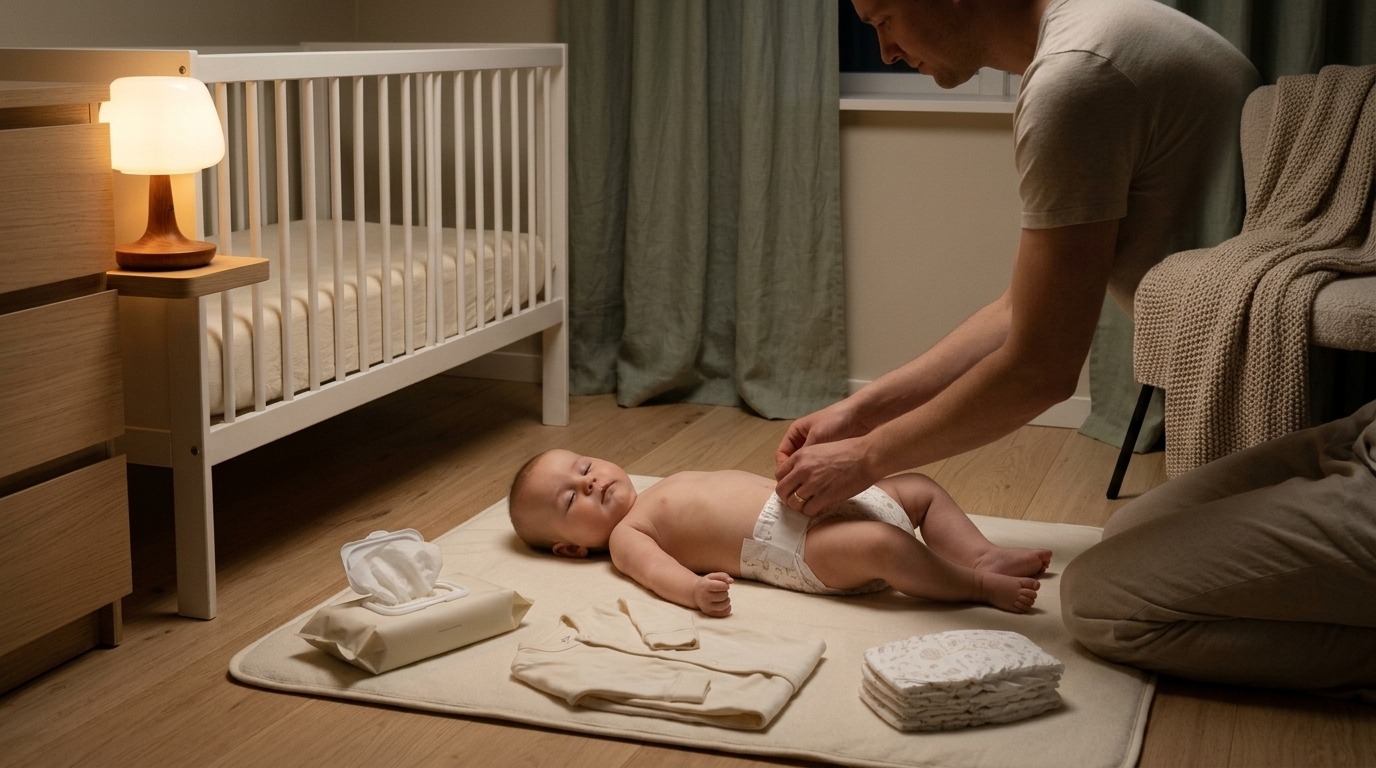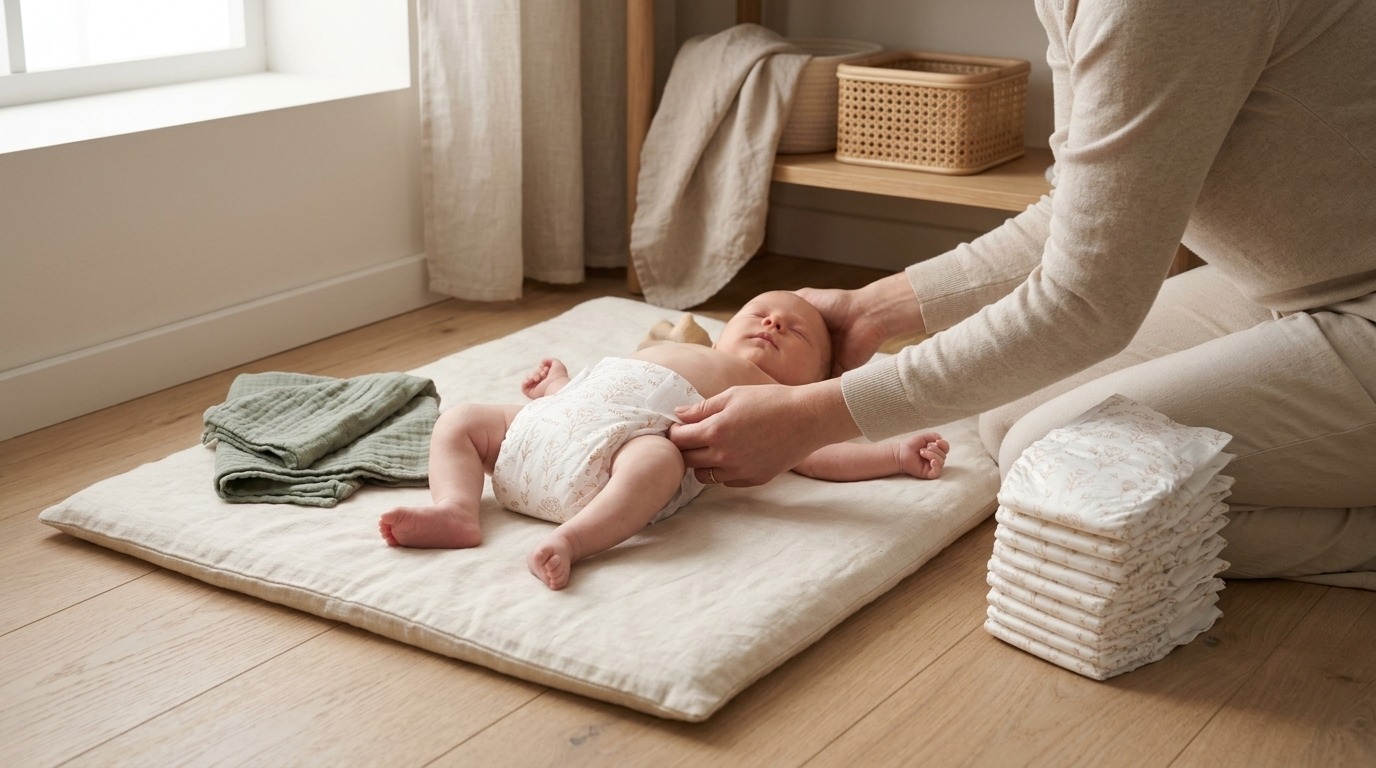
Ask a room of new parents what surprised them most about the first few weeks, and nappies will come up fast.
Not the changing itself. The sheer number of them.
Here's the short answer. Most babies get through somewhere between about 2,000 and 3,000 disposable nappies in their first year, and around 2,600 is a sensible figure to plan with. Newborns use the most, often 8 to 12 a day. Older babies usually settle at around 5 to 8. Every baby is different, so treat these numbers as a planning guide rather than a target, and don't feel you need to buy a year's supply before your baby arrives.
Below you'll find how that estimate is worked out, what changes month by month, how many packs it adds up to and what it might cost.
How Many Nappies Does a Baby Use Per Day?
The NHS says young babies may need changing as many as 10 or 12 times a day, while older babies need changing around 6 to 8 times. The bands in between are our planning estimates, built around those two reference points.
| Baby's age | Estimated nappies per day | Estimated nappies per month |
|---|---|---|
| 0–1 month | 8–12 | 240–360 |
| 1–2 months | 7–10 | 210–300 |
| 2–3 months | 6–9 | 180–270 |
| 3–6 months | 6–8 | 180–240 |
| 6–12 months | 5–8 | 150–240 |
Monthly figures use a 30-day month and are rounded. They're estimates for budgeting, not clinical norms.
Why newborns need so many changes
A newborn's bladder is tiny and empties often. Feeds are small and frequent, and many babies wee or poo during or straight after one. According to the NHS, babies do 2 or more poos a day in the first week, and some do a lot more.
Feeding type plays a part too. The NHS notes that breastfed newborns may poo at each feed in the early weeks and then, after about 6 weeks, sometimes go several days without one. Formula-fed babies may poo up to 5 times a day when newborn, dropping to around once a day after a few months. Neither pattern tells you how many nappies your baby will use, though. The difference between two babies on the same milk is often bigger than the difference between the groups.
Older babies still need regular checks
As your baby grows, their bladder holds more and poos tend to space out. That's why daily use drops. It doesn't mean you can stretch the time between changes. A nappy that's dirty still needs changing promptly, whatever age your baby is.
Nappy Usage Month by Month During the First Year
Here's how the year breaks down if you add up each stage. The middle column shows the likely total for each period.
| Age | Estimated daily use | Approximate nappies for the period | What you can expect |
|---|---|---|---|
| Month 1 | 8–12 | 240–360 | Frequent changes, including at night |
| Month 2 | 7–10 | 210–300 | Feeding settles and a routine starts to form |
| Month 3 | 6–9 | 180–270 | Your baby's own pattern becomes clearer |
| Months 4–6 | 6–8 | 540–720 | Changes often become more predictable |
| Months 7–9 | 5–8 | 450–720 | More movement, new foods, routine shifts |
| Months 10–12 | 5–8 | 450–720 | Usage may ease off a little more |
| First year | About 2,070–3,090 | Roughly 2,600 at the middle of each range |
How the total is worked out: each period's daily range is multiplied by its number of 30-day months, then added up. The low end assumes your baby sits at the bottom of every range all year. The high end assumes the top. Real babies wander between the two, which is why the middle figure (about 2,580, rounded to 2,600) is the most useful one for budgeting.
That lines up with other published figures. Nuby's UK guide estimates between 2,000 and 3,000 nappies in the first year. Brand-commissioned surveys of UK parents have landed both lower and higher: one for Rascals put it at 2,555, and one for Asda at 3,365. Surveys rely on parents' recall, so we wouldn't lean on either as an average.
A few things can push your numbers up or down in any month:
- a tummy bug or diarrhoea, which can mean several extra changes a day
- a growth spurt or a run of cluster feeding
- starting solid foods, which often changes how often your baby poos
- leaks from a nappy that no longer fits well
- teething, a cold or anything else that unsettles the usual routine
The most reliable number is your own. Count changes for three or four days, take the average and redo the sums every few weeks.
How Many Newborn Nappies Should You Buy Before Your Baby Arrives?
One to two weeks' supply is plenty for most families. At 8 to 12 changes a day, that's roughly 60 to 170 nappies. It's tempting to fill a cupboard, but you won't know your baby's weight, how quickly they'll grow or which nappies fit best until they're here.
Nappy sizes are set by weight, not age, and each brand uses its own ranges. A baby born at 2.8 kg may stay in the smallest size for weeks. A baby born at 4.2 kg might be ready for the next size up almost straight away. Any unopened packs they've outgrown are money spent on nothing, unless the shop will exchange them.
A sensible approach:
- buy a week or two's worth, plus a few for the hospital bag
- check the weight range on the pack rather than the size name
- open one pack at a time, so unused packs are easier to swap or pass on
- buy more once you know the fit and your baby's daily usage
We go into newborn numbers in more detail in our guide to how many nappies a newborn uses a day.
One point worth knowing early: the number of nappies you change isn't the same as the number of wet nappies a midwife asks you to count. Changes are your shopping number. Wet and dirty nappies, alongside weight and feeding, are one of the ways your midwife or health visitor checks that your baby is getting enough milk. Our article on how many wet nappies a newborn should have each day explains what to look for.
How Many Packs of Nappies Will You Need in the First Year?
Divide the number of nappies by the number in a pack. These examples use hypothetical pack sizes and our 2,600 planning figure:
- Example A: packs of 50. 2,600 ÷ 50 = 52 packs over the year.
- Example B: packs of 60. 2,600 ÷ 60 = 43.3, so about 44 packs.
These are illustrations, not a shopping list. In practice, packs usually get smaller as the nappies get bigger. Moise packs, for instance, go from 44 nappies in size 1 to 30 in size 4, and other brands follow a similar pattern. So you'll likely buy more packs in the second half of the year than the nappy count alone suggests.
Three things help here:
- Compare price per nappy, not price per pack. Divide the pack price by the number of nappies.
- Buy in step with your baby's size. A big box only saves money if your baby will finish it before sizing up.
- Keep a small buffer. Two or three days' spare covers a late delivery or a bad night.
How Much Will Nappies Cost in Your Baby's First Year?
The basic sum is simple:
Estimated first-year nappy cost = total nappies used × average price per nappy
The prices below are hypothetical, chosen only to show how the total moves. They aren't current UK market averages.
| Price per nappy | Estimated nappies in year one | Illustrative first-year cost |
|---|---|---|
| £0.10 | 2,600 | £260 |
| £0.15 | 2,600 | £390 |
| £0.20 | 2,600 | £520 |
| £0.25 | 2,600 | £650 |
The usage range matters as much as the price. At £0.15 a nappy, a baby at the low end of our estimate (about 2,100 nappies) costs around £315 for the year, while one at the high end (about 3,100) costs around £465.
Your real figure will depend on:
- the brand and range you choose
- nappy size and how many come in each pack
- where you buy, and whether there's a genuine promotion on
- subscription or multipack discounts
- whether you use disposables, reusables or a mix of both
Disposable vs Reusable Nappies: How Does Usage Differ?
The numbers in this article are for disposables, where every change uses a new nappy. Reusables work differently, so the two counts don't compare directly.
Disposable nappies
Disposables are easy to buy, quick to use and need no washing. That's a big plus in the sleep-deprived early weeks, at nursery and when you're out. The trade-off is that you keep buying them for as long as your baby is in nappies, and they take up bin and storage space. The NHS advises rolling a used nappy up, sealing it with the tabs and putting it in a bag kept only for nappies before it goes in the outside bin.
Reusable nappies
With reusables you buy a rotation, a "stash", and wash it. How many you need depends on your baby's age and how often you wash. A guide from Lisburn & Castlereagh City Council, citing the UK Cloth Nappy Library Network, suggests anywhere between 12 and 40 nappies, with fewer needed as your baby gets older, and recommends 18 to 22 as a starting point.
A few things change the size of the stash you need:
- How often you wash. Washing every day needs a smaller stash than washing twice a week.
- Drying time. Thick inserts can take a while to dry indoors in winter.
- Your baby's age. Newborns need more changes, so more nappies in rotation.
- Night-time. Many families use a more absorbent nappy overnight.
The NHS says cloth nappies can be machine washed at 60C, and that fabric conditioner should be avoided because it makes them less absorbent. Nappies with poo in them should be washed separately from other laundry.
Which option is better for your family?
There isn't one right answer. The NHS notes that disposables are very handy, but washable cloth nappies work out cheaper if you add up the costs over the years your baby's in nappies. Reusables do mean an upfront cost, plus laundry time, water and energy.
The environmental picture depends heavily on how you wash. In the UK's most recent government life-cycle study (published in 2008, using 2006 data), disposables came to about 550 kg CO2 equivalent over two and a half years, and reusables to about 570 kg with average washing and drying. Line drying and fuller loads cut that by 16%. Reusing the nappies on a second child cut it by 40%. Tumble drying every load pushed it up by 43%. The data is now old, so read it as a guide to what matters rather than a final verdict.
Plenty of families mix and match: reusables at home, disposables for nights, nursery or trips. Think about your budget, your washing machine and drying space, how much time you have and what feels manageable.
How Often Should You Change Your Baby's Nappy?
Check regularly and change whenever the nappy is dirty, and soon after it's wet. The NHS explains that babies have very delicate skin, so their nappy needs to be changed as soon as they wet or poo themselves, otherwise their skin becomes sore and red.
In practice:
- Check around feeds and when your baby wakes. Many nappies have a wetness indicator line that changes colour.
- Change dirty nappies promptly. Poo irritates the skin more than wee alone.
- At night, judge it case by case. If your baby has done a poo, or the nappy is leaking or clearly uncomfortable, change it. Our guide on changing a nappy at night without waking your baby has tips for keeping it calm.
- Follow your healthcare team's advice if your baby has nappy rash, broken skin or a skin condition.
Please don't leave your baby in a wet or dirty nappy for longer just to make a pack last. It can lead to sore skin and leaks, and it usually costs more in the end.
Does Nappy Size Affect How Many Nappies You Use?
It can. A nappy that fits well holds what it's meant to. One that's too small or too big leaks, and every leak means an extra nappy, an outfit change and sometimes a sheet change.
Sizes are based on weight, and ranges overlap. Moise, for example, tells parents to go by weight rather than age and to choose the larger size if your baby is right at the start of the next range. Always check the guidance for the brand you're using.
Signs a nappy may be too small:
- red marks on the tummy or thighs that don't fade quickly
- tabs that only just meet, or a waistband that looks tight
- frequent leaks, especially up the back
Signs a nappy may be too large:
- gaps around the legs or waist
- leaks at the legs, even when the nappy isn't full
- the nappy sagging or twisting as your baby moves
If leaks keep happening, our guide to nappy leaking at the legs or back walks through the usual causes and fixes.
Practical Tips to Manage Nappy Usage and Save Money
- Work out the cost per nappy before comparing deals.
- Buy bigger quantities only in a size your baby will use for a while.
- Don't overstock the smallest sizes before the birth.
- Look for genuine promotions on products you already know fit.
- Consider a subscription if it offers a real saving and lets you change size, skip or pause easily.
- Keep a small supply in the changing bag so you're not buying emergency packs at higher prices. Our changing bag checklist covers the essentials.
- Get the size right to cut down avoidable leaks.
- Try reusables part-time if they suit your home and routine.
- Track how long each pack lasts. It's the quickest way to spot when usage changes.
Saving money should never mean delaying a change your baby needs, or using a nappy that doesn't fit.
Every baby's nappy needs are different. If you're worried about how many wet or dirty nappies your baby is having, or about their poo, skin or feeding, speak to your midwife, health visitor or GP.
Frequently asked questions
Most babies use somewhere between about 2,000 and 3,000 disposable nappies in their first year. Around 2,600 is a sensible planning figure. That's based on 8–12 changes a day in the first month, easing to around 5–8 a day by the second half of the year. Your baby's total may sit higher or lower.
Usually around 8 to 12. The NHS says young babies may need changing as many as 10 or 12 times a day. Some days you'll use more, for example after a leak or a run of runny poos, and some days fewer.
Around one to two weeks' worth, which is roughly 60 to 170 nappies at 8–12 a day. You won't know your baby's weight or how fast they'll grow until they arrive, so buy more once you've checked the fit.
In a 30-day month, expect roughly 240–360 in month one, 210–300 in month two and 180–270 in month three. From three to six months it's usually 180–240, and from six to twelve months around 150–240.
Usually gradually over the first few months. The NHS describes older babies as needing around 6 to 8 changes a day. Breastfed babies may show a clear drop after about six weeks, when some start pooing less often. There's no fixed date.
It depends on pack size. Using 2,600 nappies as an example, packs of 50 would mean 52 packs, and packs of 60 about 44. Packs usually hold fewer nappies in bigger sizes, so the real number of packs is often a little higher.
Multiply the nappies you use by the price per nappy. As an illustration, 2,600 nappies at £0.15 each comes to £390, and at £0.25 each to £650. Brand, pack size, promotions and subscriptions all change the final figure.
Not reliably. Breastfed newborns may poo at each feed in the early weeks, while formula-fed newborns may poo up to five times a day. Patterns change over time and vary a lot between babies, so plan with the same estimates either way.
Check regularly, change a dirty nappy promptly and change a wet one soon after. The NHS advises changing as soon as possible after a wee or poo to help prevent nappy rash. At night, change after a poo, a leak or if your baby seems uncomfortable.
Only in a size your baby will be in for a while. Bulk buying saves money when you finish the box. Avoid stockpiling the smallest sizes before birth, and keep unopened packs so you can exchange or pass them on.
Look at weight and fit rather than age. Red marks that don't fade, tabs that barely meet and regular leaks up the back are common signs. Check the weight range on the pack and, if your baby is at the start of the next range, consider moving up.
Usually, over the whole time your baby is in nappies. The NHS says washable cloth nappies work out cheaper when you add up the costs over the years. You'll pay more upfront and for washing, and the saving grows if you reuse them for another child.