The first few nappy changes can feel oddly high-stakes. Your baby is tiny, the poo is everywhere, and nobody told you exactly where to wipe. Most new parents wonder whether they are doing it properly.
Here is the short answer to how to clean your baby's nappy area:
- Clean the whole nappy area gently at each change.
- For girls, wipe from front to back, so poo moves away from the vaginal and urethral openings.
- For boys, clean the outside of the penis, the scrotum and the surrounding folds. Never force the foreskin back.
- Use warm water with cotton wool or a soft cloth, or suitable baby wipes.
- Pat the skin dry, then put on a clean, well-fitting nappy.
That really is most of it. Gentle cleaning removes wee and poo, keeps the skin comfortable and cuts down on avoidable irritation. The rest of this guide covers the details for girls and boys, step by step.
This article offers general information. It is not a substitute for advice from your midwife, health visitor or GP.
What Do You Need to Clean Your Baby's Nappy Area?
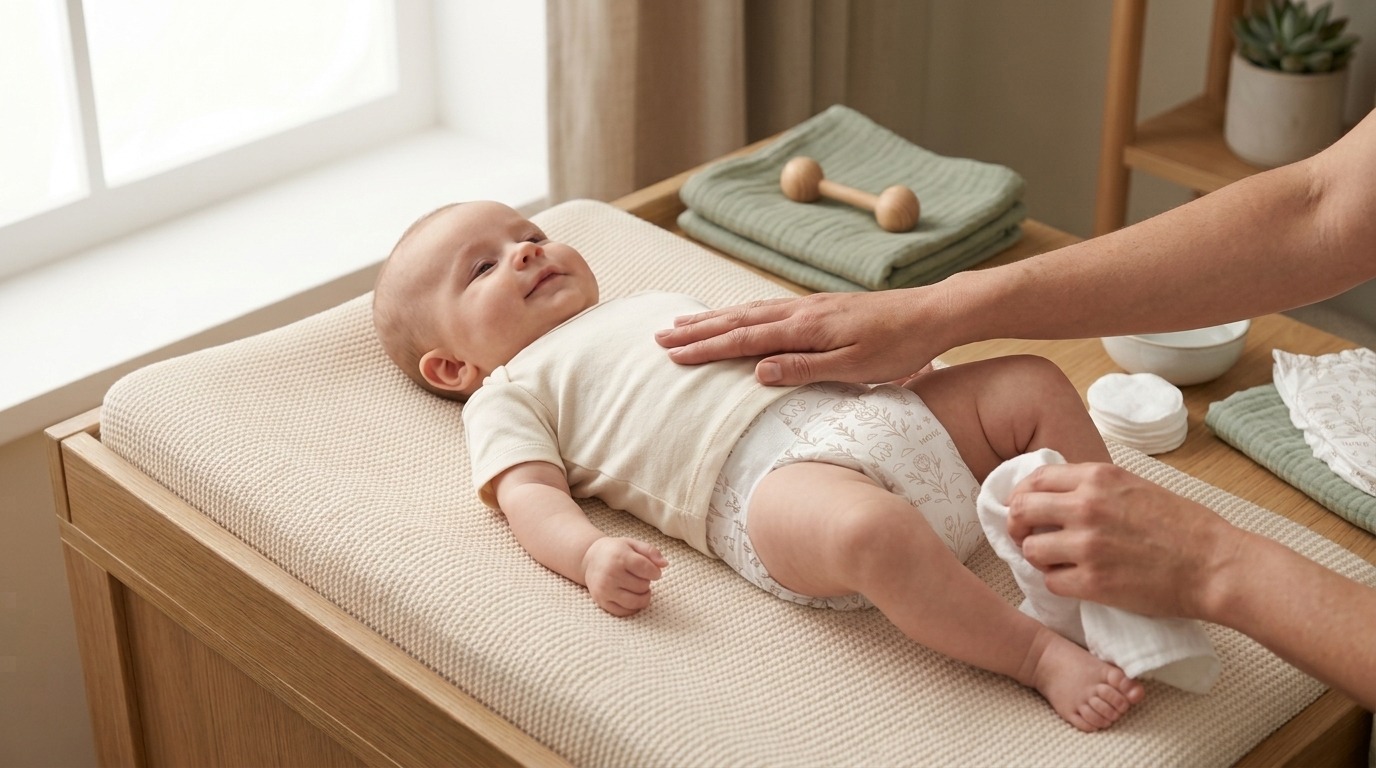
You need very little: something to clean with, something to dry with, and a clean nappy. The NHS guide to changing a nappy suggests gathering everything in one place before you start.
A simple kit looks like this:
- A clean nappy
- A bowl of warm water
- Cotton wool or a soft, clean cloth
- Fragrance-free, alcohol-free baby wipes, if you prefer them
- A clean towel or soft cloth for drying
- A barrier cream, if your baby needs one
- A changing mat or towel on a safe, stable surface
- A bag or bin for the dirty nappy
There is no need for a shelf of specialist products. If you are still building your kit, our newborn essentials checklist covers the basics for the first month.
Staying safe during a nappy change
A few habits make every change safer and calmer:
- Prepare first. Lay out your supplies before you undo the nappy.
- Change on the floor when you can. The NHS describes a mat or towel on the floor as the best place, because your baby cannot fall.
- Keep a hand on your baby on any raised surface. Do not rely on the straps.
- Never walk away from a baby on a changing table, even for a second.
- Bin it properly. Roll up the used nappy, bag it and put it in an outside bin.
- Wash your hands before and after each change.
Chat to your baby while you work. It helps them relax, and it helps you slow down.
How to Clean Your Baby Girl's Nappy Area
Clean a baby girl from front to back, on the outside only. That one habit covers most of what you need to know.
A little anatomy helps. The vulva is the outer part you can see, including the soft folds of skin called the labia. Tucked within those folds are two small openings: the urethra, where wee comes out, and the vagina just behind it. The anus sits further back.
Because these openings are close together, the direction you wipe matters.
Step-by-Step: Cleaning a Baby Girl
- Lay your baby on a safe, stable changing surface and undo the dirty nappy.
- If there is poo, use the clean front of the nappy to lift most of it away. Then use the cleanest part of your wipe or cloth.
- Wipe from front to back, moving away from the vulva towards her bottom.
- Use a fresh wipe, or a fresh section of cloth, for each pass when needed.
- Gently clean the outer folds of the vulva where you can see residue. Do not scrub.
- Never put wipes, cotton wool or anything else into the vaginal opening.
- Clean the area around the anus last.
- Pat her skin dry, then put on a clean nappy.
Why front to back? Poo carries bacteria. Wiping backwards moves it away from the urethral and vaginal openings. The NHS advises that girls should be cleaned from front to back to avoid getting germs into the vagina.
How Do You Clean Between the Folds?
Clean between the folds only where you can see poo or cream, using a soft, damp cloth and one light stroke at a time. Residue tends to collect here after a messy nappy.
Keep these points in mind:
- Clean only where it is needed.
- Use gentle, downward movements, front to back.
- Part the outer folds lightly. Avoid pulling or stretching the skin.
- Leave normal whitish secretions alone. They do not need to be removed.
- Stop if the skin looks sore or fragile, and switch to plain warm water.
Her skin does not need to look spotless. A healthy vulva is never scrubbed clean, and the vagina looks after itself on the inside.
Is White Discharge Normal in a Newborn Girl?
Yes, a little white discharge is common in newborn girls. The NHS explains that it is caused by hormones that crossed the placenta before birth. It usually appears in the first days and settles by itself.
Those same hormones can occasionally cause slight bleeding, a bit like a mini period. The NHS describes both as nothing to worry about.
You do not need to clean inside the vagina or wipe the discharge away. Simply clean the outside as usual.
Speak to your midwife, health visitor or GP if the discharge:
- carries on or comes back after the early weeks
- smells unpleasant
- comes with a fever, marked redness or swelling
- worries you for any other reason
A professional can look properly. Appearance alone cannot tell you the cause.
How to Clean Your Baby Boy's Nappy Area
Clean a baby boy on the outside only: the penis, the scrotum and the skin folds around them. Leave the foreskin exactly where it is.
The same principles apply as for girls. Be gentle, remove wee and poo, check the creases and skip unnecessary products.
Step-by-Step: Cleaning a Baby Boy
- Lay your baby on a safe, stable changing surface.
- Undo the dirty nappy carefully. Use the clean front to lift away most of any poo.
- Gently clean the penis, scrotum and surrounding skin with warm water and cotton wool, a soft cloth or suitable baby wipes.
- Clean around the base of the penis and under the scrotum, where residue likes to hide.
- Clean the area around the anus last, so poo does not travel forwards.
- Pat the skin dry.
- Put on a clean, well-fitting nappy.
One practical tip: cool air often makes baby boys wee mid-change. Keep a clean cloth or the fresh nappy within reach, and lay it loosely over him while you work.
Should You Pull Back a Baby Boy's Foreskin to Clean It?
No. Never forcibly pull back a baby's foreskin. It is not needed for cleaning, and it can hurt him.
In babies, the foreskin is usually still attached to the head of the penis, called the glans. It separates naturally over time. The NHS page on tight foreskin says this is normal, and that most boys' foreskins do not pull back before the age of 5.
The NHS also warns that pulling back a foreskin that is still attached can be painful and cause damage. So during nappy changes:
- Clean only what you can see and reach easily.
- Wipe the outside of the penis as you would any other skin.
- Do not use cotton buds, antiseptics or anything else under the foreskin.
You may notice small white lumps beneath the foreskin. This is usually smegma, a harmless mix of skin cells and natural oils. The Royal Children's Hospital Melbourne notes that there is no need to retract the foreskin to remove it.
If your son's foreskin moves back a little without any effort or pain, that is fine. Do not push it further, and ask your health visitor or GP if you would like guidance.
If your son has been circumcised, follow the aftercare advice from the clinician who carried out the procedure.
How Do You Clean Around the Scrotum and Penis?
Use a damp cloth or wipe and work through each area in turn: the penis, then the scrotum, then the creases, then the bottom.
- Penis: wipe the outside with soft strokes. Do not pull on the penis or the foreskin.
- Scrotum: lift it gently and clean underneath. Poo often collects here.
- Groin creases: wipe along the folds where the thighs meet the body.
- Bottom: clean between the buttocks last, wiping away from the genitals.
Avoid rubbing hard, and dry each fold with a soft pat. Speak to your GP or health visitor if you notice lasting redness, swelling, pain or discharge.
How to Clean Your Baby's Nappy Area After a Poo
After a poo, remove the bulk first, then clean in passes from the cleanest area to the dirtiest. Poo irritates skin more than wee does, so this is the change to take your time over.
- Open the nappy and use its clean front to wipe away most of the poo.
- Fold the dirty nappy under your baby's bottom, clean side up, while you work.
- Use a fresh wipe, or a fresh part of the cloth, for each pass.
- For girls, keep wiping from front to back.
- For boys, clean the penis, scrotum, folds and surrounding skin gently.
- Clean the anus last.
- If residue is stubborn, hold a warm, wet piece of cotton wool on it for a moment, then lift it away.
- Pat the skin dry without rubbing.
- Apply a thin layer of barrier cream if your baby needs it, then fasten a clean nappy.
Newborn poo can leave a faint stain on the skin, especially sticky meconium in the first days. Do not scrub to shift it. Clean, comfortable skin matters more than spotless skin, and the mark will fade.
Baby Wipes or Water: Which Is Better?
Neither is better for every baby. The NHS lists both options: cotton wool with warm water, or fragrance-free and alcohol-free baby wipes. The right choice depends on your baby's skin, the product and what suits your day.
Cleaning With Warm Water and a Soft Cloth
Water is the simplest option, and many parents prefer it in the newborn weeks.
- Minimal ingredients. Nothing touches the skin except water.
- Kind to sore skin. It is a sensible choice when skin is sensitive or irritated.
- Needs clean materials. Use fresh cotton wool each time, or a freshly washed cloth.
- Warm, not hot. Test the water on the inside of your wrist first.
- Needs drying. Water leaves skin wetter than a wipe, so pat dry carefully.
Using Baby Wipes
Wipes are practical at home and hard to beat when you are out.
- Choose wipes made for babies. Adult or household wipes are not suitable.
- Fragrance-free and alcohol-free is the NHS recommendation. The NHS notes that fragranced wipes or wipes containing alcohol can irritate skin.
- Follow the pack instructions, including any age guidance.
- Watch your baby's skin. If a product seems to make redness worse, stop and switch to water for a few days.
If you prefer wipes, check the ingredient list before you buy. You can read the full ingredient details for Moise baby wipes on the product page.
Soap is rarely needed at a nappy change. For more on gentle cleansers, see our guide to baby bath products and what to avoid.
| Warm water and cloth | Baby wipes | |
|---|---|---|
| Best for | Newborns, sore or sensitive skin | Travel, nights, quick changes |
| Watch out for | Water temperature, damp skin afterwards | Fragrance, alcohol, skin reactions |
| Drying needed | Yes, always | A light pat is usually enough |
How Often Should You Clean Your Baby's Nappy Area?
Clean the nappy area at every nappy change, and promptly after every poo. There is no need to wash it between changes.
The NHS advises changing a nappy as soon as possible after a wee or poo. It also says to clean your baby fully whether they have wet themselves or done a poo. A wet-only change can still be quick and light.
- Change dirty nappies promptly. Poo is the bigger irritant.
- Check wet nappies regularly. Do not wait for one to feel heavy.
- Wipe lightly after a wee. One or two gentle passes are enough.
- Avoid over-washing. Extra scrubbing does not make skin healthier.
- Adapt for sore skin. Use plain water and softer strokes during a flare-up.
The number of changes varies with age and feeding. The NHS says young babies may need changing 10 to 12 times a day, and older babies around 6 to 8 times. Treat those as typical ranges, not targets. Our guide to how often to change a baby's nappy explains this stage by stage.
How to Dry Your Baby's Nappy Area Properly
Pat your baby's skin dry with a soft, clean towel before the new nappy goes on. Damp skin sealed inside a nappy is more likely to become sore.
- Pat, do not rub. Press the towel gently against the skin.
- Use a clean, soft towel or cloth kept just for nappy changes.
- Dry the creases. Check the groin, the folds of the thighs and between the buttocks.
- Do not pull skin apart to reach a fold. A light press is enough.
- Allow some air. If the room is warm, let your baby lie nappy-free on the mat for a while.
- Wait until skin is dry before fastening the clean nappy.
Never use a hairdryer or any other direct heat on your baby's skin. It can burn.
The same gentle approach works for the rest of your baby's daily wash. See our guide to top and tailing a newborn.
How to Help Prevent Nappy Rash
Prompt changes, gentle cleaning and dry skin are the three habits that help most. The NHS advice on nappy rash recommends the following:
- Change wet or dirty nappies as soon as possible.
- Clean with water, or fragrance-free and alcohol-free baby wipes.
- Pat the skin dry gently.
- Leave the nappy off when you can.
- Make sure nappies fit properly and are not fastened too tightly.
- Avoid soap, bubble bath and baby lotion on the nappy area.
- Do not use talcum powder or antiseptic creams on nappy rash.
A pharmacist may suggest a thin layer of barrier cream at each change to protect the skin.
Nappy rash can still appear with excellent care. The NHS describes it as normal for babies to get it sometimes. Loose poos and some medicines can trigger it, and no single product prevents every rash. It is not a sign that you have done something wrong.
For causes, treatment and what to look for, read our full guide to nappy rash causes, treatment and prevention.
Common Mistakes When Cleaning a Baby's Nappy Area
Every parent makes a few of these while learning. Each has a simple fix.
| Common mistake | What to do instead |
|---|---|
| Wiping a baby girl from back to front | Always wipe front to back |
| Scrubbing the vulva or penis | Use light strokes, on visible residue only |
| Cleaning inside the vagina | Clean the outside only |
| Pulling back a baby's foreskin | Leave it alone and clean the outside |
| Reusing a dirty wipe on clean skin | Take a fresh wipe or fold to a clean side |
| Leaving poo in skin folds | Check the groin, scrotum and buttock creases |
| Rubbing the skin dry | Pat with a soft towel |
| Using perfumed products on sore skin | Switch to plain warm water |
| Layering several creams at once | Use one barrier cream, thinly |
| Stepping away from a raised surface | Keep a hand on your baby, or change on the floor |
When Should You Contact a Healthcare Professional?
Contact your health visitor, pharmacist or GP if a rash is not improving, is getting worse, or your baby seems unwell. Mild redness usually settles with gentle care, but some signs need a proper look.
Seek advice if:
- the redness is severe, lasts, spreads or keeps getting worse
- the skin is broken, bleeding, blistered or producing pus
- there is marked swelling or your baby is clearly in pain
- there is unusual or foul-smelling discharge
- your baby has a high temperature or seems unwell alongside a rash
- your baby cries when weeing, or struggles to wee
- a rash has not improved after a few days of careful basic care
- you are simply unsure whether something is normal
Young babies and fever need extra caution. The NHS advises calling 111 if a baby under 3 months has a temperature of 38C or higher, or a baby aged 3 to 6 months has 39C or higher.
Call 999 or go to A&E if a boy's foreskin has been pulled back and will not return to its normal position. The NHS treats this as an emergency.
This article cannot diagnose a rash or an infection. If in doubt, ask. Health professionals would rather see you early.
Final Thoughts: Gentle Nappy Care for Girls and Boys
Knowing how to clean your baby's nappy area comes down to a handful of habits:
- Clean gently and avoid rubbing.
- Wipe girls from front to back.
- Clean the outside of the genital area only.
- Never force a baby boy's foreskin back.
- Use warm water and a soft cloth, or suitable baby wipes.
- Pat the skin dry and change nappies regularly.
- Ask a professional if symptoms persist or anything worries you.
The first few changes feel fiddly for everyone. Within a week or two, your hands will know what to do. A simple, gentle routine is usually all your baby needs.