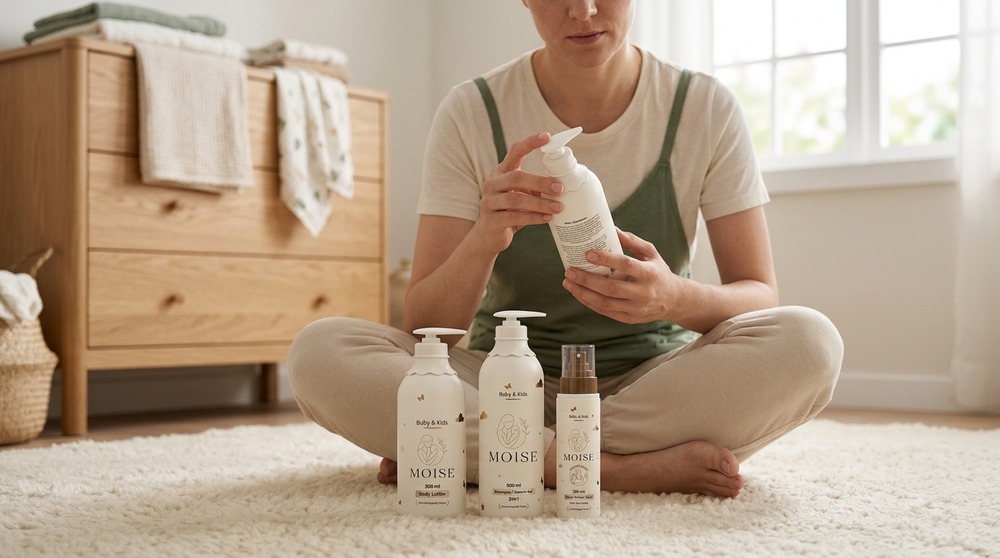
You pick up a bottle of baby lotion, turn it over, and find twenty-odd words that look like a chemistry exam.
Butyrospermum Parkii Butter. Caprylic/Capric Triglyceride. Phenoxyethanol. Is any of that good? Bad? Should you put it back?
That list on the back follows a standard naming system called INCI, the International Nomenclature of Cosmetic Ingredients. Once you know how it works, it becomes one of the most useful things on the pack, far more useful than most of the words on the front.
It matters more for babies than for adults because a baby's skin barrier is still developing. Newborn skin is thinner and loses moisture more easily, so it can react to things that wouldn't bother you. Many reactions come from just a few kinds of ingredient, and those are easy to spot once you know what to look for.
You don't need a chemistry degree. This guide shows you how to read a baby skincare ingredients list step by step: how the order works, how to spot moisturisers, fragrance, preservatives and cleansers, which ingredients deserve a closer look, and how to decode claims like "hypoallergenic" and "dermatologically tested".
Why should parents read baby skincare ingredients lists?
The front of a bottle tells you what the brand wants you to feel. The ingredients list tells you what's actually inside. Reading it helps you:
- See what's really in the product. "Enriched with oat" might mean oat is the third ingredient or the twenty-third.
- Spot fragrance and other common irritants, which matters most if your baby's skin is sensitive.
- Recognise the useful stuff, the ingredients that moisturise and protect the skin barrier.
- Compare products fairly. Two lotions at very different prices can have surprisingly similar formulas.
- Look past marketing claims like "natural", "pure" or "gentle", which have no fixed legal meaning.
- Avoid repeat reactions. If your baby has reacted to something before, the list is how you avoid it next time.
- Make better choices for eczema-prone skin, where small differences in a formula can matter.
An ingredients list is a screening tool, though, not a guarantee. It can't tell you the exact amount of each ingredient, how the formula behaves as a whole, or how your particular baby will react. Use it to narrow down your choices, then let your baby's skin have the final say.
What is an INCI ingredient list?
INCI stands for International Nomenclature of Cosmetic Ingredients. It's a shared naming system, so the same ingredient has the same name on a label in London, Berlin or New York.
In the EU and UK, the cosmetics rules require an ingredients list headed "Ingredients" using these standard names. In the US, the FDA also requires cosmetic ingredients to be listed, and most brands use INCI names there too.
The system explains why labels can look strange:
- Plant ingredients usually appear under their Latin botanical name, for example Helianthus Annuus Seed Oil for sunflower oil.
- Water is written as "Aqua" in many markets.
- Fragrance mixtures can appear as one word, usually "Parfum" or "Fragrance".
- Colourants often appear as CI numbers, such as CI 77891.
- Nanomaterials must be marked "[nano]" on EU labels.
| INCI name | Common name | Typical function |
|---|---|---|
| Aqua | Water | Solvent and product base |
| Glycerin | Glycerin | Humectant |
| Butyrospermum Parkii Butter | Shea butter | Emollient |
| Helianthus Annuus Seed Oil | Sunflower seed oil | Skin-conditioning agent / emollient |
| Panthenol | Pro-vitamin B5 | Skin-conditioning agent |
| Tocopherol | Vitamin E | Antioxidant (protects oils in the formula) |
| Petrolatum | Petroleum jelly | Occlusive skin protectant |
One thing to keep in mind: an ingredient's job depends on the whole formula and how much is in it. The same oil can be a minor softener in a wash and the main moisturiser in a balm.
How to read a baby skincare ingredients list step by step
Step 1: Find the full ingredients list
Look on the back of the bottle, the outer box, or a peel-back or fold-out label on small packs. In the EU and UK, the list is headed "Ingredients". If you're shopping online, the full list should be on the product page. If a brand only shows "key ingredients" and you can't find the complete INCI list anywhere, that's worth noting. Good brands publish everything.
Step 2: Understand the ingredient order
This is the part most people don't know.
- Ingredients are listed in descending order of weight at the time they're added to the product. The biggest amount comes first.
- Under EU rules, ingredients present at less than 1% can be listed in any order after the ones above 1%.
- Colourants can be listed at the end, in any order.
- So the first four or five ingredients usually make up most of the product.
- But position doesn't tell you an exact percentage. You can't tell whether ingredient number 8 is at 2% or 0.3%.
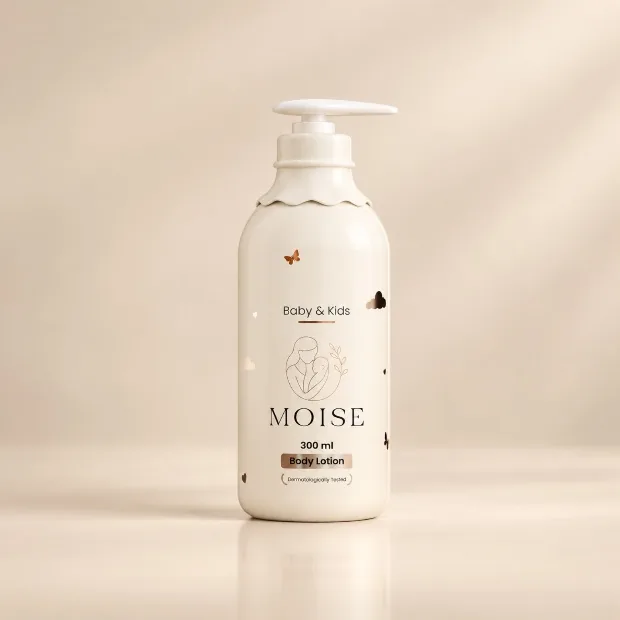
A real example. Here's how the start of our own Moise Body Lotion reads:
Water, Caprylic/Capric Triglyceride, Ethylhexyl Palmitate, Glycerin, Propanediol, Hydrogenated Coconut Oil, Cetearyl Alcohol, Avena Sativa (Oat) Kernel Oil…
Read from the top: water is the base, which makes it a lotion rather than a balm. Next come two light emollients and then two humectants, glycerin and propanediol, so the main job is softening and holding in moisture. Oat sits further down. It's there, but in a smaller amount than the first few. Further along the list you'll also find "Fragrance", which tells you this is not a fragrance-free product. That's exactly the kind of thing the list is for.
Step 3: Identify the main moisturising ingredients
Moisturisers usually combine three types of ingredient:
Humectants draw water into the outer layer of the skin and help it stay there.
- Glycerin
- Sodium hyaluronate (a form of hyaluronic acid)
- Panthenol
- Propanediol
Emollients fill tiny gaps between skin cells, making skin feel softer and smoother.
- Shea butter (Butyrospermum Parkii Butter)
- Sunflower seed oil (Helianthus Annuus Seed Oil)
- Squalane
- Caprylic/capric triglyceride
Occlusives form a thin layer on top of the skin that slows water loss.
- Petrolatum
- Mineral oil (Paraffinum Liquidum)
- Dimethicone
A good moisturiser often contains something from more than one group. Lighter lotions lean towards humectants and light emollients. Thicker creams and ointments carry more emollients and occlusives, which is why they suit very dry patches.
Step 4: Look for skin-conditioning ingredients
These support the skin's comfort and barrier in a cosmetic sense:
- Ceramides (e.g. Ceramide NP): fats that occur naturally in the skin barrier.
- Panthenol: pro-vitamin B5, a conditioning humectant.
- Colloidal oatmeal (Avena Sativa Kernel Flour): finely ground oat, long used in products for dry, itchy-feeling skin.
- Allantoin: a soothing, skin-conditioning ingredient.
- Bisabolol: a calming ingredient originally found in chamomile.
- Niacinamide: vitamin B3, more common in adult products.
These are useful signs that a product is designed for dry or sensitive skin. But a cosmetic moisturiser isn't a treatment. If your baby has eczema, follow the emollient plan from your GP, health visitor or dermatologist.
Step 5: Check for fragrance and essential oils
Fragrance can show up as:
- Parfum or Fragrance (one word covering a mixture of many scent ingredients)
- Aroma (usually flavour, in lip or oral products)
- Named fragrance allergens such as Linalool, Limonene, Citral, Geraniol or Citronellol. In the EU these must be listed individually above certain levels, and the list of allergens that must be named is being expanded.
- Essential oils under their Latin names, for example Lavandula Angustifolia Oil (lavender), Mentha Piperita Oil (peppermint), Eucalyptus Globulus Leaf Oil or Citrus Aurantium Dulcis Peel Oil (orange).
Fragrance is one of the most common causes of skin allergy from cosmetics, and essential oils contain many of the same allergens. Plenty of babies use lightly fragranced products without any problem, and the amount matters. But if your baby has sensitive or eczema-prone skin, fragrance-free products are the simpler, lower-risk starting point.
Fragrance-free vs unscented: "Fragrance-free" generally means no fragrance has been added. "Unscented" means the product doesn't smell of much, which can be achieved by adding masking fragrance. Always check the list rather than the claim.
Step 6: Understand preservatives
Any product that contains water can grow bacteria and mould. Preservatives stop that, and they protect your baby from contaminated products. A water-based lotion without an effective preservative system isn't safer. It's a risk.
Common ones you'll see:
- Phenoxyethanol: one of the most widely used. Permitted in the EU up to 1%.
- Sodium benzoate and potassium sorbate: often used together.
- Benzyl alcohol: also a fragrance allergen at higher levels.
- Parabens (Methylparaben, Ethylparaben, etc.).
- Hydroxyacetophenone, 1,2-hexanediol, chlorphenesin: newer or "boosting" ingredients often used in "paraben-free" formulas.
The safety of a preservative depends on which one it is, how much is used, the type of product and the regulations it has to meet. In the EU, every preservative must be on an approved list with maximum levels. "Preservative-free" isn't automatically better, and "contains preservatives" isn't a red flag.
Step 7: Check for cleansing agents (surfactants)
In washes and shampoos, the first few ingredients after water are usually surfactants. These lift dirt and oil so they can be rinsed away.
- Coco-glucoside, decyl glucoside, lauryl glucoside: generally considered mild.
- Cocamidopropyl betaine: a common mild co-surfactant.
- Sodium laureth sulfate (SLES): widely used. Milder than SLS, especially when combined with other surfactants.
- Sodium lauryl sulfate (SLS): more likely to dry or irritate skin, especially with frequent use.
Don't judge a cleanser on one ingredient. A wash with a small amount of SLES alongside gentler surfactants and humectants can be milder than you'd expect. For young babies, though, the bigger point is that you need very little cleanser at all. Plain water is enough in the first month.
Which ingredients should parents be cautious about in baby skincare?
This isn't a blacklist. Whether an ingredient is a problem depends on how much is used, what kind of product it's in, your baby's age and skin, and the rules the product has to meet. These are simply the ingredients worth a second look.
| Ingredient or category | Why you might check it | Practical consideration |
|---|---|---|
| Added fragrance / Parfum | A common cause of skin irritation and allergic reactions | Consider fragrance-free options for sensitive or eczema-prone skin |
| Essential oils | Contain natural fragrance allergens; some can irritate | Don't assume "natural oil" means gentle; essential oils aren't recommended for routine care of young babies |
| Methylisothiazolinone (MI) | A well-known contact allergen | Banned in leave-on cosmetics in the EU; only allowed at very low levels in rinse-off products |
| Methylchloroisothiazolinone (MCI) | Can cause allergic contact dermatitis | The MCI/MI mix is banned in EU leave-on products; check imports and older stock |
| Sodium lauryl sulfate (SLS) | Can be drying or irritating, especially with frequent use | Choose gentler cleansing systems for regular baby washing |
| Exfoliating acids (glycolic, salicylic, lactic acid at higher levels) | Not needed in routine baby care | Use only if a healthcare professional advises it |
| Drying alcohols | Some short-chain alcohols can dry the skin | Don't confuse these with fatty alcohols |
| Propyl- and butylparaben in nappy-area leave-on products | Restricted in the EU for leave-on products for the nappy area of children under three, as a precaution | Products may carry "Do not use on the nappy area" |
Not all alcohols are the same
This is one of the most common label mix-ups.
- Drying alcohols: Alcohol Denat., Alcohol (ethanol), Isopropyl Alcohol. Often high on the list in sprays, gels and wipes. They evaporate quickly and can dry the skin.
- Fatty alcohols: Cetyl Alcohol, Stearyl Alcohol, Cetearyl Alcohol. Waxy ingredients that thicken creams and help soften skin. They're not drying, and they're very common in good moisturisers.
So "alcohol-free" on a label usually refers to drying alcohols. A product containing cetearyl alcohol can still honestly be called alcohol-free in that everyday sense.
Ingredients commonly found in baby skincare products
A quick reference for the ingredients you'll see most often:
| Ingredient (INCI) | Typical function | What parents should know |
|---|---|---|
| Glycerin | Humectant | One of the most widely used moisturising ingredients; well tolerated by most skin |
| Butyrospermum Parkii Butter (shea butter) | Emollient | Rich and softening; common in creams and balms |
| Petrolatum | Occlusive | Very effective at reducing water loss; refined cosmetic grade is used |
| Paraffinum Liquidum (mineral oil) | Emollient / occlusive | Long track record in baby products; not "bad" just because it isn't plant-based |
| Panthenol | Skin-conditioning agent | Pro-vitamin B5; common in moisturisers and nappy creams |
| Ceramide NP / AP / EOP | Skin-conditioning lipids | Support the skin barrier; common in products for dry skin |
| Avena Sativa Kernel Flour (colloidal oatmeal) | Skin-conditioning agent | Often found in products for dry or sensitive skin |
| Dimethicone | Skin protectant / emollient | Silicone that forms a breathable protective layer |
| Tocopherol | Antioxidant | Vitamin E; protects oils in the formula from going off |
| Sodium Hyaluronate | Humectant | Helps skin hold on to water |
| Zinc Oxide | Skin protectant | The classic active in many nappy barrier creams |
Seeing a familiar ingredient on the list is reassuring, but it doesn't guarantee the finished product suits every baby.
How to read baby skincare marketing claims
The front of the pack is marketing. Here's what common claims do and don't tell you.
Hypoallergenic
It means the brand has designed the product to reduce the chance of allergic reactions, for example by leaving out common allergens. It does not mean a reaction can't happen. In the EU, claims must be backed up by evidence, but there's no single legal test for "hypoallergenic". In the US, there's no federal definition at all.
Dermatologically tested
Some kind of skin test was done, usually on adult volunteers under a dermatologist's supervision. It doesn't tell you how many people took part, what the results were, or whether babies were included. It's a reasonable sign of care, not proof of suitability for your baby.
Fragrance-free
No fragrance has been added. This is one of the more useful claims for babies with sensitive skin. Still check the list for essential oils or named fragrance ingredients, as "fragrance-free" isn't always used consistently.
Natural or organic
"Natural" has no legal definition for cosmetics. Organic certification (such as COSMOS) tells you about where ingredients come from and how they're farmed, not whether the product is gentler. Plant extracts and essential oils are among the more common allergens.
Clinically tested
Ask what was tested, on whom, how many people, for how long, and what the result was. A brand that can't answer that is using the phrase for decoration.
Suitable for newborns / from birth
Useful, but look for the age guidance in the directions too, not just on the front. And remember the NHS advice: in the first month, plain water is usually all a newborn's skin needs, without lotions or oils. "Suitable from birth" means you can use it, not that you should.
Does a baby's age matter when choosing skincare ingredients?
Yes, though the overall principle stays the same: keep it simple.
- Newborn (0–4 weeks): The skin barrier is still settling in. Plain water for washing, and a barrier cream in the nappy area if needed. Peeling and dry patches are common and usually settle without help.
- 1–3 months: If skin is dry, a plain, fragrance-free moisturiser on the dry patches is enough. A small amount of mild baby wash can be introduced if you want.
- 3–6 months: Some babies show the first signs of eczema around now. If you see dry, itchy, red or rough patches that keep coming back, get them checked rather than switching products repeatedly.
- 6–12 months: Babies are more mobile and messier, so food on the face and longer nights in a nappy become the main skin challenges. The same gentle basics still apply.
The key difference to watch for is normal dryness versus a skin condition. Normal dryness improves with a moisturiser and simpler routine. Eczema tends to itch, flare and come back. Babies with eczema or other skin conditions usually need individual advice, often with a prescribed emollient.
For a full month-by-month guide, see our baby skincare routine by age. If you're dealing with flaky patches, read dry skin in babies: causes and remedies.
How to choose baby lotion, cream, wash and shampoo
This is how to choose baby skincare products by reading the label, whatever the brand.
Baby lotion
Lotions are mostly water, so they're light and absorb quickly. They suit mild, all-over dryness. On the label, look for water first, then a mix of humectants (glycerin, propanediol, sodium hyaluronate) and light emollients (caprylic/capric triglyceride, plant oils, squalane). For sensitive skin, check whether fragrance is listed. Some baby lotions contain a small amount of fragrance, including our own Moise Body Lotion, which lists it openly on the label. If you want to avoid fragrance completely, choose a product without "Parfum" or "Fragrance" on the list.
Baby cream
Creams contain more oil and less water, so they're richer and better for very dry areas like cheeks in winter or rough patches on the legs. Look for emollients and occlusives near the top: shea butter, petrolatum, dimethicone, ceramides. Ointments, which are mostly oil and petrolatum with little or no water, are richer still and often need no preservatives.
Baby body wash
The first ingredients after water should be mild surfactants such as glucosides or cocamidopropyl betaine, ideally with a humectant like glycerin. Avoid heavy fragrance and SLS-led formulas for regular use. You won't need much: a small amount on the nappy area and skin folds, and only after the first month. Our guide to baby bath products covers what's worth buying.
Baby shampoo
Most young babies need shampoo rarely, if at all. When you do use one, choose a mild, age-appropriate formula with gentle surfactants. "Tear-free" products are designed to sting less, but you should still keep shampoo out of your baby's eyes and rinse with clean water. Many parents use one product for both hair and body, such as a 2-in-1 baby shampoo and body wash, which keeps things simple. As always, read the list before you buy.
Baby oil
Mineral oil (Paraffinum Liquidum) is stable, inexpensive and has a long safety record in baby products. Plant oils vary. Some research suggests that certain plant oils, olive oil in particular, may not support a newborn's developing skin barrier, which is one reason oils aren't recommended in the early weeks. Oil isn't essential in routine care: follow the age guidance on the bottle, avoid it on the face, and don't use it in the first month unless advised. Never use essential oils.
A simple checklist for reading any baby skincare label
Take this into the shop with you:
- Is the product suitable for my baby's age?
- Can I find the full ingredients list?
- What are the first four or five ingredients, and what do they do?
- Is there added fragrance, Parfum or essential oils?
- Is there anything my baby has reacted to before?
- Does it contain sensible moisturising ingredients for its purpose?
- Are the front-of-pack claims clear and believable?
- Does the brand give proper product and safety information?
- Is it made for the area I'm using it on (face, body, nappy area)?
- Are the directions and warnings clear?
Start with simple formulas and introduce one new product at a time, leaving a few days before adding another. Then, if your baby's skin reacts, you'll know what caused it.
Common mistakes parents make when reading baby skincare labels
- "Natural means safer." Not necessarily. Essential oils and some plant extracts are frequent allergens. Judge the ingredient, not its origin.
- "If I can't pronounce it, it's bad." Butyrospermum Parkii is shea butter. Tocopherol is vitamin E. Look it up before ruling it out.
- "All alcohol is drying." Cetyl, stearyl and cetearyl alcohol are softening fatty alcohols. It's alcohol denat. and ethanol you might want to limit.
- "Unscented means fragrance-free." It doesn't always. Check the list for Parfum or Fragrance.
- "Hypoallergenic means my baby can't react." It means a lower likelihood, not zero.
- "Only the first ingredient matters." The first one is usually just water. Look at the top five, and scan the whole list for things to avoid.
- "Longer list = worse product." Many ingredients are present in tiny amounts to keep the product stable and safe. A short list isn't automatically better.
- "Expensive must be gentler." Price reflects branding as much as formula. Compare lists, not price tags.
- Skipping the directions. Age guidance and "not for the nappy area" warnings are there for a reason.
- Borrowing adult products. Adult face creams, acne treatments and fragranced body lotions are not designed for baby skin.
When should parents seek professional advice?
Speak to your health visitor, GP, pharmacist, paediatrician or dermatologist if you notice:
- irritation that keeps going or gets worse after stopping a product
- a rash that might be an allergic reaction
- swelling, blistering, oozing or crusting skin
- severe redness, cracking or obvious discomfort
- signs of infection, such as yellow crusts, pus, spreading redness or fever
- eczema or another skin condition that isn't well controlled
- uncertainty about using a product on a newborn or a baby with a known skin condition
If your baby has any signs of a serious allergic reaction (difficulty breathing, wheezing, sudden swelling of the lips, face or tongue, or becoming floppy or unresponsive), call 999 or your local emergency number straight away.
If you suspect a product has caused a reaction, keep the bottle. The ingredients list will help a doctor or pharmacist work out what to avoid. For more on reading your baby's skin, see our guides to signs of sensitive skin and nappy rash.
This article is for general information and education. It doesn't replace personalised advice from your GP, health visitor, pharmacist or dermatologist, especially if your baby has eczema, allergies or another skin condition.
Frequently asked questions
Find the full INCI list. Remember ingredients are in descending order by weight (anything under 1% can be in any order), so focus on the first four or five. Then identify the moisturisers, check for fragrance and essential oils, note the preservatives and, for washes, the cleansing agents.
There's no universal blacklist. For sensitive skin, many parents avoid added fragrance and essential oils, harsh cleansers like SLS, and drying alcohols. Methylisothiazolinone is a known allergen and is banned in leave-on cosmetics in the EU. Avoid anything your baby has reacted to before.
No. Natural doesn't mean gentler. Essential oils and some plant extracts are common allergens, while well-studied synthetic ingredients like petrolatum or dimethicone are very well tolerated.
For sensitive or eczema-prone skin, fragrance-free is a sensible, lower-risk choice. Many babies tolerate low levels of fragrance without problems, but if in doubt, leave it out.
INCI is the International Nomenclature of Cosmetic Ingredients, a standard naming system so each ingredient has the same name on every label. Plant ingredients appear under Latin names and water as "Aqua".
Yes. Glycerin is a humectant that helps skin hold water. It's one of the most widely used and well-tolerated moisturising ingredients in baby products.
Parabens are regulated preservatives. Methyl- and ethylparaben are considered safe at permitted levels by EU scientific advisers. As a precaution, the EU doesn't allow propyl- and butylparaben in leave-on products for the nappy area of children under three. Paraben-free products use other preservatives instead.
Cetyl alcohol is a waxy fatty alcohol that thickens and softens. Alcohol denat. is a drying, fast-evaporating alcohol. They're completely different ingredients despite the shared word.
It means the product is designed to minimise the risk of allergic reactions. It's not a guarantee, and there's no single legal standard for it.
Humectants (glycerin, panthenol, sodium hyaluronate), emollients (shea butter, squalane, plant oils, caprylic/capric triglyceride) and occlusives (petrolatum, mineral oil, dimethicone). Ceramides and colloidal oatmeal also support dry skin.
Usually not. In the first month, plain water is generally enough. After that, use a plain moisturiser only where skin is dry, unless a healthcare professional has advised a daily emollient, for example for eczema.
Look for a fragrance-free formula with a short-ish list of well-known moisturising ingredients, no essential oils or drying alcohols, and clear age guidance. Then try it on a small patch first and watch for a reaction over a day or two.