Seeing spots on your baby’s face
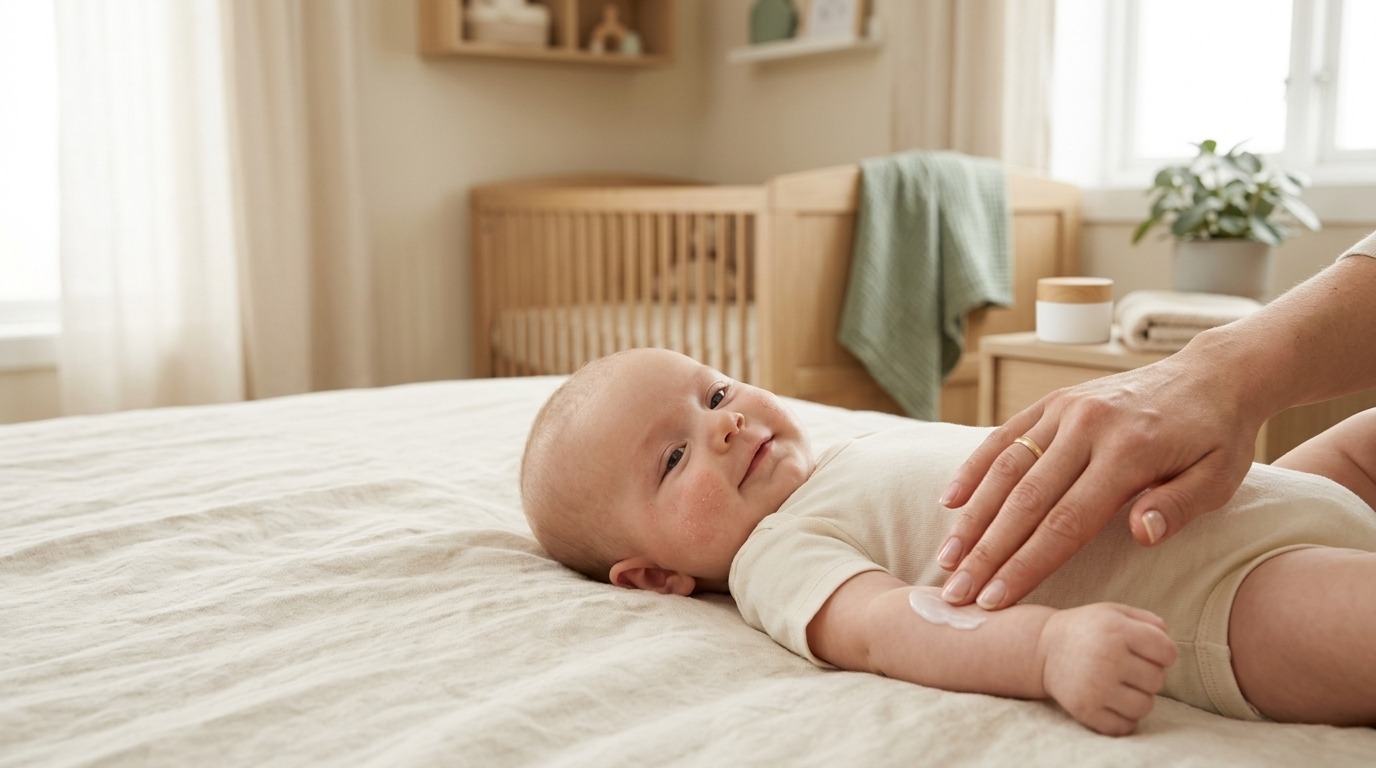
Your baby is a couple of weeks old. The feeds are settling into some kind of pattern, you’ve just about worked out the car seat, and then one morning you notice a scattering of little red bumps across their cheeks. A few have pale tips. By the evening there seem to be more on the forehead.
It’s a very normal thing to worry about. Spots on a brand-new baby look wrong somehow, and in those early weeks almost every change feels like it might mean something.
In most cases, those spots are baby acne. It’s common, it isn’t caused by anything you did, and it usually clears up by itself. The NHS is clear that baby acne doesn’t need treating. What helps most is gentle washing with water, leaving the spots alone and giving it time. Acne creams, home remedies and changes to feeding aren’t needed.
That said, not every newborn rash is acne. Several other harmless conditions look similar, and a few rashes do need a doctor to see them. This guide covers what baby acne looks like, why it happens, how long it tends to last, how to care for your baby’s skin in the meantime, and the signs that mean you should get advice.
What is baby acne?
Baby acne is a harmless rash of small spots that appears on a newborn’s skin, usually on the face, in the first few weeks of life. Doctors often call it neonatal acne. “Neonatal” simply means the newborn period, roughly the first month or so.
The American Academy of Dermatology (AAD) estimates that about one in five newborns get it. It most often shows up at around two weeks old, although it can start at any point before six weeks, and some babies are born with a few spots already.
The most common places are the cheeks and nose. You may also see spots on the forehead, chin, scalp, neck, upper back or chest. The NHS describes baby acne as spots on the face, scalp or upper body that appear up to six weeks after birth.
Neonatal acne and infantile acne are not the same thing
This is one of the most useful distinctions to know, because the two are handled differently.
- Neonatal acne starts in the first six weeks. It’s common, rarely leaves a mark and tends to fade on its own over a few weeks to a few months.
- Infantile acne starts after six weeks, most often between three and six months of age. It’s much less common, can sometimes leave scars and is worth having checked by a doctor.
You’ll sometimes see the two terms used loosely online, as if they meant the same thing. They don’t. If your baby is older than six weeks when spots first appear, read the section on infantile acne further down.
Why does a newborn’s skin change so much?
A baby’s skin goes through a lot in the first weeks. It has gone from fluid to air, it is still building up its protective barrier, and the glands that make oil (sebum) are adjusting to life outside the womb. Peeling, dryness, blotches and spots are all part of that settling-in period. Baby acne is one more temporary stage, not a sign that anything is wrong with your baby’s skin.
What causes baby acne?
The honest answer is that nobody knows for certain. There are a few well-supported ideas, and they probably work together.
Hormonal influences after birth
The most widely given explanation is hormones. During pregnancy, your baby is exposed to hormones that cross the placenta, and their own hormone levels also shift in the weeks after birth. These hormones are thought to switch on the tiny oil glands in a baby’s skin for a while, which can lead to spots.
The exact mechanism isn’t fully understood. What is clear is that this is something happening inside your baby’s body as a normal part of early development. It isn’t something you could have prevented by eating differently in pregnancy or using a different skincare routine.
Developing skin and oil glands
Oil glands sit next to hair follicles and produce sebum, an oily substance that helps protect the skin. In newborns these glands can be briefly overactive, and the skin around them is still immature. That combination makes a baby’s skin react differently from an older child’s or an adult’s. It also explains why the spots tend to settle down on their own once things calm down.
Is baby acne caused by bacteria?
Ordinary baby acne is not an infection, and it doesn’t mean your baby needs antibiotics. Some dermatologists believe a type of yeast that lives harmlessly on everyone’s skin, called Malassezia, may play a part in some babies, by causing a mild inflammatory reaction when oil production is high. This form is sometimes called neonatal cephalic pustulosis. For parents, the practical message is the same: it usually clears without treatment.
That said, a few rashes that look like spots do have an infectious cause. Spots that become very swollen, crusted, weepy or painful, or that come with a high temperature, should be looked at by a doctor rather than assumed to be acne.
Can breast milk, formula or a parent’s diet cause baby acne?
There’s no good evidence that baby acne is caused by breastfeeding, formula feeding or anything in a parent’s diet. Baby acne is not a reason to stop breastfeeding, switch formula or cut foods out of your own diet.
If your baby has other symptoms alongside a rash, such as being very unsettled after feeds, vomiting, diarrhoea or dry itchy patches elsewhere, that’s a different conversation. Speak to your health visitor or GP about it, rather than making feeding changes on your own.
How long does baby acne last?
Newborn acne usually fades within a few weeks, though for some babies it lingers for a few months. Both the NHS and the AAD describe it as getting better on its own over a few weeks to months, and it rarely leaves a mark.
It’s quite common for the spots to look worse before they look better, so a flare a week or so after you first notice them doesn’t mean something has gone wrong. The rash may also seem to come and go, looking redder when your baby is hot, crying or has been lying on one side.
There’s no exact date to expect it gone, because babies vary and because the timeline depends partly on what is actually causing the spots. Infantile acne, the type that starts after six weeks, follows a different pattern. According to the AAD it often clears over roughly six months to a year, and occasionally lasts longer, which is one reason a doctor should see it.
Use this as a rough guide, not a way to diagnose your baby:
| Age or stage | What you may notice | What to do |
|---|---|---|
| First few weeks | Small red or pale-tipped bumps on the face | Wash gently with water and keep an eye on it |
| The following weeks | Spots may flare, then gradually fade | Leave them alone and skip acne products |
| Persistent or worsening rash | Little improvement, or new symptoms appear | Ask your health visitor, GP or pharmacist |
| Acne starting after 6 weeks | Persistent, inflamed or deeper spots | Book a GP appointment, especially if severe or scarring |
What does baby acne look like?
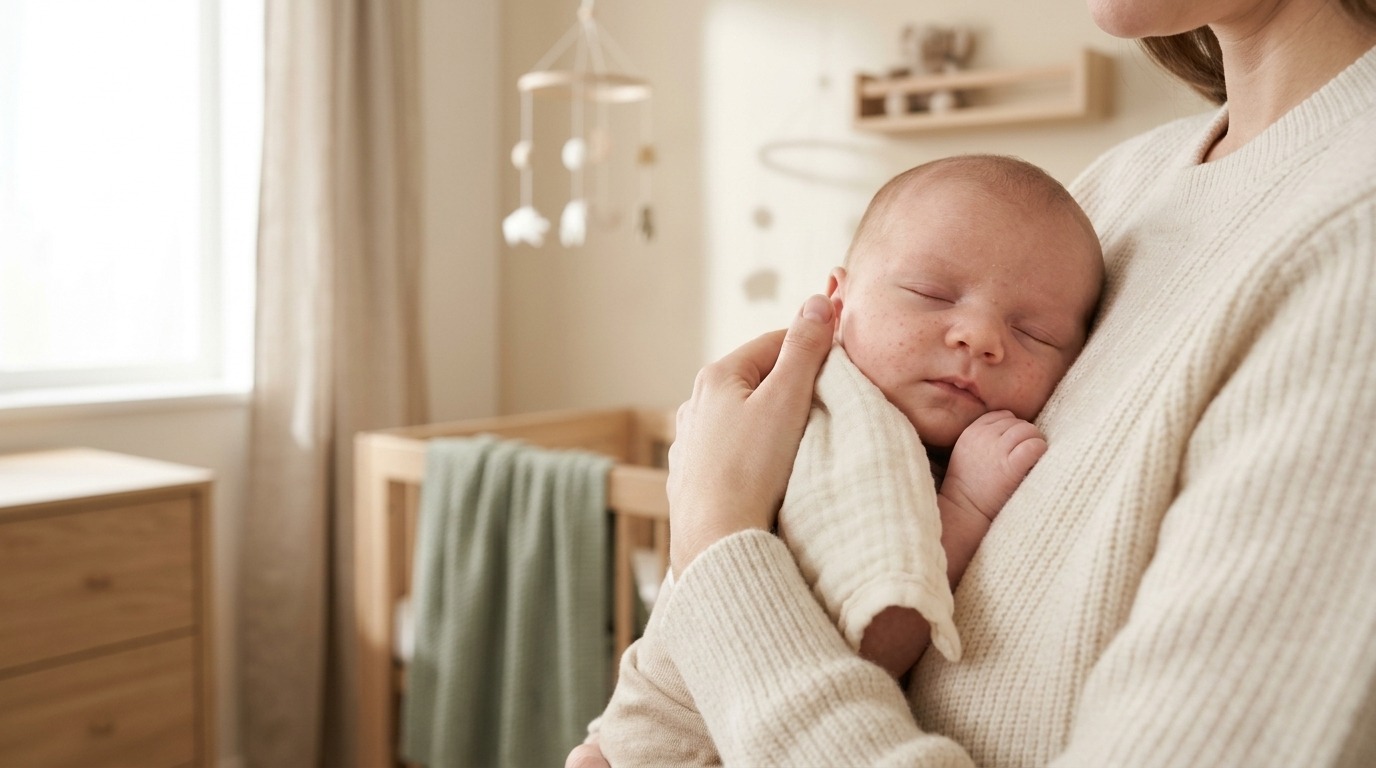
Baby acne looks a lot like a mild teenage breakout, only smaller. Things you might see:
- small red or pink raised bumps
- some spots with a white or yellowish tip
- clusters across the cheeks, nose, forehead or chin
- a little redness around some of the spots
- spots that look more obvious when your baby is warm, crying or flushed
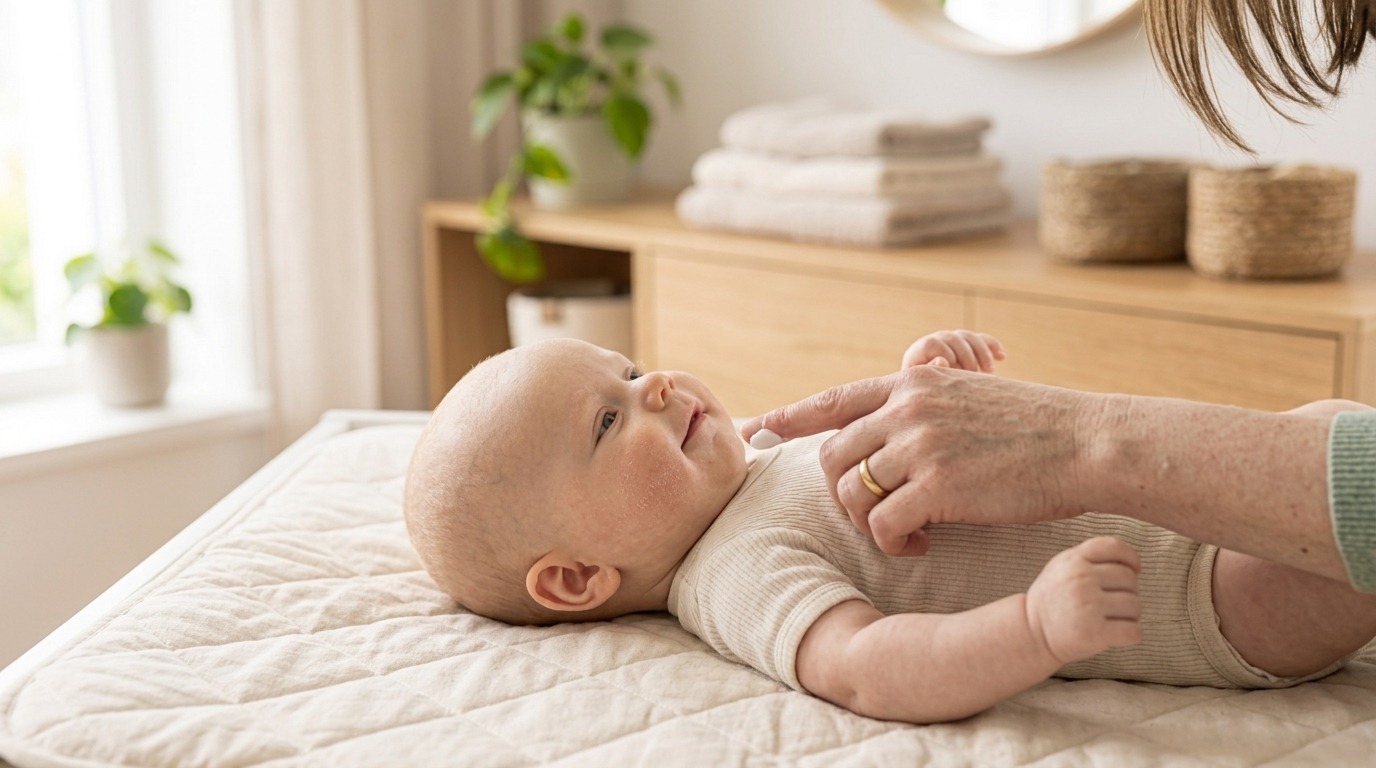
On brown and black skin, the redness can be harder to see. The bumps may look darker than the surrounding skin, or simply feel slightly raised when you stroke the area lightly.
Baby acne doesn’t usually itch or hurt, and most babies with it are perfectly content. If your baby keeps rubbing their face, seems irritable or uncomfortable, or the skin looks dry and rough, something else may be going on.
Appearance alone can’t confirm what a rash is. Please don’t squeeze or press the spots to see what’s inside. That won’t tell you anything useful and may irritate the skin.
Baby acne or another skin condition?
Several common newborn skin conditions can look like baby acne, and most of them are harmless too. Your baby’s age, where the spots are, how they feel and whether there are other symptoms all help tell them apart.
| Condition | Typical appearance | Helpful distinction |
|---|---|---|
| Baby acne | Small red bumps or pale-tipped spots, mostly on the face | Usually starts before 6 weeks and clears without treatment |
| Milia (“milk spots”) | Tiny white or yellow pinhead dots, often on the nose | Often there from birth or the first few days; not red or inflamed |
| Erythema toxicum | Raised red, yellow and white spots on the face, body, arms and thighs | Common in the first weeks; can fade and reappear |
| Eczema | Dry, rough, red or darker patches that may itch | Dryness and itching stand out more than individual spots |
| Seborrhoeic dermatitis or cradle cap | Greasy yellow or white scales, mainly on the scalp, sometimes eyebrows and skin folds | Scaling is more noticeable than spots; doesn’t bother the baby |
| Heat rash | Small raised spots, sometimes prickly | Appears in warm or sweaty areas and settles when the skin cools |
| Other rashes or infections | Varies widely | Fever, blisters, crusting, spreading redness or an unwell baby need medical advice |
Milia are the ones parents most often confuse with acne. The NHS notes that they usually appear when a baby is just a few days old, whereas acne tends to arrive a little later, at around two weeks. Milia also look like neat little white dots without the redness that often surrounds acne spots.
If you’re not sure what you’re looking at, that’s completely reasonable. Ask your health visitor, GP or a pharmacist to take a look. A photo can help you show how the rash has changed, but a description or picture isn’t a substitute for someone seeing your baby. If you want to read more about one of these, our guides to baby eczema and dry skin in babies go into more detail.
What should you do about baby acne?
For straightforward newborn acne, you don’t need medication. Your job is mostly to keep the skin clean, calm and left alone.
Clean your baby’s face gently
Once a day, wipe your baby’s face with lukewarm water and a soft, clean cloth or cotton wool. Lukewarm, not hot. There’s no need to scrub, and doing it more often won’t make the spots go faster. Gently pat the skin dry afterwards rather than rubbing it.
It’s worth wiping away milk or dribble from around the mouth and chin after feeds, since it can sit on the skin and make it look more irritated. Skip exfoliating cloths, facial brushes and anything gritty.
The same less-is-more approach applies at bath time. If you’re wondering how much washing a young baby really needs, our guide on how often to wash your baby’s hair is a useful read.
Keep the skincare routine simple
Plain water is enough for most babies. If you do use a cleanser, choose a mild, fragrance-free one and use only a little. No product suits every baby, so introduce one thing at a time.
Avoid putting lotions, ointments or oils on the spots. Mayo Clinic advises that these can make baby acne worse, and the AAD suggests stopping oily or greasy products while your baby has acne. A moisturiser isn’t routinely needed for baby acne, unless your baby also has dry skin or a health professional has recommended one. If you’re unsure whether your baby’s skin is on the sensitive side, our article on signs of sensitive skin in babies may help.
Let the spots clear naturally
Patience really is the treatment here. Baby acne usually fades by itself, and no remedy has been shown to speed that up. It can feel strange to do nothing, especially when friends or family suggest a cream, but leaving the skin alone is the advice from both the NHS and dermatologists.
Keep an eye on changes, without overchecking
A quick look during nappy changes or bath time is plenty. You’re watching for the general direction: is it slowly settling, or spreading and getting angrier? Constantly examining or touching the area can irritate it.
Get advice if the rash becomes painful, severe, crusted, keeps getting worse, or comes with any other symptoms.
What should you avoid when your baby has acne?
Don’t squeeze or pick the spots
It’s tempting, especially with a pale-tipped spot. But squeezing or scratching can irritate the skin, break the skin barrier and increase the chance of infection or a mark. Keeping your baby’s nails short also helps if they tend to scratch their face.
Avoid adult acne products
Don’t use spot creams, acne washes or anything containing benzoyl peroxide, salicylic acid or retinoids on your baby. These are made for teenage and adult skin and can badly irritate a baby’s. The AAD is firm that acne treatment should never go on a baby’s skin unless a dermatologist or paediatrician has recommended it.
Skip essential oils and harsh home remedies
Lemon juice, vinegar, toothpaste, alcohol, tea tree oil and other essential oils can sting and damage sensitive newborn skin. Online tips sometimes suggest dabbing breast milk on spots, but there’s no reliable evidence it helps with baby acne. “Natural” doesn’t automatically mean safe for a newborn.
Don’t use medicated creams without advice
Steroid creams, antibiotic creams and antifungal products aren’t routine treatments for ordinary baby acne. They have a place for specific diagnosed conditions, and a doctor may occasionally prescribe something for acne that is severe or not improving. Using them without advice can cause more problems than it solves.
Don’t change feeding unnecessarily
Suspected baby acne on its own isn’t a reason to stop breastfeeding, switch formula or follow a restrictive diet yourself. Keep feeding as you normally would.
When should you worry about baby acne?
Typical newborn acne is harmless. The signs below are here to help you spot when a rash might be something other than ordinary baby acne.
Speak to your health visitor, GP or pharmacist if:
- the rash is getting worse, spreading a lot, or isn’t improving after several weeks
- the spots look painful, swollen, crusted or are filled with pus
- acne-like spots first appear after six weeks of age, or are persistent, deep or leaving marks
- your baby has blisters, open sores or skin that looks different from typical baby acne
- there are other symptoms, or you’re simply not sure what the rash is
Get urgent medical help if:
- your baby is under three months old and has a measured temperature of 38°C or higher. The NHS advises asking for an urgent GP appointment or calling 111
- your baby is difficult to wake, floppy, struggling to breathe, feeding poorly or seems seriously unwell. Call 999 or go to A&E
- the rash looks like small bruises or bleeding under the skin and doesn’t fade when you press a glass against it. Call 999
You know your baby. If something feels wrong, trust that and get them seen.
Can you prevent baby acne?
Not reliably. Its causes aren’t fully understood and it reflects normal changes in early infancy, so there’s no routine that guarantees your baby won’t get it.
What you can do is avoid making it worse:
- keep face washing gentle and simple
- avoid scrubbing and unnecessary products
- avoid putting oily, greasy or fragranced products on your baby’s face
- keep your baby comfortably warm rather than hot, as overheating can bring out heat rash too
- use a soft, clean cloth under your baby’s head if milk or dribble tends to collect there
And please don’t blame yourself. Baby acne isn’t a sign of poor hygiene, dirty bedding or the wrong feeding choice. Plenty of babies with the most carefully kept skin get it anyway.
Final thoughts: keep baby skincare gentle
Baby acne is one of the most common things to appear on a newborn’s face, and in most babies it fades away without any help. Gentle washing with lukewarm water, patting dry and leaving the spots alone is usually all it takes.
Adult acne products, medicated creams and home remedies aren’t needed and can do more harm than good. Feeding doesn’t need to change.
If the rash is severe, slow to improve, starts after six weeks or comes with other symptoms, get it checked. You’re the person who sees your baby every day. If something doesn’t look or feel right to you, asking your health visitor or GP is always a sensible step, and never a fuss over nothing.
Frequently asked questions
Usually a few weeks, sometimes a few months. Newborn acne tends to fade on its own and rarely leaves a mark. If spots first appear after six weeks of age, or haven’t improved after a few months, ask your GP.
No, it isn’t usually painful or itchy. Most babies don’t seem to notice it. If your baby is rubbing their face, seems uncomfortable or the spots look sore, get it checked, as it may be something else.
Generally, no. Lukewarm water and a soft cloth are enough. Avoid acne creams, lotions, oils and home remedies unless a doctor has recommended something specific.
There’s no reliable evidence that dabbing breast milk on the spots helps. It isn’t needed, because baby acne clears on its own. Gentle washing with water is the simplest option.
It’s best not to put lotion on the spots themselves. Lotions, ointments and oils can make baby acne worse. If your baby also has dry patches elsewhere, ask your health visitor or pharmacist what would suit their skin.
No. There’s no good evidence linking baby acne to breastfeeding, formula or a parent’s diet. It isn’t a reason to change how you feed your baby.
It can appear beyond the face, on the scalp, neck, upper back or chest. It isn’t contagious and doesn’t spread from person to person. A rash that is spreading quickly or covers large areas should be seen by a health professional.
Baby acne looks like small separate spots, mostly on the face, and doesn’t usually itch. Eczema tends to cause dry, rough, itchy patches, often on the cheeks and in skin creases. If you’re not sure, a GP or health visitor can tell you.
Contact your GP if the spots start after six weeks, are severe, painful, crusted or pus-filled, keep getting worse, or come with other symptoms. A baby under three months with a temperature of 38°C or higher needs urgent advice through your GP or NHS 111.
Newborn acne very rarely scars. Infantile acne, which starts later, can sometimes leave permanent marks, which is why it’s worth having it assessed. Not picking or squeezing the spots also lowers the risk.