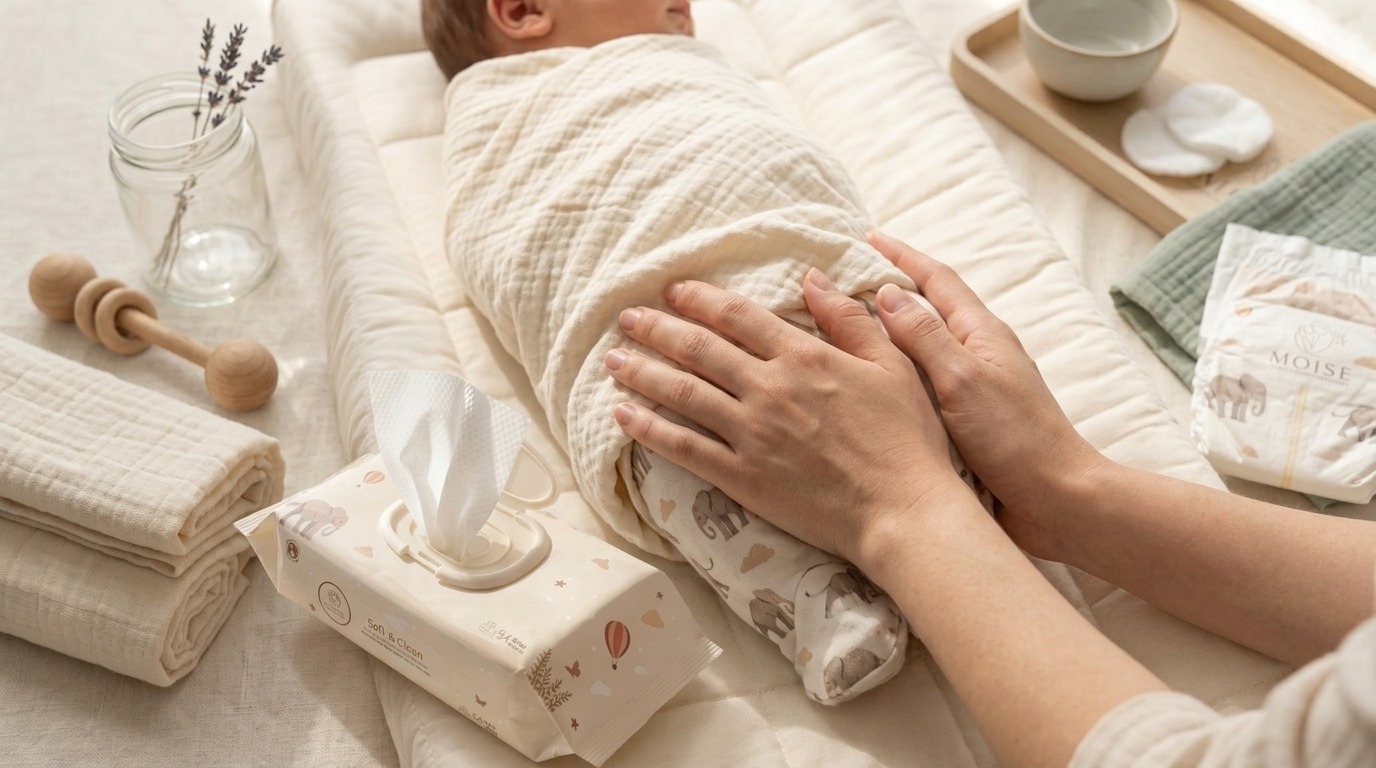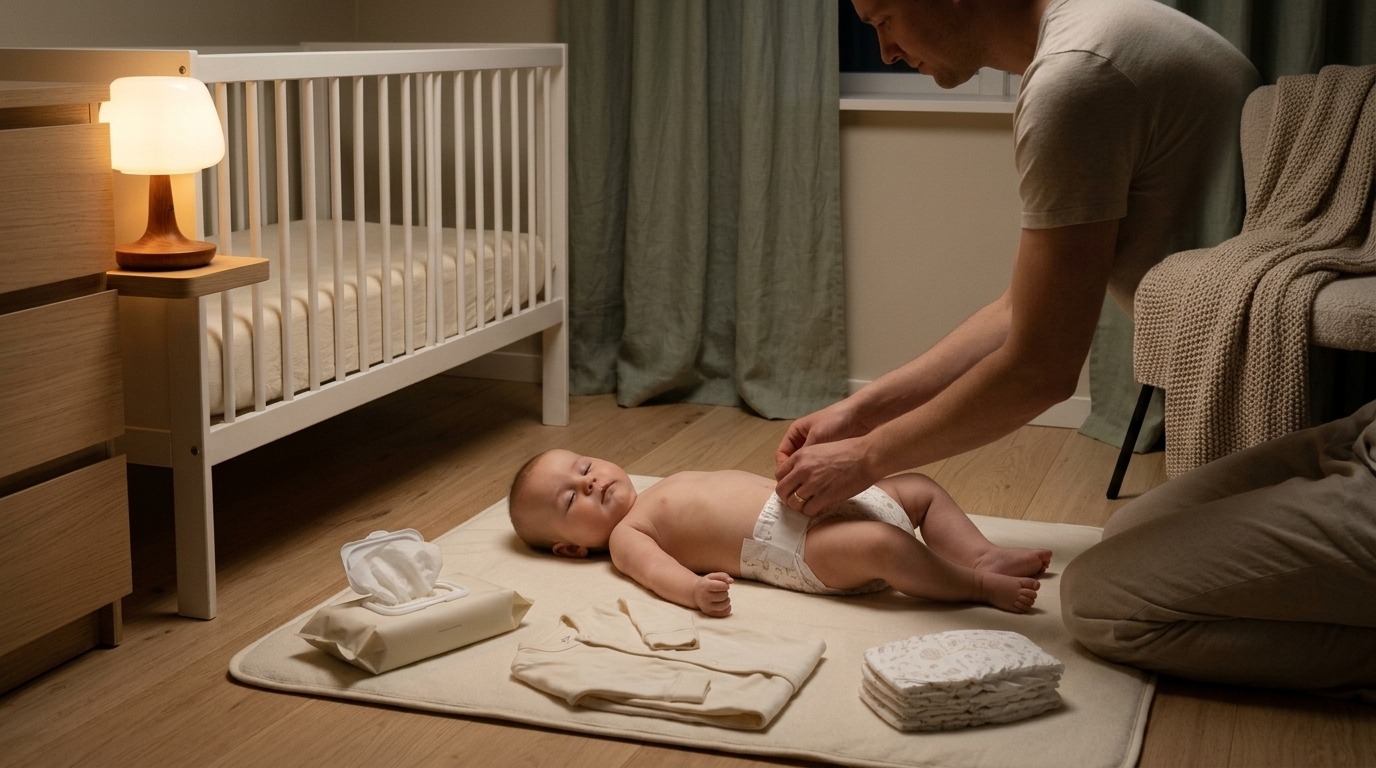
It's 3am. Your baby has stirred, you've caught a whiff of something, or you've felt a heavy nappy through the sleepsuit. You want to deal with it and get everyone back to sleep before your baby decides it's morning.
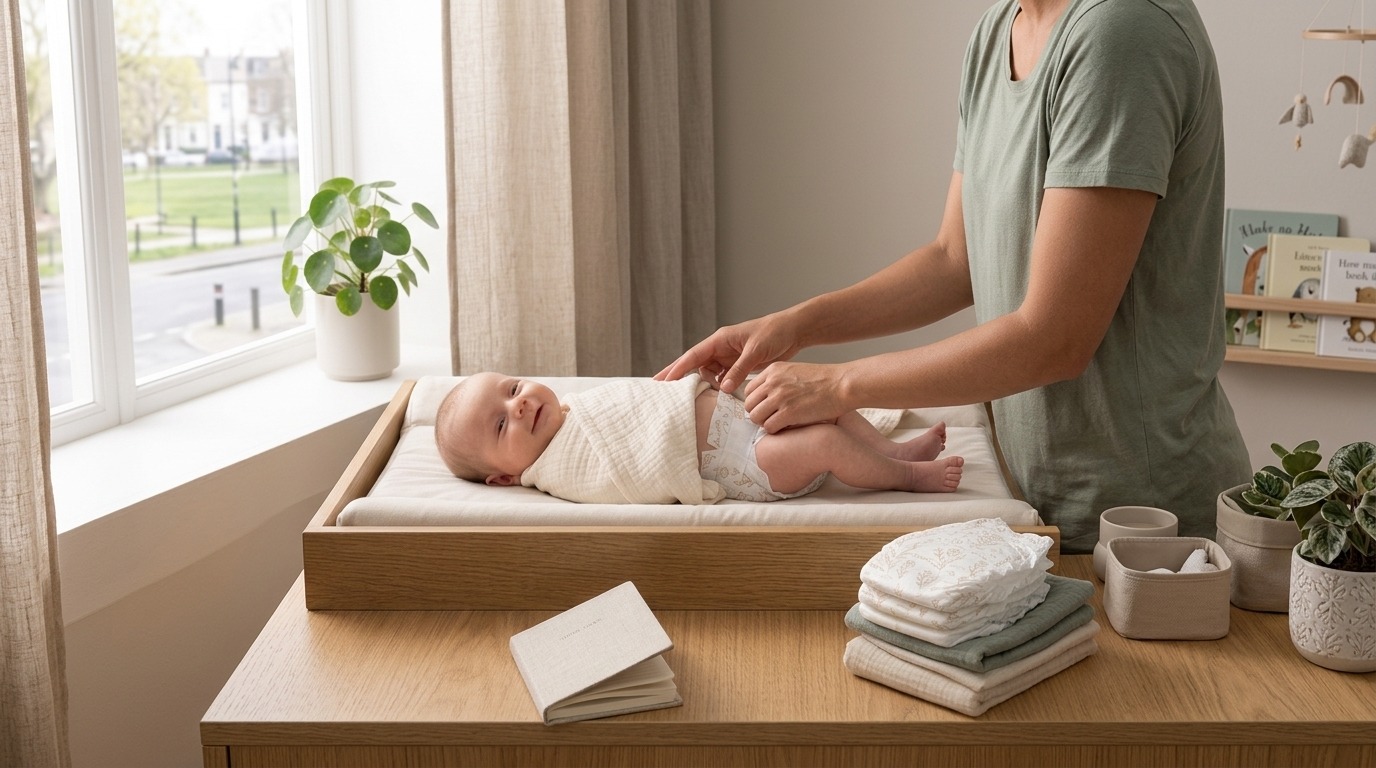
Here's the short answer. Get everything ready before you start, keep the light low but bright enough to see properly, move slowly, and say as little as possible. Clean any poo away, put on a well-fitting nappy and return your baby to their cot or Moses basket on their back.
That approach lowers stimulation. It can't promise your baby will stay asleep. Some babies sleep through a change, and others wake the moment the cool air hits their skin. Both are normal, and neither means you've done anything wrong.
A lot also depends on what's in the nappy. A wet nappy and a dirty one are different situations at night, and your baby's age, skin, the nappy itself and any advice from your midwife or health visitor all play a part.
This article gives general information. It doesn't replace advice from your midwife, health visitor, pharmacist or GP.
Do you need to change your baby's nappy at night?
Sometimes, yes. Sometimes it can wait until the next feed. The deciding question is whether leaving the nappy on would harm your baby's skin or comfort.
NHS guidance for parents on helping babies sleep suggests keeping night-time care low-key, which includes not changing your baby unless they need it. The useful bit is working out when they do.
When you should change the nappy
Change the nappy at night if:
- There's poo in it. Poo irritates skin more than wee, and the NHS lists long contact with pee or poo among the causes of nappy rash. Clean it away when you notice it, even if your baby is drowsy.
- It's leaking. If the sleepsuit, sleeping bag or sheet is wet, change the nappy and anything damp.
- Your baby has nappy rash, broken skin or very sensitive skin. Sore skin needs to stay as clean and dry as possible, so wet nappies matter more.
- It's heavily soaked or your baby seems uncomfortable. A sagging, full nappy is more likely to rub and leak.
- A healthcare professional has told you to change more often. Follow that advice over any general rule, including anything here.
Can you leave a wet nappy on overnight?
Sometimes. Many modern disposable nappies are made to draw wee away from the skin and hold it for a while, so a lightly wet nappy on a baby with healthy skin may be fine until the next feed.
That isn't the same as saying every wet nappy can stay on all night. Think about:
- your baby's age
- how their skin looks at the next change
- how wet the nappy feels
- how absorbent that nappy is
- whether there are leaks or signs your baby is uncomfortable
There's no safe number of hours that applies to every baby, so treat any fixed figure you see online with caution. If your baby's skin starts looking red after night-time wet nappies, that's a sign to change more often.
A dirty nappy is different. Don't leave poo on your baby's skin until morning to protect their sleep.
What about newborns?
Newborns usually need more night-time changes than older babies. They feed often, wee often and in the early weeks may poo at or after many feeds. The NHS says young babies may need changing around 10 to 12 times a day in total, so night changes are part of normal newborn care, not a sign of a routine going wrong.
Let feeding and care lead. If your newborn wakes for a feed, that's usually a sensible moment to check the nappy. Your midwife or health visitor can also tell you what to expect for your baby, especially if they want you to keep track of wet and dirty nappies. Our guide to how many wet nappies a newborn should have each day explains why those counts matter.
How to change a nappy at night without waking your baby
These eight steps keep the change short and calm. Adjust them to suit your baby and your home.
1. Prepare everything before you start
The quieter and quicker the change, the better your chances of a sleepy baby afterwards. Most full wake-ups happen while a parent hunts for a wipe or a clean vest.
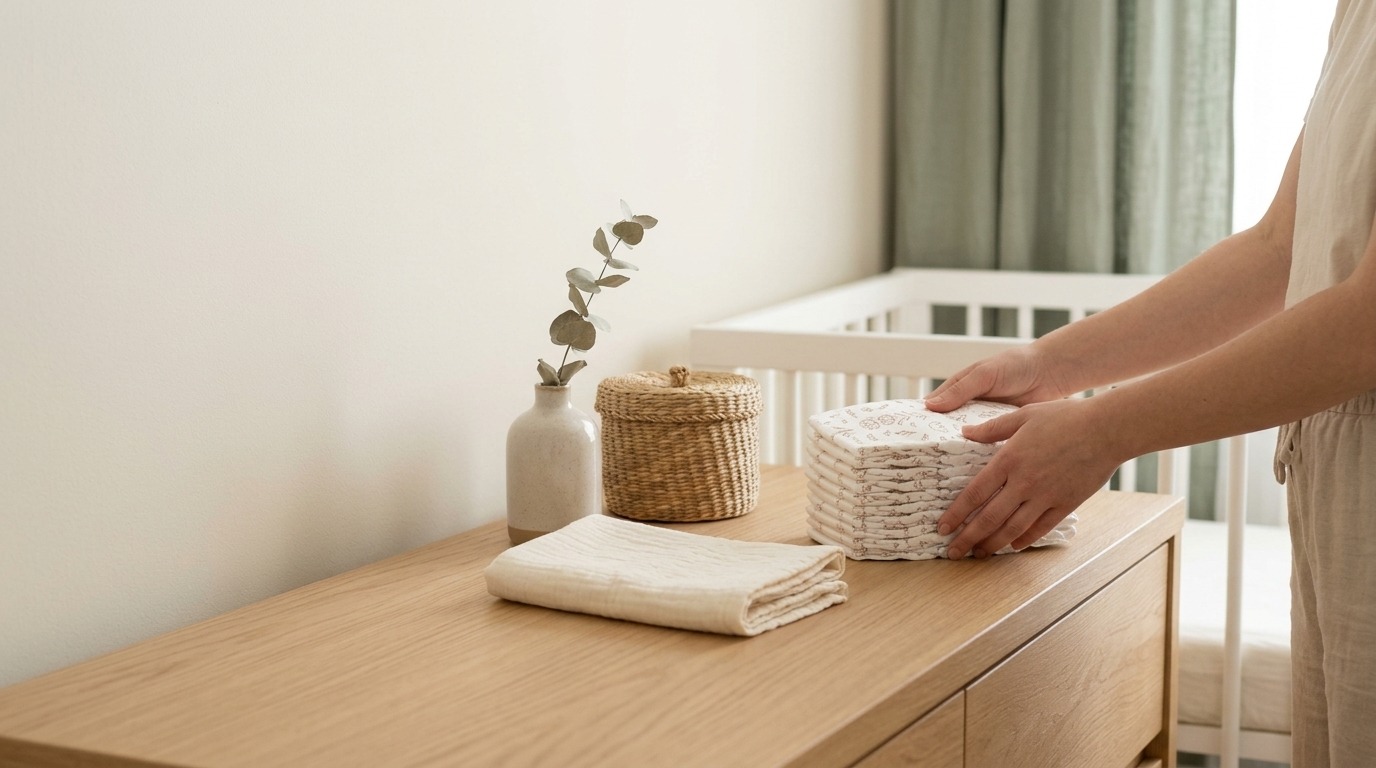
Before bed, set up your changing area with:
- a clean nappy in the right size, already opened
- cotton wool and a small bowl of water, or suitable baby wipes
- a changing mat or towel on a safe, clean surface
- a clean sleepsuit or vest in case of leaks
- a barrier cream, if your baby needs one
- a nappy bag or bin
- a dim light you can switch on with one hand
Check everything is within reach before you lift your baby. If you've forgotten something and you're using a changing table, take your baby with you or put them down somewhere safe, such as their cot. Never leave a baby alone on a raised surface. The NHS describes a changing mat on the floor as the best place to change a nappy because your baby can't fall.
2. Keep the lighting dim but sufficient
A low lamp or night light helps you see without lighting up the whole room. Many parents find a warm-toned light easier at night than a bright overhead bulb or a phone screen.
The light still has to be good enough to do the job. You need to see whether there's poo in the skin folds, how the skin looks and whether the nappy is fastened properly. Don't change a nappy in complete darkness. A slightly brighter light for two minutes is better than missed poo or a badly fitted nappy.
3. Keep your voice and movements calm
Daytime nappy changes are a good time for chatting and smiling. At night, the aim is to make the change as boring as possible.
- Speak softly, or don't talk at all.
- Move slowly and predictably.
- Avoid playful faces, games, songs and bright screens.
- Keep the room comfortably warm but not hot.
- Keep the change separate from playtime.
Calm handling may help your baby stay drowsy. Even so, some babies wake fully no matter how gently you work.
4. Open the nappy gently and check for poo
Undo the tabs slowly and look before you decide what to do. If the nappy is only lightly wet and your baby's skin looks healthy, you may choose to leave it, depending on everything in the section above. If there's poo, carry on with a full change.
Use the clean front of the old nappy to lift away most of the poo first. Then clean the skin:
- For a baby with a vulva: wipe from front to back, away from the vulva and towards the bottom, so poo doesn't move towards the vagina and urethra. Clean the outside only.
- For a baby with a penis: clean the penis, scrotum and creases gently on the outside. Never pull back the foreskin. In babies it's usually still attached and doesn't need to move for cleaning.
There's no need to clean healthy skin over and over. For more detail, see our step-by-step guide to cleaning your baby's nappy area.
5. Clean and dry the skin gently
Use warm water with cotton wool, or baby wipes, whichever suits your baby's skin and your routine. The NHS recommends water or fragrance-free, alcohol-free baby wipes for babies with nappy rash, and that's a sensible default for night changes too.
- Clean away all the poo, thoroughly but gently.
- Don't scrub, and don't keep wiping skin that's already clean.
- Pat the area dry if it's damp. Water leaves more moisture than a wipe.
- Check the creases in the groin, thighs and bottom without rubbing them.
- If the skin looks irritated, keep products simple. Ask a pharmacist or health visitor if it isn't settling.
Wipes are often easier than water in the middle of the night, and suitable baby wipes are fine for most babies. If you're choosing a product, our guide to baby wipes for newborns and sensitive skin covers what to look for. A full wash at every change isn't necessary.
6. Apply barrier cream only when appropriate
A barrier cream puts a protective layer between the skin and wee or poo. It can help when your baby has nappy rash or is prone to it. The NHS says a pharmacist may suggest a thin layer at each change while a rash is causing discomfort.
If your baby's skin is healthy, you don't have to use cream at every night change. When you do use it, a thin layer is enough. Don't start a medicated cream without advice from a pharmacist, health visitor or GP.
7. Fasten the clean nappy correctly
Night-time fumbling can lead to a crooked nappy, which then leaks an hour later. Before you dress your baby, check that:
- the nappy is the right size for your baby's current shape
- the waistband sits comfortably below the belly button area and isn't digging in
- the leg cuffs are pulled out, not tucked in
- it's snug, but you can slide a couple of fingers under the waistband
- there are no gaps at the thighs or back
The NHS advises against fastening nappies too tightly, as this can irritate the skin. A good fit helps reduce leaks. It won't stop every one.
8. Settle your baby back to sleep
Once the nappy is on, keep things just as quiet:
- Leave the light low and the room calm.
- Skip the chat and play.
- Offer a feed if your baby is hungry or it's time for one.
- Use whatever soothing usually works for your baby, such as gentle shushing or a hand on their tummy.
- Put your baby back in their own safe sleep space, on their back.
Never hold back a feed from a hungry baby to protect a sleep routine, and respond if your baby seems unwell or distressed.
Wet nappy versus dirty nappy: what's the difference?
This table is a general guide. Your baby's needs, and any advice from a health professional, come first.
| Situation | What to consider | Recommended approach |
|---|---|---|
| Lightly wet nappy, healthy skin, baby settled | Absorbency of the nappy, your baby's age, whether they're due a feed soon | Often fine to change at the next feed or waking; check skin at the next change |
| Heavily wet or saturated nappy | Risk of leaks, rubbing and damp skin | Change it, keeping the room dim and the change brief |
| Nappy containing poo | Poo irritates skin and can cause soreness | Change and clean as soon as you notice it |
| Leaking nappy | Wet clothes or bedding; possible fit or size problem | Change the nappy and any damp clothes or bedding; check fit afterwards |
| Wet nappy when baby has nappy rash or broken skin | Moisture can make sore skin worse | Change more often; clean gently, pat dry, use a barrier cream if advised |
| Change needed under an individual healthcare plan | Medical reasons may require set changes or monitoring | Follow the plan from your midwife, health visitor or doctor |
How to prevent overnight nappy leaks
Fewer leaks means fewer full changes of clothes and bedding in the night. These steps help without adding extra nappy changes.
Choose the correct nappy size
A nappy that's too small fills quickly and can leave red marks. One that's too big leaves gaps at the legs and waist. Use the manufacturer's size guide as a starting point, then go by fit, because babies of the same weight can be very different shapes. Frequent leaks, tight tabs or marks on the skin often mean it's time to look again at the size.
Consider an overnight nappy
Some nappies are designed with extra absorbency for longer stretches. They can help babies who leak most nights. Plenty of babies manage well in their normal daytime nappy, though, so you don't need a separate overnight product unless leaks are a regular problem. Some families find nappy pants fit their baby differently; our comparison of nappy pants and nappies explains how they differ.
Check the fit around the legs and waist
Run a finger around each leg cuff to make sure the frill sits outside, not folded in. Line the nappy up evenly front and back, and fasten the tabs at the same height on both sides. For babies with a penis, pointing it downwards before fastening can help stop wee leaking out of the top.
Consider the timing of the last nappy change
A fresh nappy as part of the bedtime routine gives your baby a dry start. The NHS includes changing into night clothes and a fresh nappy in its suggested bedtime routine. A bedtime change doesn't remove the need for later ones, especially for newborns, but it can make night leaks less likely.
Don't cut back feeds or drinks to reduce wee overnight. Babies need their milk, and fewer wet nappies can be a sign a baby isn't getting enough.
What if your baby has nappy rash?
Nappy rash can show up as red or raw patches, spots, scaly skin or a sore bottom that makes your baby unhappy at changes. On brown and black skin, redness can be harder to see, so look for changes in texture and signs of discomfort as well. The NHS links nappy rash to long contact with wee or poo, the nappy rubbing, irritating wipes or soaps, diarrhoea and some medicines, among other causes.
At night, rash changes the picture. A wet nappy you might have left until the next feed is better changed if the skin is sore. To help:
- Change dirty nappies straight away, and wet ones sooner than usual.
- Keep the skin clean and dry.
- Pat, don't rub.
- Use a suitable barrier cream, thinly, if a pharmacist suggests it.
- Avoid fragranced products if they seem to make things worse.
- Give your baby some nappy-free time during the day when it's warm and safe to do so.
See a health visitor or GP if the rash doesn't go away, gets worse or spreads, if your baby has a high temperature, or if they seem very uncomfortable. Get advice promptly, too, if the skin is blistered, bleeding or broken. A rash can have different causes, including infection, and only a health professional who has looked at your baby can decide whether a prescription cream is needed. Our full guide to nappy rash causes, treatment and prevention goes into more detail.
Common mistakes during night-time nappy changes
Tired parents make all of these at some point. Each one has a simple fix.
| Mistake | What to do instead |
|---|---|
| Leaving poo in the nappy so the baby stays asleep | Change it when you notice it; a short, dim change is kinder to the skin |
| Changing every lightly wet nappy out of habit | Think about the nappy, the skin and your baby's comfort first |
| Switching on the main light | Use a low lamp or night light that's still bright enough to see |
| Chatting, singing or playing | Keep your voice soft and the change uneventful |
| Using wipes or creams that irritate the skin | Switch to water or fragrance-free wipes, and keep products simple |
| Fastening the nappy too tightly | Leave room for a couple of fingers at the waistband |
| Ignoring repeated leaks or a fussy, uncomfortable baby | Check the size and fit, and ask your health visitor if it continues |
| Leaving your baby on a changing table to grab something | Prepare first, or change on a mat on the floor |
| Changing in complete darkness | Turn on enough light to clean properly and check the skin |
| Putting your baby back to sleep on their side or front, or in an unsafe spot | Always lie them on their back in their own clear cot or Moses basket |
Safe sleep after a night-time nappy change
Once the change is done, how and where your baby goes back to sleep matters more than whether they stay drowsy.
The Lullaby Trust's safer sleep advice for every sleep, day and night:
- Lie your baby on their back to sleep, never on their side or front, even if they tend to leak on one side.
- Use a firm, flat, waterproof mattress in a cot or Moses basket designed for babies.
- Keep the sleep space clear. No pillows, duvets, cot bumpers, soft toys or loose bedding.
- Avoid overheating. The Lullaby Trust suggests a room temperature of 16 to 20°C, with lightweight bedding or a well-fitting baby sleeping bag.
- Sleep your baby in the same room as you for at least the first six months.
- Don't use sleep positioners, pods, nests, weighted products or any accessory that goes against current safer sleep advice.
- Never leave your baby unattended on a changing table or any raised surface.
If you settled your baby with a feed on the sofa or in your bed, move them into their own sleep space once they've finished. The Lullaby Trust warns that sleeping on a sofa or armchair with a baby is especially risky.
Keep night-time nappy changes simple and safe
Night changes get easier with a little preparation and practice. The main points:
- Prepare everything before you start.
- Use a dim light that's still bright enough to see.
- Keep your movements slow and your voice low.
- Clean away poo promptly.
- Decide about wet nappies based on your baby's skin and comfort.
- Choose the right size and fit, and keep products simple.
- Return your baby to their own clear sleep space, on their back.
Some nights your baby will sleep straight through a change. Other nights they'll wake and need a feed and a cuddle before settling again. That's normal. Their comfort, hygiene and safety come first, and a short wake-up now and then is a fair trade for a clean, comfortable baby.
Frequently asked questions
Usually not. If the nappy is only wet, your baby's skin is healthy and they're sleeping comfortably, you can generally wait until they next wake. Change sooner if they have nappy rash, the nappy is soaked or leaking, or a health professional has advised it.
Yes, if there's poo in it, it's leaking or your baby's skin is sore. A gentle, dim change may not wake them fully. For a lightly wet nappy on healthy skin, many parents wait for the next feed.
Yes, change it as soon as you notice it. Poo against the skin can quickly cause soreness and nappy rash, so it shouldn't be left until morning.
Some babies can sleep in a wet nappy for a long stretch without problems, especially older babies in absorbent nappies. It depends on their age, skin, how wet the nappy gets and whether it leaks. There's no fixed number of hours that suits every baby, so watch their skin and change more often if you see redness.
There's no set schedule. Most newborns need changing several times a night because they feed and wee often. Checking the nappy at each night feed works well for many families, and your midwife or health visitor can advise on your baby's needs.
Use a small lamp, a dimmable light or a night light near the changing area. Set it up before bed so it's ready to switch on with one hand. Make sure it's bright enough to clean your baby properly and check their skin.
You can. Suitable baby wipes are quick and practical at night. Fragrance-free and alcohol-free wipes are a gentle choice, and cotton wool with warm water works well if your baby's skin is sensitive.
No, not if your baby's skin is healthy. A thin layer of barrier cream can help if your baby has nappy rash or is prone to it. Ask a pharmacist if you're unsure which cream suits your baby.
Check the size and fit first, especially the leg cuffs and waistband. Put on a fresh nappy at bedtime, and consider a more absorbent overnight nappy if leaks happen often. Don't reduce feeds or fluids to cut down on wee.
Stay calm and keep the room dim and quiet. Finish the change, then settle your baby the way you normally would, which may include a feed if they're hungry. Waking during a change is common and usually passes.
Either can work. Changing first means your baby can drift off at the end of the feed. Changing afterwards makes sense if your baby often poos during or after feeding. Try both and see which suits your baby.
See a health visitor or GP if the rash doesn't go away, gets worse or spreads, if your baby has a high temperature or seems very uncomfortable. Also get advice if the skin is blistered, bleeding or broken. If your baby seems unwell, contact your GP or NHS 111.