"Is my child actually ready for this?" is one of the most common questions parents ask themselves around the toddler years, usually after a friend mentions their own child is potty trained, or a nursery starts gently asking the question.
There's no single age at which every child is ready. Readiness shows up through a combination of physical, communication and behavioural signs that develop gradually, and children reach them at genuinely different paces. Some toddlers show several signs at once; others build them up over weeks or months. Night-time dryness, in particular, tends to develop separately and later than daytime toilet control. None of this is a race, and there's no benefit to approaching it with pressure, shame or a fixed deadline.
What Are the Signs Your Child Is Ready for Potty Training?
Common signs of readiness include: staying dry for longer stretches between nappy changes, noticing when they need to wee or poo, telling you before or while they're going, showing interest in the toilet or potty, understanding simple instructions, being able to sit on and get up from a potty safely, managing to pull trousers up and down, going somewhere private or quiet to poo, showing discomfort in a wet or dirty nappy, and wanting to copy adults or older children using the toilet.
These are possible signs to look out for, not a checklist your child needs to complete in full. Most children show a mix of several, rather than all of them, before parents start introducing the potty.
1. Your Child Starts to Notice When They Need to Wee or Poo
This growing body awareness is one of the more meaningful developmental steps. It can show up as your child pausing mid-play, going quiet, hiding somewhere, telling you they're doing a wee or poo, using a particular word or gesture, pointing at their nappy, or mentioning it after they've already gone.
There's a useful distinction here: noticing after they've been is a good early sign, but noticing before — and telling you in advance — tends to be a more reliable indication that your child is connecting the physical sensation with the idea of using the toilet. According to NHS-aligned guidance, potty training tends to go more smoothly and quickly when a child has reached this later stage before you start.
2. Your Child Stays Dry for Longer Periods
Longer stretches between wet nappies can suggest developing bladder control. This might look like longer gaps between changes, occasionally waking from a nap with a dry nappy, or staying dry through a whole nap. UK health guidance generally points to a dry period of around one to two hours as a useful readiness indicator.
It's just one sign among several, though, not proof on its own that your child is ready for full potty training. Occasional wet nappies remain completely normal at this stage, and a child who's mostly dry but still has regular wet nappies isn't necessarily "behind."
3. Your Child Shows Interest in the Potty or Toilet
Curiosity is a genuinely useful sign. It might look like watching you use the toilet, asking questions about it, wanting to sit on the potty (even fully clothed, or without actually using it), wanting to flush, carrying the potty around, pretending to use it during play, or asking about wearing "big kid" underwear.
You can encourage this curiosity gently — letting them watch, answering their questions simply — without turning it into pressure or expectation. Interest alone doesn't mean they're ready to begin, but it's a sign worth paying attention to alongside the others.
4. Your Child Can Communicate Their Needs
Communication doesn't need to mean clear speech. A toddler might communicate through words, gestures, pointing, facial expressions, simple signs, or physically taking you toward the bathroom.
Being able to say or signal "I need a wee" or "I need a poo" tends to make the whole process easier, since it gives you a chance to act before an accident happens rather than after. That said, your child doesn't need advanced or fluent speech before you can start gently introducing toilet learning — plenty of children begin with fairly basic communication and build from there.
5. Your Child Understands Simple Instructions
A few examples worth checking: "Come to the bathroom," "Sit on the potty," "Pull your trousers down," "Let's wash your hands." If your child can generally follow instructions like these — most of the time, not perfectly — it suggests they can participate meaningfully in the routine rather than just being led through it.
This isn't about expecting flawless obedience. Toddlers are toddlers, and following instructions "most of the time" is a perfectly reasonable bar.
6. Your Child Can Manage Some Clothing Independently
Worth checking: can your child pull their trousers down, and back up again? Manage an elasticated waistband? Sit down and stand up from a low seat safely on their own?
Choosing simple, easy-to-remove clothing — elasticated waistbands rather than buttons or complicated fastenings — makes this whole part of the process noticeably easier, regardless of exactly how independent your child already is with dressing.
7. Your Child Notices a Wet or Dirty Nappy
Growing awareness of being wet or soiled — pulling at the nappy, trying to take it off, or telling you and asking to be changed — can be a useful clue.
It's worth holding two things at once here: some children clearly dislike wet nappies but aren't otherwise showing readiness yet, and some children don't seem bothered by a wet nappy at all but are still perfectly capable of learning toileting skills. So this is one data point among several, not proof by itself either way.
8. Your Child Has a More Predictable Bowel Routine
Some toddlers develop a fairly regular, predictable pattern of bowel movements around a similar time each day, which can make it easier to offer potty opportunities at sensible moments.
Bowel habits genuinely vary a lot between children, though, and it's worth not forcing your child to sit on the potty at a fixed time regardless of whether they actually need to go. It's also worth flagging constipation specifically here, since it can complicate potty training considerably — a child who's uncomfortable or in pain during bowel movements may start withholding, which works against the whole process. If you're concerned your child might be constipated, it's worth addressing that with your GP or health visitor before pushing ahead with training.
9. Your Child Wants to Copy Adults
Toddlers learn an enormous amount through imitation, and the bathroom is no exception. This might look like following you into the bathroom, watching how the toilet works, asking about underwear, pretending to use a potty during play, or wanting to flush.
Modelling normal bathroom routines naturally — narrating simply what you're doing, without making a big production of it — tends to work better than direct instruction alone at this age.
10. Your Child Is Comfortable Sitting on the Potty
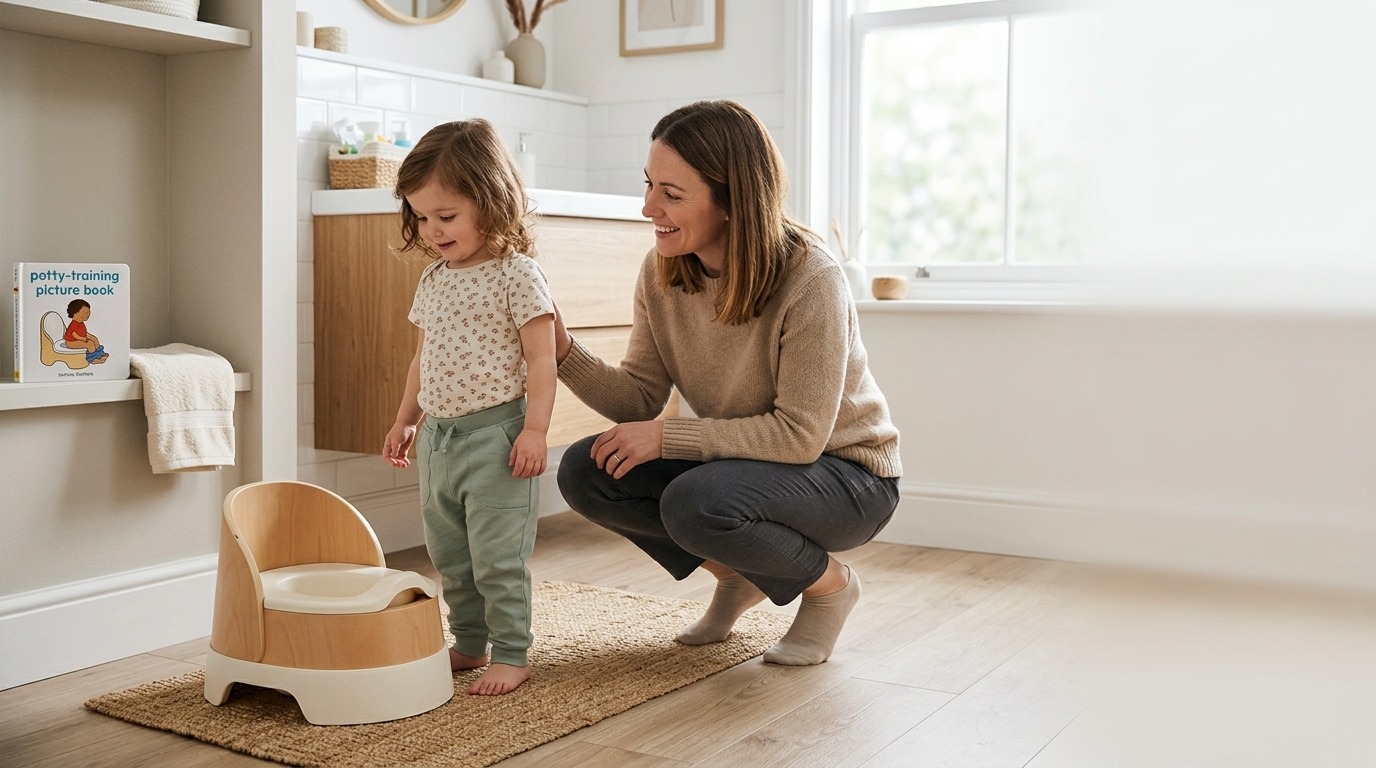
Some children happily sit on the potty fully clothed at first, without any fear or resistance, and gradually build up to sitting for short periods, clothed or not. This familiarity can be introduced gradually and playfully, well before any actual toilet use is expected.
It's not a good idea to force a child to sit for extended periods, especially if they're uncomfortable or want to get up — that tends to create the kind of resistance that makes the whole process harder later on.
Potty Training Readiness Checklist
My child may be showing signs of readiness if they:
- Notice when they are having a wee or poo
- Sometimes tell me before they need to go
- Stay dry for longer periods
- Show interest in the potty or toilet
- Understand simple instructions
- Can pull trousers up and down
- Dislike being in a wet or dirty nappy
- Want to copy adults
- Can sit comfortably on a potty
- Can communicate their needs in some way
Your child doesn't need to tick every box before you can gently introduce potty learning. Most children show a handful of these signs, not all ten, before parents make a start.
Does Age Determine When a Child Is Ready?
Not on its own, no. There's no single correct age at which every child becomes ready — developmental readiness varies genuinely from child to child, and pushing ahead based purely on age, rather than the signs your own child is actually showing, tends to make the process more stressful for everyone involved.
That said, general developmental patterns can be a useful backdrop. UK health guidance and NHS-aligned sources commonly note that most children show signs of readiness somewhere between about 18 months and 3 years, with many showing clearer signs closer to the two to two-and-a-half mark. These are broad patterns, not rules — some children are ready earlier, some later, and neither is a reflection of anything other than normal individual development. Children with physical or learning differences may show readiness signs at a different stage, which is entirely normal too.
Is My Child Ready for Daytime but Not Night-Time Potty Training?
Yes, this is genuinely common, and it's worth expecting rather than seeing as a setback. Daytime and night-time bladder and bowel control develop as separate processes, and daytime control very often comes first, sometimes by a considerable margin.
It's entirely normal for a child to be reliably using the potty during the day while still wearing a nappy at night for some time afterwards. Occasionally waking up with a dry nappy is an encouraging sign, but it doesn't necessarily mean your child is ready to stop wearing nappies overnight — night-time dryness tends to develop on its own timeline as your child's body matures, and there's no need to rush or force this alongside daytime training.
What If My Child Shows Some Signs but Not Others?
This is genuinely the norm, not the exception. Readiness isn't all-or-nothing — your child might show real interest in the potty but not yet reliably notice the need to wee, or might understand exactly what's supposed to happen but not yet manage their own clothing.
In this in-between stage, a few gentle steps can help without creating pressure: introducing the potty casually as a familiar object rather than a task, reading age-appropriate books about using the toilet together, talking about wee and poo in simple, neutral language, letting your child observe your own bathroom routine if you're comfortable with that, practising pulling trousers up and down as a standalone skill, and generally avoiding any sense of pressure or urgency around the whole thing.
What If My Child Refuses the Potty?
Refusal is common and doesn't mean something's gone wrong. A few principles worth holding onto: don't force your child to sit if they're resisting, avoid any punishment or shame around refusal or accidents, keep the potty available and visible without pushing it, and if your child becomes genuinely distressed, it's entirely reasonable to pause and try again in a few weeks or months.
Praising participation and effort, sitting on the potty, showing interest, trying — tends to work better than praise reserved only for successful wees or poos, since it keeps the whole experience lower-pressure. Reward systems (stickers, small treats) are something some parents find helpful, but they're worth introducing thoughtfully rather than as a way to force compliance, since they can sometimes add pressure rather than reduce it.
Signs Your Child May Not Be Ready Yet
It's worth pausing potty training, at least for now, if you notice:
- Strong resistance to every attempt, rather than occasional reluctance
- Genuine distress when sitting on the potty is suggested
- No sign of recognising or communicating the need to go, even in a basic way
- Major changes or stressors happening in your child's life right now — a new sibling, a house move, starting nursery, or similar
- The whole process becoming a daily source of conflict rather than a gradual, low-key routine
Not being ready yet isn't a failure on your part or your child's — it's simply useful information. You can put it aside and revisit it in a few weeks or a couple of months, when things may look quite different.
What Should Parents Do When Their Child Starts Showing Readiness Signs?
Step 1: Introduce the potty. Keep it accessible in the bathroom, without making a big event of it at first.
Step 2: Talk about wee and poo. Use simple, neutral language your child can understand and repeat back.
Step 3: Let your child observe. Modelling your own bathroom routine, if you're comfortable doing so, helps normalise the process.
Step 4: Practise sitting. Only if your child seems comfortable — clothed sitting is a perfectly good starting point.
Step 5: Make clothing easy. Choose trousers and bottoms that are simple to pull down and back up independently.
Step 6: Offer regular opportunities. Suggest the potty at natural moments — after meals, before a bath — without repeatedly asking or pressuring.
Step 7: Praise effort. Focus on participation and trying, not just successful outcomes.
Step 8: Expect accidents. They're a completely normal, expected part of learning this skill, not a sign anything's wrong.
Common Potty Training Mistakes to Avoid
- Starting solely because of your child's age. Age is a rough backdrop, not the actual readiness signal — starting because "they're two now" rather than because of what you're actually observing tends to make things harder.
- Comparing your child with siblings or friends. Every child develops at their own pace, and comparison adds pressure without any practical benefit.
- Shaming accidents. Accidents are a normal, expected part of learning — reacting with frustration or shame can slow progress and create anxiety around the whole process.
- Forcing a child to sit on the potty. This tends to create resistance rather than cooperation.
- Expecting immediate success. Potty training is a gradual skill, not something mastered in a day or two.
- Removing nappies before your child is developmentally ready. This can lead to frequent accidents and frustration for everyone rather than faster progress.
- Restricting fluids. This isn't recommended and doesn't support the learning process — your child needs normal fluid intake throughout.
- Treating night-time dryness as a requirement alongside daytime training. As covered above, these develop separately, often with a considerable gap between them.
- Making toilet training a source of conflict. A calm, low-pressure approach genuinely tends to work better than turning it into a battle of wills.
When Should You Speak to a Health Professional?
Most potty training challenges are a normal part of the process and don't need professional input. It's worth speaking to your GP, health visitor or paediatrician if you notice:
- Persistent constipation
- Painful bowel movements
- Pain when urinating
- Blood in urine or stool
- Significant, unexplained changes in urination
- Unusual thirst or noticeably frequent urination
- Persistent difficulties that are causing your child real distress
- A child who had been reliably dry suddenly having frequent accidents again, without an obvious explanation such as illness or a big change at home
These aren't necessarily signs of anything serious, but they're worth having checked rather than working through alone, since a professional can properly assess what's actually going on.
Final Checklist
My child may be ready to start exploring potty training if they:
- Notice when they need to wee or poo
- Show increasing body awareness
- Stay dry for longer periods
- Show interest in the toilet or potty
- Understand simple instructions
- Can manage some clothing
- Can communicate their needs
- Are comfortable sitting on a potty
- Want to participate
There's no need to wait for every sign. Readiness develops gradually, and potty training works best when children are supported without pressure.
Conclusion
Potty training readiness isn't a birthday you circle on the calendar, it's a gradual collection of signs that build up at your own child's pace. Watching for a combination of awareness, communication and interest, rather than counting down to a particular age, tends to make the whole process smoother and considerably less stressful for both of you.
If you're navigating the transition away from nappies, Moise's nappy pants can be a practical option alongside underwear as your child builds confidence, though the real groundwork happens through the everyday readiness signs covered above, not through any particular product.