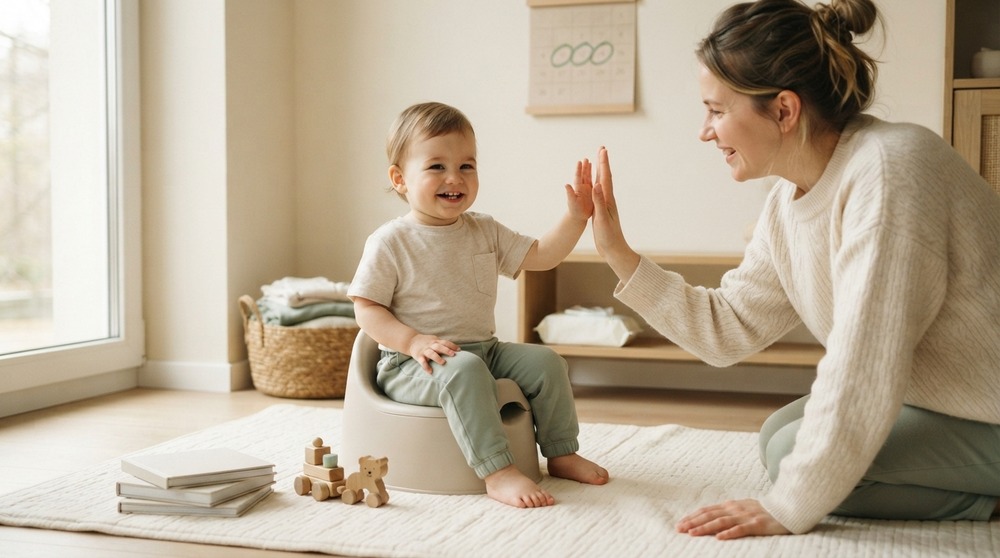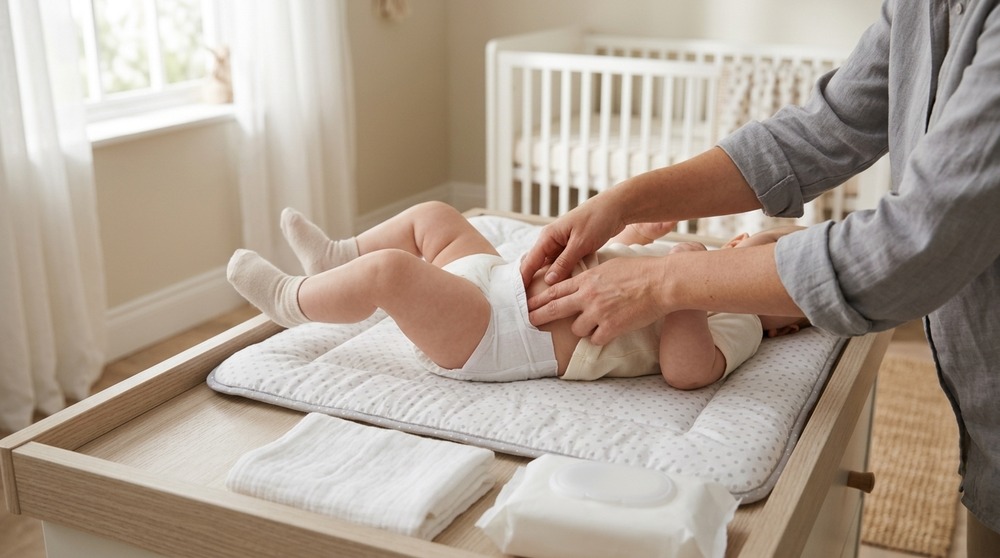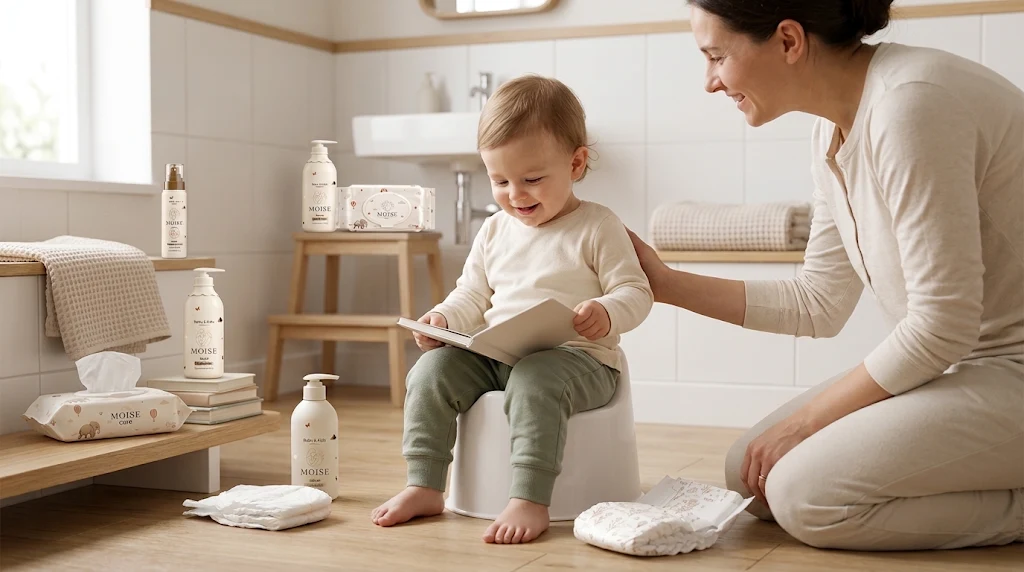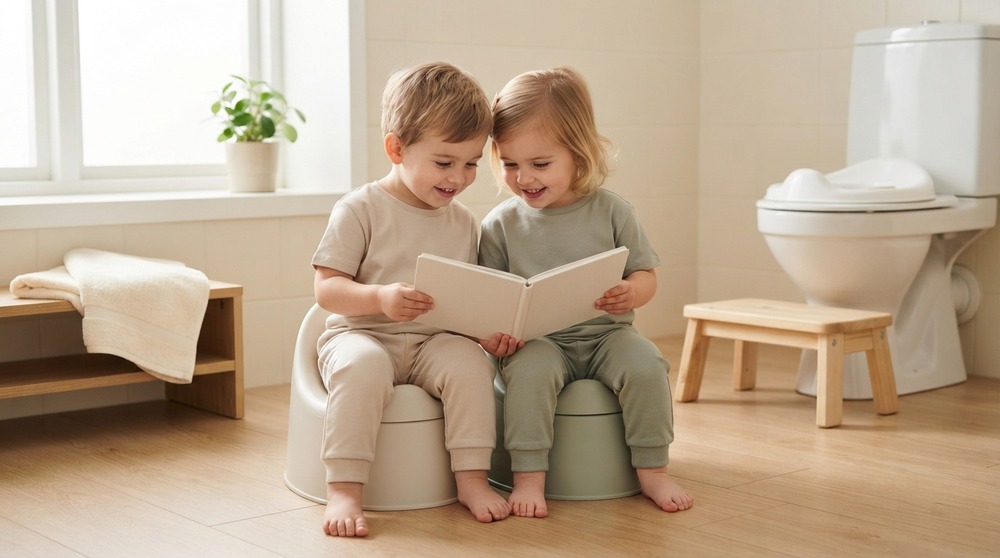
"Girls are so much quicker." "Just teach him to stand up, it's easier." If you've mentioned potty training at a toddler group or a family dinner, you've probably heard both. So is potty training boys vs girls really a different job?
The short answer: mostly, no. The core steps are the same for every child. There are a few practical differences, like whether boys sit or stand to wee and how girls learn to wipe. Research also shows girls reach some toilet milestones a little earlier on average. But your own child's readiness, temperament and routine will shape things far more than whether they're a boy or a girl.
In this guide we look at what actually differs, when to start, how to handle sitting, standing, aiming and wiping, and what to do when things don't go to plan.
Is potty training different for boys and girls?
The basic process is the same. Every child has to learn to notice the feeling of a full bladder or bowel, get to the potty in time, get clothes down, sit and relax, then wipe and wash their hands. NCT puts it simply: the basics are almost identical whether you're training a boy or a girl.
Anatomy does change a few practical details. Girls always sit, so wiping from front to back becomes an important habit. Boys can sit or stand to wee, and if they stand, they'll need to learn to aim. That's about it.
What about speed? A well-known US study published in Pediatrics followed 267 children and found that girls reached most toilet-training skills a little earlier than boys. Girls in the study were staying dry during the day at a median of 32.5 months, boys at 35 months. That's an average gap of a few months, not a rule.
The same study found that boys and girls learned the skills in almost exactly the same order. And within each group, the range was wide. Plenty of boys train before plenty of girls.
So there's no set age for boys or for girls. Whether your child is interested, can communicate and feels confident matters much more than gender.
When should you start potty training?
There's no single best age to start potty training. Most UK guidance mentions somewhere between 18 months and 3 years, but children vary a lot. Some are dry in the daytime well before three, others a while after.
The UK continence charity ERIC goes a step further. It says children can start learning potty skills much earlier, from when they can sit up, and that there's no need to wait passively for "signs of readiness". Their approach is to prepare gradually, practise, and then stop nappies. ERIC also points out that stopping nappies between 18 and 30 months is better for bladder and bowel health.
That said, readiness signs are still a useful guide to when your child might be able to manage without nappies. Look out for your child:
- Staying dry for an hour or two at a time
- Noticing, or telling you, when their nappy is wet or dirty
- Showing interest in the toilet, the potty or what you're doing in the bathroom
- Following simple instructions, like "get your teddy"
- Letting you know, with words or actions, that they need a wee or poo
- Sitting comfortably on a potty and getting up again
- Wanting to pull their own trousers up and down
Your child doesn't need to tick every box. And try not to start just because of a birthday, a nursery deadline or a comment from a relative. Starting when things at home are fairly settled, and not during a house move or the arrival of a new baby, usually helps.
We've also got a full step-by-step guide to starting potty training if you want the practical plan.
Potty training girls: what should parents know?
Teaching girls to sit correctly
Girls wee and poo sitting down, so getting comfortable on the potty or toilet is step one. A good position helps the muscles relax, which makes it easier to empty the bladder and bowel fully.
Encourage your daughter to sit well back on the seat with her knees slightly apart and leaning forward a little. If she's using the big toilet, a child's toilet seat stops her feeling like she might fall in.
Feet matter too. ERIC recommends that children's feet are flat and supported on a step or box, with knees higher than hips. Dangling legs make it harder to relax and push, which can make poos more difficult.
Teaching girls to wipe properly
The key habit for girls is wiping from front to back. This helps keep bacteria from the bottom away from the urinary opening, which lowers the risk of urine infections.
Show her how to fold a little toilet paper and pat or wipe gently, rather than rubbing hard. Toddler skin can get sore quickly. After a poo, you'll probably need to help or do a final check for quite a while. That's completely normal: reaching round and wiping properly takes coordination most toddlers simply don't have yet.
During the learning phase, a gentle water wipe can help with cleaning up after accidents or when the skin is a bit red.
Common potty training challenges for girls
- Fear of the potty or toilet. The flush, the big hole, the cold seat. Let her get used to it with her clothes on first.
- Not noticing she needs a wee. Especially when she's busy. Gentle reminders at natural times, like after meals and before going out, help.
- Not wanting to stop playing. Very common. Try "let's do a wee and then you can finish the tower".
- Accidents. Expected, and not a sign of failure.
- Learning to wipe on her own. Takes time. Keep helping and praise every attempt.
Potty training boys: what should parents know?
Should boys wee sitting down or standing up?
Most UK experts suggest boys start by sitting down for both wees and poos. ERIC recommends it because sitting helps the bladder and bowel empty properly and helps children relax. It also means a boy who needs a poo is already in the right place, rather than missing the moment while standing.
It keeps things simple, too. Learning to get to the potty in time is a big enough job without deciding whether to sit or stand.
Standing to wee can come later, once he's confident and dry, and especially if he's keen to copy a dad, brother or other family member. There's no medical need for boys to stand up to wee, though. Plenty of boys and men sit, and that's fine. Choose whatever works for your child and your home.
If he does learn to stand, remember he'll still need to sit down for poos every day. NCT points out that this is easy to forget once standing becomes the exciting new skill.
Teaching boys to aim
When sitting, teach him to gently point his penis down into the potty. Many potties have a raised front guard that helps catch splashes.
If he moves on to standing at the toilet, a sturdy step helps him reach. A family member can show him how it's done, or you can explain it simply. Some families drop a piece of toilet paper in the bowl as a target. Teach him to give a little shake at the end and to wash his hands every time.
There will be splashes. Lots of them. Keep some wipes or a cloth handy and try to laugh it off.
Common potty training challenges for boys
- Aiming when standing. Often messy at first and improves with practice.
- Not wanting to sit still. A book or a song can help him stay long enough to empty properly.
- Getting distracted. Many toddlers rush off before they've finished.
- Recognising bladder signals. Like girls, boys can miss the feeling when they're busy.
- Accidents during play or outings. Plan potty stops and pack spares.
Potty training boys vs girls: key differences at a glance
| Aspect | Potty training girls | Potty training boys |
|---|---|---|
| Starting age | Depends on individual readiness | Depends on individual readiness |
| Wee position | Sitting | Sitting at first; standing optional later |
| Poo position | Sitting | Sitting |
| Wiping | Front to back, gently | Wiping after poos; a little shake after wees |
| Aiming | Not a separate skill | Pointing down when sitting; aiming if standing |
| Common challenges | Independent wiping, noticing signals | Aiming, distractions, sitting long enough |
| Learning pace | Varies from child to child | Varies from child to child |
| Parental support | Encouragement and hygiene guidance | Encouragement and hygiene guidance |
These are practical differences, not fixed rules. Some girls struggle to sit still, and some boys never want to stand. Go with the child in front of you.
Do girls really potty train faster than boys?
It's one of the most repeated bits of parenting wisdom. And there is some evidence behind it. In the Pediatrics study mentioned above, girls reached nearly all toilet-training skills earlier than boys, including finishing training. A review in American Family Physician also notes that girls usually complete training earlier.
But the difference is an average of a few months across a large group. It tells you nothing about how your particular child will get on. A chatty, routine-loving boy may well be dry before a busy, independent girl who isn't interested yet.
What tends to matter more:
- Readiness and development. Can your child notice the feeling, communicate it and manage their clothes?
- Communication. Having words, or signs, for wee and poo makes a real difference.
- Temperament. Some children love the praise, others resist anything that feels like your idea.
- Routine at home and nursery. Consistency across carers helps everyone.
- Calm, patient support. Pressure tends to slow things down for boys and girls alike.
So if your son is taking longer than his cousin, it's very unlikely to be because he's a boy.
8 practical tips for successful potty training
These potty training tips work for boys and girls.
- Look at your child, not just the calendar. Readiness signs and your child's interest are a better guide than age alone.
- Introduce the potty in a relaxed way. Leave it in the bathroom, let them sit on it fully clothed, or let a teddy "have a go".
- Build a routine. Offer the potty at natural moments: after waking, after meals, before bath and before leaving the house.
- Use simple words. Pick your family's words for wee and poo and stick with them.
- Choose easy clothes. Elasticated trousers and no fiddly buttons give your child a fighting chance.
- Praise the effort. "You sat on the potty, well done" counts, even if nothing came out. Keep it warm but low-key.
- Stay calm about accidents. Clean up without fuss and never punish. Accidents are part of learning.
- Be prepared when you're out. Spare pants, trousers, socks, a bag for wet clothes and a pack of travel-size wipes save a lot of stress.
Common potty training mistakes to avoid
- Starting under pressure. Beginning before your child can manage the basics often means more accidents and frustration.
- Comparing children. Brothers, sisters, cousins and the neighbour's twins all learn at their own pace.
- Forcing them to sit. Holding a child on the potty can create fear and resistance.
- Punishing accidents. It makes children anxious and more likely to hold on, which can lead to constipation.
- Expecting night-time dryness straight away. Day and night are separate milestones.
- Making toilet visits stressful. Long sessions, nagging or constant asking can put children off.
- Ignoring constipation or discomfort. Hard or painful poos are a common reason children start avoiding the potty.
- Being inconsistent. Switching between nappies and pants day to day, or different rules at home and nursery, can confuse your child.
What if your child refuses to use the potty?
Refusal is really common, and it doesn't mean you've done something wrong. Toddlers say no to lots of things. The potty is just one more.
Common reasons include:
- Fear of falling in, the flushing noise or the feeling of doing a poo
- A change in routine, like starting nursery, moving house or a new sibling
- Constipation, so poos hurt and they try to avoid them
- Wanting control: deciding when they go is one of the few things a toddler gets to choose
If things have become a battle, take a short break of a week or two. Put the potty away, go back to nappies or nappy pants without any drama, and try again later with a fresh, relaxed start.
When you reintroduce the potty, start small. Let them sit with clothes on, read a book there, or flush the toilet for a grown-up. If your child keeps withholding poos, seems frightened or nothing has changed after several attempts, speak to your health visitor or GP. They can check for constipation and give you a plan.
Daytime potty training vs night-time dryness
Being dry in the day and being dry at night are two separate milestones. Daytime control is something a child learns. Night-time dryness depends a lot on their body: how much wee the bladder can hold and how well the brain responds to a full bladder during sleep.
That's why many children are happily using the potty in the day but still need a nappy at night for months or even years. ERIC notes that some children become dry at night soon after daytime training, while others take much longer, and that wetting at night is normal for young children.
You can't really train night-time dryness, so there's no need to rush it. Keep using a nappy or nappy pants at night until you see dry mornings regularly. When you do try without, a waterproof mattress protector and a calm bedtime routine with a wee just before sleep make life easier.
Occasional wet nights are common throughout early childhood. If your child is still regularly wet at night beyond about five, ERIC says treatment is available, so it's worth speaking to your GP.
When should parents seek professional advice?
Most potty training hiccups sort themselves out with time and patience. Speak to your health visitor or GP if your child has:
- Pain, stinging or burning when they wee
- Frequent wetting accidents after being reliably dry for a while
- Hard, painful or infrequent poos, or ongoing constipation
- A habit of regularly holding in wees or poos
- Blood in their wee or poo
- A lot of distress around the toilet, or little progress despite trying for a long time
These can have many causes, and some are easy to treat. A professional can check what's going on and help you find a way forward. ERIC also runs a helpline for families with bladder and bowel questions.
Conclusion: every child learns at their own pace
When it comes to potty training boys vs girls, the differences are mostly practical. Girls sit and learn to wipe front to back. Boys usually start sitting and may learn to stand and aim later. Both sit for poos, and both need help with hygiene for a while.
The learning process underneath is the same. On average girls may reach some milestones a little sooner, but that tells you very little about your own child.
What really helps is following your child's readiness, keeping a steady routine and staying patient. Make the potty a relaxed, pressure-free part of the day and celebrate the small wins.
And when the accidents come, as they will, take a breath, grab the spare trousers and remember it's all part of learning.
Frequently asked questions
Not necessarily. Studies show boys reach some milestones a few months later on average, but every child is different. Readiness, temperament and routine matter more than gender.
On average, slightly. In one large US study, girls were dry during the day at a median of 32.5 months and boys at 35 months. Individual children vary widely either side of that.
Yes, that's what most UK experts recommend. Sitting helps the bladder empty fully, makes it easy to do a poo at the same time and keeps things simple.
There's no fixed age. Many boys start somewhere between 18 months and 3 years. Watch for readiness signs and pick a calm time at home.
The same as for boys: there's no set age. Follow her signs and interest rather than a date.
Show her how to wipe gently from front to back, using a small folded piece of toilet paper. Help with or check poo wipes until she has the coordination to do it herself.
Once he's confident using the potty or toilet sitting down, and only if he's interested. There's no medical need for boys to stand.
It varies a lot. Some children get the hang of the daytime basics in a few weeks, while others take several months. Accidents often continue for a while afterwards.
No. Any stable potty works. A potty with a raised front can help boys keep wee inside while sitting.
Yes. Accidents are very common, especially when children are tired, ill, excited or busy playing. Frequent accidents after being reliably dry are worth mentioning to your health visitor or GP.
No. Night-time dryness is a separate milestone that often comes later. Keep a nappy at night until your child wakes up dry regularly.