Newborns sleep a lot. In the early weeks it can feel like your baby spends most of the day and night asleep, which means the place they sleep matters more than almost anything else you set up at home.
If you have questions about it, you're in good company. Should the baby go on their back or their side? Is a little blanket okay? What about the cot bumper that came with the nursery set? Most new parents wonder about all of this, often at 3am.
The good news is that safe sleep for babies comes down to a handful of simple habits. They don't cost much and they don't need special gadgets. Followed every time your baby sleeps, they lower the risk of sudden infant death syndrome (SIDS) and other sleep-related accidents. Below you'll find the essentials: sleeping position, the cot, room sharing, bedding, clothing, temperature, naps and travel, plus a checklist you can stick on the fridge.
Why Is Safe Sleep Important for Babies?
Young babies can't yet move themselves out of trouble. If their face presses into something soft, or a blanket slips over their head, they can't reliably turn away or push it off. That's why the first year needs a sleep space with nothing in it that could block their breathing.
Two terms come up a lot, and it helps to know the difference:
- SIDS (sudden infant death syndrome) is the sudden death of a baby under one year old that still has no explanation after a full investigation. It usually happens during sleep.
- SUID (sudden unexpected infant death) is the wider term. It covers SIDS, but also deaths with a known cause, such as accidental suffocation or strangulation in bed.
SIDS can't be fully explained, but research has identified clear risk factors, such as stomach sleeping, soft bedding, overheating and smoke exposure. Accidental suffocation is more directly linked to the sleep environment: a pillow, a sofa cushion or an adult duvet in the wrong place.
The same rules apply to a 20-minute nap as to a full night. And while safe sleep habits lower the risk a great deal, no routine or product can remove it completely. What you can control is the environment, and that makes a real difference.
The ABCs of Safe Sleep for Babies
If you remember nothing else, remember the ABCs. Health organisations use this shorthand because it covers the most important points in three words.
A – Alone. Your baby sleeps in their own sleep space, not in your bed, on a sofa or in a pile of cushions. "Alone" also means alone in the cot: no pillows, loose blankets, soft toys or other soft objects that could cover their face. You stay close by, ideally in the same room.
B – Back. Put your baby down on their back for every sleep, day and night. Side sleeping and stomach sleeping are not recommended. Once your baby can roll from back to tummy and tummy to back by themselves, you don't need to keep turning them over. You still put them down on their back at the start of each sleep.
C – Cot (or crib). Use a cot, crib, bassinet or Moses basket that meets current safety standards. The mattress should be firm, flat and not tilted, with a fitted sheet and nothing else. Adult beds, sofas and armchairs are not safe alternatives, even for a short nap.
What Is the Safest Sleeping Position for a Baby?
On their back, every time. This is the single most effective safe sleep habit, and campaigns promoting it (often called "Back to Sleep") have been linked to a large drop in SIDS since the 1990s.
A common worry is choking. Many parents fear that a baby lying on their back will choke if they spit up. In healthy babies, the opposite is true: babies have a strong gag reflex and naturally cough up or swallow milk. Back sleeping has not been shown to increase choking.
Side sleeping isn't a safe middle ground. Babies placed on their side can easily roll onto their tummy, and the AAP says side sleeping carries almost as much risk as stomach sleeping.
A few more points:
- Use the feet-to-foot position. Place your baby with their feet touching the bottom of the cot or Moses basket. This stops them wriggling down under any bedding.
- Skip positioners and wedges. Don't use rolled towels, foam wedges or sleep positioners to keep your baby on their back or side. They add risk rather than reducing it.
- Rolling is a milestone, not a problem. Once your baby rolls both ways confidently, you can leave them in the position they choose. Until then, gently turn them back if they roll onto their tummy.
- Stop swaddling at the first signs of rolling. A swaddled baby who rolls onto their front can't use their arms to lift or turn their head.
Premature babies are sometimes placed on their tummies in hospital under monitoring. That's a medical setting. At home, unless your doctor says otherwise for a specific reason, back sleeping is the rule.
How to Create a Safe Sleeping Environment for Your Baby
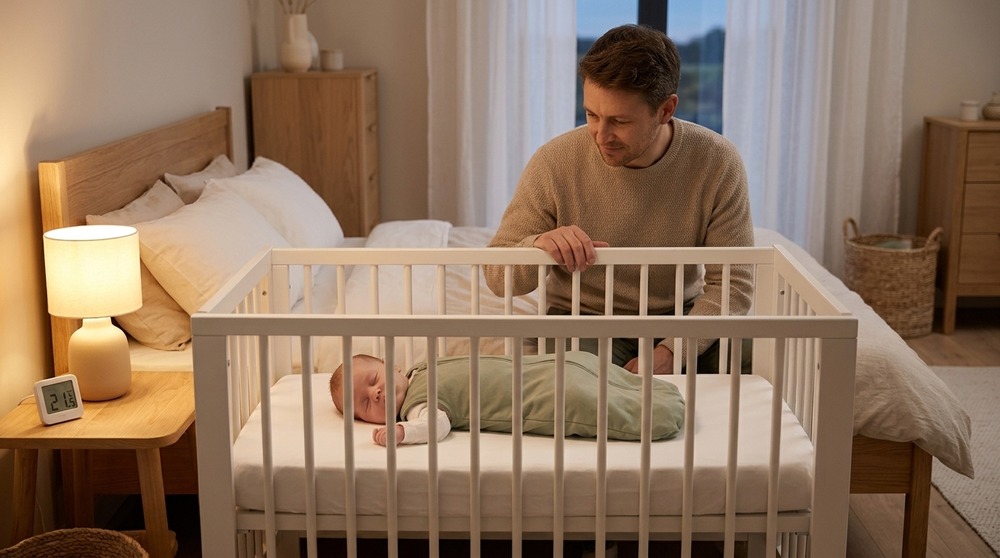
A safe sleeping environment for babies looks almost boring: a firm mattress, a fitted sheet, your baby in a sleeping bag, and nothing else. That plainness is exactly the point.
Choose the Right Crib or Bassinet
Buy a cot, crib, bassinet or Moses basket that meets the safety standards where you live, and follow the maker's instructions for assembly and age or weight limits. For baby crib safety, check that:
- the mattress fits snugly, with no gap big enough to trap a little hand, foot or head;
- the frame is stable and every part is tight and undamaged;
- nothing has been modified, such as an added mattress topper or a sawn-down side;
- the product hasn't been recalled.
Secondhand cots are fine if you check them carefully. Make sure no parts are missing, the instructions are available and the mattress is firm and the right size. Many parents buy a new mattress for a used cot.
Use a Firm, Flat Mattress
Firm means the mattress keeps its shape when you press on it and doesn't mould around your hand. Flat means level: the AAP says any surface inclined more than 10 degrees isn't safe for sleep, because a baby's head can slump forward and restrict breathing.
Use only the mattress made for the cot and a fitted sheet in the right size. Soft mattresses, memory foam toppers, sheepskins and padded inserts can let a baby's face sink in, which raises the risk of suffocation.
Keep the Crib Free of Loose Items
These all stay outside the cot for at least the first 12 months:
- pillows
- loose blankets
- duvets and comforters
- stuffed animals and soft toys
- cot bumpers, padded or mesh
- positioning pillows, wedges, pods and nests
- any other loose bedding
Each of these can cover a baby's face, trap them or make them too warm. A simple, uncluttered cot is the safest one.
Maintain a Comfortable Room Temperature
Overheating is a known risk factor for SIDS, so aim for a room that feels comfortable rather than warm. In the UK, the NHS and The Lullaby Trust suggest about 16–20°C, checked with a room thermometer.
There's no single temperature that guarantees safety, though. What your baby is wearing and lying under matters just as much as the number on the thermometer. To check, feel your baby's chest or the back of their neck. Cool hands and feet are normal. Signs your baby is too warm:
- sweating or damp hair
- flushed, red skin
- a hot chest or back of the neck
If you notice any of these, take off a layer. Keep the cot away from radiators, heaters and direct sunlight. Never use a hot water bottle or electric blanket for a baby.
What Should Babies Wear to Sleep?
Keep it simple: breathable layers, usually cotton, and a sleeping bag instead of loose bedding. A handy rule from the AAP is to dress your baby in one layer more than you'd be comfortable in yourself in the same room.
Baby sleeping bags (sleep sacks) are a good alternative to blankets. They can't slip over your baby's face, and your baby can't kick them off. Choose one that:
- fits your baby's weight and age, snug around the neck and arms so their head can't slip inside;
- has no hood;
- suits the season, with a lighter bag for warm rooms and a warmer one for cooler rooms.
Avoid weighted sleeping bags, weighted swaddles and weighted blankets. The AAP advises against any weighted product on or near a sleeping baby.
Hats come off indoors. Babies lose heat through their heads, and a hat at bedtime can lead to overheating. Unless a doctor has told you otherwise for a medical reason, your baby sleeps bareheaded once you're home.
| Room feels | What your baby could wear |
|---|---|
| Warm (above 22°C) | Short-sleeved bodysuit only, or a nappy and a very light sleeping bag. |
| Comfortable (about 18–20°C) | Bodysuit plus a light sleepsuit, or bodysuit and a medium sleeping bag. |
| Cool (about 16°C) | Bodysuit, long-sleeved sleepsuit and a warmer sleeping bag. |
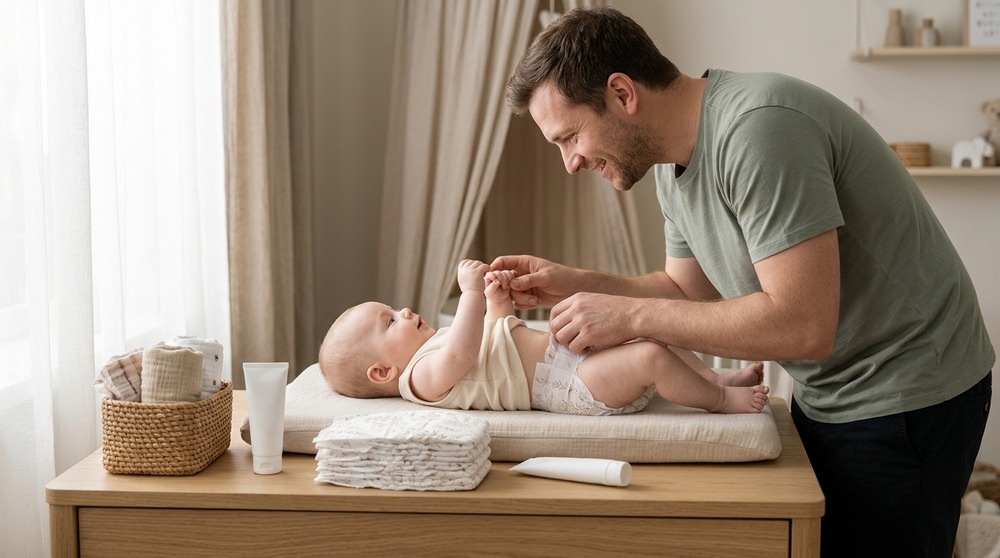
Night-time nappy changes are part of this too. A well-fitting, absorbent nappy means fewer wet, cold wake-ups. If you'd like tips, read our guide on how to change a nappy at night without waking your baby.
Is Swaddling Safe for Newborns?
Swaddling is fine for many newborns if you do it carefully, but it's optional. It doesn't lower the risk of SIDS. Some parents use it because a snug wrap can calm a startled newborn.
If you choose to swaddle:
- always place your swaddled baby on their back;
- use a thin, breathable fabric and don't add extra layers on top;
- wrap the arms and upper body snugly, but leave the hips and legs loose enough to bend up and out, which protects healthy hip development;
- keep the wrap well below the chin and away from the face;
- don't swaddle if your baby is sharing your bed.
Stop swaddling as soon as your baby shows signs of trying to roll. That's often around 3 to 4 months, but some babies start earlier. Never use weighted swaddles. If you want to keep the cosy feeling, a sleeping bag with arm holes is a good next step.
Room Sharing vs. Bed Sharing: What Should Parents Know?
These two sound similar but mean very different things:
- Room sharing means your baby sleeps in their own cot or Moses basket in your bedroom.
- Bed sharing means your baby sleeps in your bed with you.
The AAP, the NHS and The Lullaby Trust all recommend room sharing for at least the first six months, with your baby on a separate sleep surface. You can hear them, feed them easily, and check on them without getting up. The AAP says room sharing can lower SIDS risk by as much as 50%.
Adult beds aren't designed for babies. Soft mattresses, pillows, duvets, gaps by the wall and a sleeping adult all add risk. The AAP advises against bed sharing in all circumstances. UK guidance acknowledges that many parents end up sharing a bed, sometimes without planning to, and gives advice on making it as safe as possible.
Bed sharing is particularly risky if:
- you or your partner smoke;
- you've drunk alcohol or taken drugs or medicine that makes you drowsy;
- your baby was born before 37 weeks or weighed less than 2.5kg;
- your baby is under 4 months old.
Falling asleep with a baby on a sofa or in an armchair is far more dangerous than any bed. Babies can slip into the gap between you and a cushion and be unable to breathe. If you feel yourself nodding off on the sofa during a feed, put your baby down in their cot first.
Some practical tips for night feeds:
- Keep the cot or bedside crib right next to your bed so it's easy to put your baby back.
- Before a feed in bed, move pillows and the duvet away from your baby, just in case you drift off.
- Return your baby to their own space as soon as the feed is over.
- Set a gentle alarm if you're worried about falling asleep.
Can Babies Sleep with Blankets, Pillows, or Stuffed Animals?
Not in the first year. Here's why for each one.
Blankets. Loose blankets can slip over a baby's face. A wearable sleeping bag is the simplest alternative. The AAP says no blankets at all; UK guidance allows a thin cellular blanket tucked in firmly no higher than the shoulders, with your baby in the feet-to-foot position. If you want one rule, use a sleeping bag.
Pillows. Babies don't need a pillow, and it can block their breathing. Keep pillows out of the cot for at least the first 12 months. Many children don't need one until they move to a bed as a toddler.
Stuffed animals. Soft toys are lovely for playtime and cuddles while awake. During sleep, they stay outside the cot.
Cot bumpers. Padded and mesh bumpers can lead to suffocation or entrapment. They don't prevent injuries in a way that outweighs that risk, so leave them out entirely.
Sleep positioners. Wedges, rolls, pods and nests are not recommended for routine sleep. They can push a baby's face against soft material or into a risky position.
Safe Sleep During Daytime Naps and Nighttime Sleep
Every sleep counts, including a ten-minute doze after a feed. Babies spend a lot of time asleep in the day, often in different places, so naps are where safe sleep habits tend to slip.
Being nearby doesn't make an unsafe surface safe. A baby napping on a sofa cushion or an adult bed is at risk even if you're in the same room, because suffocation can happen quietly and quickly.
Car seats, swings, bouncers, prams and slings are made for travel and play, not sleep. If your baby falls asleep in one, that's normal. Move them onto a firm, flat surface on their back as soon as it's practical and safe. Napping in a car seat while you're driving is fine; take your baby out once you arrive. If you use a sling, keep your baby's face visible and their chin off their chest.
Make sure everyone who looks after your baby follows the same rules. Grandparents may have learned different advice years ago, when tummy sleeping and cot bumpers were common. A friendly chat, or sharing the checklist below, avoids mix-ups.
How to Reduce the Risk of SIDS
These are the habits with the strongest evidence behind them:
- Back to sleep. Place your baby on their back for every sleep.
- Firm, flat, separate surface. Use a cot, crib or Moses basket with a fitted sheet.
- Clear cot. Keep loose bedding, pillows, bumpers and soft toys out.
- Share a room, not a bed. Keep your baby in your room for at least six months.
- Smoke-free. Avoid smoking and vaping during pregnancy and around your baby, at home and in the car.
- No alcohol or sedating substances when you're caring for a sleeping baby, and never bed share after drinking.
- Breastfeed if you can. Breastfeeding is linked to a lower risk of SIDS. Any amount helps, and longer breastfeeding gives more protection.
- Offer a dummy (pacifier) at naps and bedtime if your baby accepts it. If you're breastfeeding, wait until feeding is well established. Don't force it or put it back in once your baby is asleep, and never tie it to clothing.
- Avoid overheating. Keep the room comfortable, dress your baby lightly and take hats off indoors.
- Keep up with routine vaccinations. The AAP notes that vaccinated babies have a lower risk of SIDS.
- Brief every caregiver. Babysitters, grandparents and nursery staff should all follow the same rules.
These steps reduce risk. They can't guarantee SIDS won't happen, and if the worst happens despite every precaution, it isn't anyone's fault.
Common Safe Sleep Mistakes Parents Should Avoid
Most of these happen out of love or tiredness, not carelessness. Knowing them helps you spot them.
- Putting your baby down on their tummy because they seem to settle better. Tummy sleeping is one of the biggest SIDS risk factors.
- Adding a pillow or soft blanket to make the cot look cosy. Both can cover your baby's face.
- Dozing off on the sofa or in an armchair with your baby. This is one of the most dangerous sleep situations.
- Using an inclined sleeper, wedge or positioner. Inclines can let a baby's head flop forward, and positioners can trap them.
- Overdressing or overheating with extra layers, a hat or a cot next to the radiator.
- Swaddling after rolling starts. A swaddled baby who rolls face down can't push up.
- Using weighted sleep products. They aren't proven safe and may make it harder for a baby to move or wake.
- Thinking supervision makes it safe. Watching your baby doesn't make a sofa or adult bed a safe surface.
- Inconsistent rules between caregivers. One unsafe nap at a relative's house can undo careful habits at home.
Safe vs. Unsafe Baby Sleep Practices
| Safe practice | Unsafe practice | Why it matters |
|---|---|---|
| Baby on their back for every sleep | Baby on tummy or side | Back sleeping lowers SIDS risk; side sleepers can roll onto their front. |
| Firm, flat mattress with fitted sheet | Soft mattress, topper, sheepskin or incline | Soft or tilted surfaces can block breathing. |
| Empty cot | Pillows, duvets, bumpers, soft toys | Soft items can cover the face or trap the baby. |
| Room sharing, separate cot | Bed sharing, especially after alcohol or smoking | Adult beds carry suffocation and entrapment risks. |
| Cot or Moses basket for naps | Sofa, armchair, car seat or swing for long sleeps | Sofas are especially dangerous; seats are not sleep surfaces. |
| Sleeping bag that fits | Loose or weighted blankets | Loose bedding can slip over the face; weight may restrict movement. |
| Light layers, room about 16–20°C | Hats indoors, extra layers, heaters nearby | Overheating is linked to SIDS. |
| Smoke-free home and car | Smoking or vaping near the baby | Smoke exposure raises SIDS risk. |
Safe Sleep Tips for Travelling with a Baby
Holiday or not, the same rules apply. Your baby still needs a firm, flat surface of their own, even if it's in a hotel room or at grandma's.
A travel cot or portable bassinet that meets safety standards is usually the easiest option. Use only the mattress that comes with it. Don't add a second mattress or folded duvet for extra padding, as that creates a soft surface and gaps around the edges. Avoid makeshift beds such as a sofa, an adult bed with pillows pushed around the baby, or a pile of cushions on the floor.
If you're staying with family or using a hotel cot, check it yourself. Ask grandparents or babysitters to put your baby down the same way you do at home.
Travel sleep checklist:
- Travel cot or bassinet that meets safety standards
- Its own firm mattress and a fitted sheet
- Baby sleeping bag in the right size and weight for the climate
- Room thermometer, or a plan to check your baby's chest for warmth
- Cot set up away from windows, blind cords, heaters and direct sun
- Caregivers briefed: back to sleep, nothing in the cot, no sofa naps
- Baby taken out of the car seat for sleep once you arrive
For a day out, a pack of travel-size wipes and spare nappies make it easier to settle your baby in a new place without a long changing session.
When Should You Ask a Doctor or Health Visitor About Baby Sleep?
Talk to your GP, health visitor or paediatrician whenever something about your baby's sleep worries you. Get help straight away if your baby has breathing pauses, struggles to breathe, turns blue or pale, or is unusually hard to wake. For anything urgent, call emergency services.
Some babies need personal advice, for example those born prematurely, babies with a low birth weight, or babies with heart, breathing or reflux problems. If your baby was born early, UK guidance is to follow safe sleep advice for a year from their due date rather than their birth date.
Don't change your baby's sleep position on your own because of reflux, a flat spot on the head or another concern. Raising the head of the cot or putting a reflux baby on their side doesn't help and can add risk. Your doctor can tell you what's right for your baby.
Safe Sleep Checklist for Parents
Use this for every sleep, day and night:
- Baby on their back, feet at the foot of the cot
- Firm, flat mattress with only a fitted sheet
- No pillows, duvets, bumpers, positioners or soft toys
- Cot or Moses basket in your room for at least six months
- Fitted sleeping bag or light layers, no hat indoors
- Room comfortably cool, about 16–20°C
- Smoke-free home and car
- Swaddle off once rolling begins
- Baby moved from car seat, swing or bouncer to the cot when practical
- Everyone who cares for your baby knows these rules
Conclusion: Making Safe Sleep a Daily Habit
Safe sleep for babies isn't complicated. Back to sleep, a firm and flat mattress, an empty cot and your baby in your room for the first six months cover most of what matters. Add a smoke-free home, a comfortable room temperature and no sofa naps, and you've done what the evidence supports.
You don't need expensive gadgets or special products. In fact, the safest cot is usually the plainest one. What helps most is doing the same thing every time, whoever is putting your baby down.
So share these habits with your partner, grandparents and babysitters. Keep the checklist somewhere handy. And on the nights when you're running on very little sleep yourself, trust the routine. A simple, consistent sleep space is one of the kindest things you can give your baby.
Frequently asked questions
On their back. Place your newborn on their back for every sleep, day and night, with their feet at the foot of the cot. Back sleeping is the most effective way to lower the risk of SIDS.
For at least the first six months. The AAP, the NHS and The Lullaby Trust all recommend room sharing on a separate sleep surface, such as a cot or Moses basket next to your bed.
Yes, if they roll there by themselves. Always put your baby down on their back. Once they can roll confidently both ways, you don't need to turn them back over, but keep the cot free of soft items.
Loose blankets aren't recommended. A fitted baby sleeping bag is the safer choice. If you use a blanket, UK advice is a thin one, tucked in firmly no higher than the shoulders, with your baby's feet at the foot of the cot.
Not before 12 months. Babies don't need a pillow, and it can block their breathing. Many children only start using one when they move from a cot to a bed.
It can be, if you do it safely. Always place your swaddled baby on their back, use a thin wrap, leave the hips free to bend and keep it away from the face. Swaddling is optional and doesn't reduce SIDS risk.
As soon as your baby shows signs of trying to roll. This often happens around 3 to 4 months, but can come earlier. A sleeping bag with arm holes is a good next step.
Breathable layers, such as a bodysuit and sleepsuit, plus a sleeping bag that fits. As a rough guide, dress your baby in one layer more than you'd wear in the same room. No hats indoors.
Not for routine sleep. A nap in the car seat while travelling is fine, but move your baby to a firm, flat surface on their back once you arrive. Swings and bouncers aren't sleep spaces.
Yes. Room sharing on a separate sleep surface is recommended and is linked to a lower SIDS risk. Bed sharing carries more risk, especially if a parent smokes, has drunk alcohol or the baby was premature.
Yes. Breastfeeding is associated with a lower risk of SIDS, and longer breastfeeding gives more protection. Any breast milk helps.
Healthy babies are not more likely to choke on their backs. They have a strong gag reflex and naturally swallow or cough up milk. Back sleeping is still the safest position for babies who spit up.
Keep the room at a comfortable temperature, around 16–20°C, and dress your baby in light layers without a hat. Check their chest or the back of their neck. If it feels hot or sweaty, remove a layer.
No. Sleep positioners, wedges, pods and nests are not recommended. They can push a baby's face against soft material or into a position where breathing is harder.
Yes, to every sleep. Naps on a sofa, adult bed or in a swing carry the same risks as night-time sleep. Put your baby down on their back in their cot or Moses basket.